
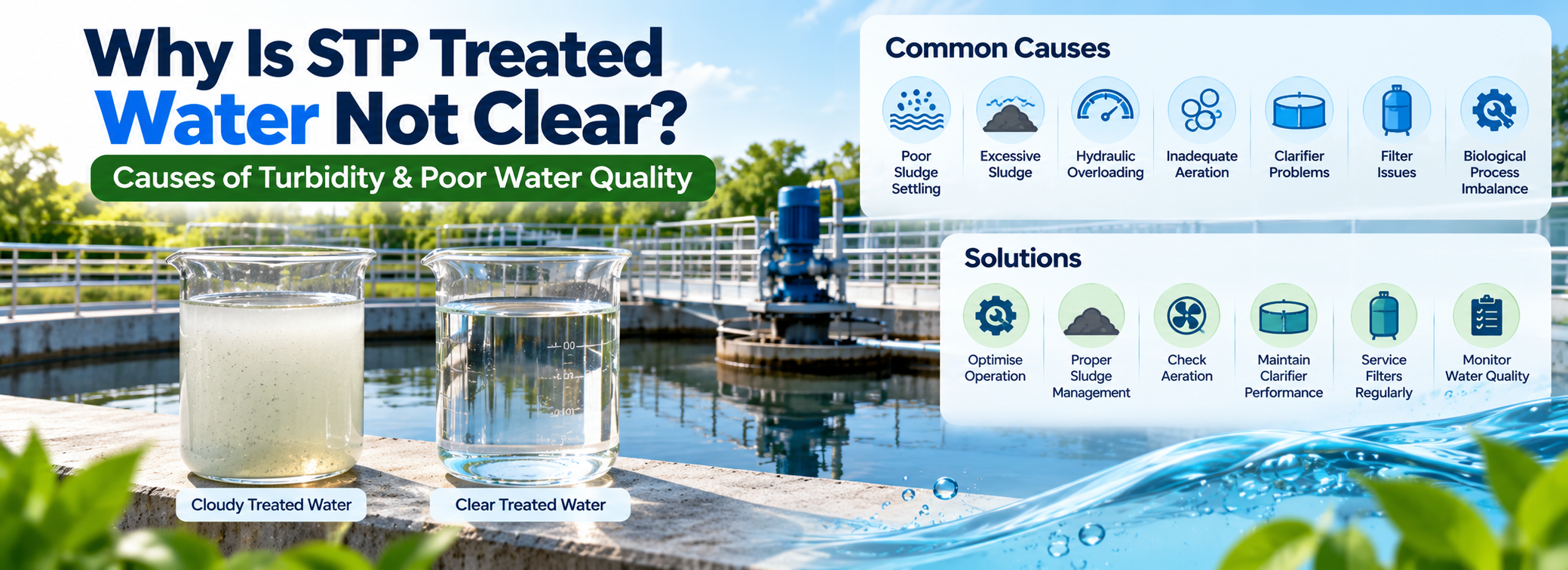
Poor STP treated water quality can appear as cloudy, hazy, greyish or visibly unclear water at the outlet of a sewage treatment plant. This usually means that suspended solids, biological flocs, fine particles or other impurities have not been adequately removed during the treatment process.
When STP treated water is not clear, operators often focus immediately on the final filtration system. However, the actual problem may have started much earlier in the treatment process.
Common causes include poor sludge settling, excessive biomass, unstable biological treatment, inadequate aeration, hydraulic overloading, clarifier problems, filter malfunction, improper sludge recirculation or sudden changes in incoming sewage characteristics.
Visual clarity is an important operational indicator, but clear water alone does not confirm that treated sewage meets all required quality parameters. A reliable assessment of treated sewage water quality should consider both appearance and measurable parameters such as turbidity, suspended solids, organic load and other relevant indicators.
The most effective way to solve cloudy STP water is therefore to identify where the treatment process is losing control and correct the root cause.
Quick Answer: Why Is My STP Treated Water Cloudy?
Cloudy STP treated water is usually caused by suspended biological solids or fine particles escaping into the final treated-water stream.
The most common causes are:
- Poor sludge settling
- Excessive sludge concentration
- High sludge blanket in the clarifier
- Hydraulic overloading
- Inadequate aeration
- Biological process imbalance
- Weak or dispersed floc formation
- Clarifier malfunction
- Filter clogging or channeling
- Incorrect sludge return or wasting
- Sudden changes in wastewater load
- Poor operation and maintenance
If STP treated water quality suddenly deteriorates, operators should inspect the complete treatment train instead of adjusting only the final filter.
What Is STP Treated Water Quality?
STP treated water quality refers to the physical, chemical and biological condition of wastewater after it passes through the required stages of a sewage treatment plant.
Depending on the STP design, treatment may include:
- Screening
- Collection
- Equalisation
- Biological treatment
- Aeration
- Secondary clarification
- Filtration
- Disinfection
- Treated-water storage
The purpose of the system is to remove pollutants, suspended matter and other contaminants from sewage before discharge or reuse.
Good treated-water quality depends on all these stages working together.
If one stage becomes unstable, the effect may appear later as:
- Cloudy water
- Suspended solids
- Floating particles
- High turbidity
- Colour changes
- Unpleasant odour
- Poor disinfection performance
- Inconsistent reuse-water quality
This is why STP troubleshooting should evaluate the entire process rather than only the final outlet.
What Is Turbidity in STP Water?
Turbidity in STP water refers to cloudiness or haziness caused by suspended or very fine particles that scatter light passing through the water.
These particles may include:
- Biological flocs
- Fine suspended solids
- Organic matter
- Sludge particles
- Colloidal material
- Microbial biomass
- Material escaping from filters
High turbidity can make treated sewage appear grey, milky, hazy or unclear.
Turbidity can be a useful operational indicator because it may suggest that clarification, biological treatment or tertiary filtration is not working effectively.
However, turbidity should not be evaluated alone. It should be considered together with other water-quality measurements and observations.
Is Clear STP Water Always Properly Treated?
No.
Water can appear completely clear while still containing contaminants that are not visible to the human eye.
Visual clarity does not confirm the absence of:
- Dissolved organic matter
- Microorganisms
- Nutrients
- Dissolved salts
- Chemical contaminants
- Residual pollutants
Likewise, cloudy water does not automatically reveal which parameter is failing.
Therefore, STP treated water quality should be evaluated according to both measurable water-quality parameters and the intended use of the treated water.
What Causes Poor STP Treated Water Quality?
Poor treated-water clarity is rarely caused by only one factor.
The following are some of the most common causes.
1. Poor Sludge Settling
Poor settling is one of the most common reasons for STP treated water not being clear.
During biological treatment, microorganisms form clusters known as flocs. These biological flocs should settle in the clarifier so that clearer water can separate above them.
If the flocs do not settle properly, they may remain suspended and escape with the treated water.
This can lead to:
- Cloudy effluent
- Higher turbidity
- Increased suspended solids
- Visible particles
- Reduced final-water clarity
Poor sludge settling may be linked to biological imbalance, incorrect sludge age, excessive loading or unstable operating conditions.
2. Weak Biological Floc Formation
Biological treatment depends on microorganisms working under suitable conditions.
Healthy biomass usually forms flocs that can settle effectively.
If flocs remain very small, weak or dispersed, they may not settle properly in the clarifier.
This can cause fine particles to remain suspended in the treated water.
Factors influencing floc formation may include:
- Dissolved oxygen
- Organic loading
- Wastewater characteristics
- pH
- Nutrient balance
- Biomass condition
- Sludge age
- Sudden influent changes
This means cloudy water can sometimes be a biological problem rather than a filter problem.
3. Excessive Sludge in the System
Biological treatment continuously generates biomass.
If excess sludge is not removed at the appropriate rate, the sludge concentration can increase beyond the desired operating condition.
This can affect:
- Settling behaviour
- Clarifier performance
- Oxygen demand
- Sludge blanket depth
- Treated-water quality
Excessive sludge can eventually carry over into the clarified-water outlet.
Proper sludge wasting is therefore an important part of maintaining stable STP treated water quality.
4. Incorrect Sludge Wasting
Removing too much sludge can also create problems.
If excessive biomass is removed, the biological treatment system may not retain enough active microorganisms to handle the incoming wastewater load effectively.
Therefore, both excessive sludge accumulation and excessive sludge wasting can reduce process stability.
The objective is to maintain the appropriate biomass concentration for the specific STP technology and wastewater characteristics.
5. Hydraulic Overloading
Every sewage treatment plant is designed to handle a specific wastewater-flow range.
When incoming flow exceeds the intended hydraulic capacity, wastewater may move too quickly through the plant.
This can reduce:
- Equalisation time
- Biological contact time
- Clarifier settling time
- Filtration efficiency
As a result, suspended solids may leave the plant before they are properly separated.
Hydraulic overloading may occur because of:
- Increased occupancy
- Additional wastewater connections
- Expansion of a facility
- Peak usage periods
- Infiltration
- Unexpected water ingress
- Operational changes
If STP treated water quality deteriorates after occupancy or wastewater generation increases, actual flow should be compared with design conditions.
6. Organic Overloading
Hydraulic loading and organic loading are not the same.
A plant may receive a normal quantity of water but still face excessive pollutant concentration.
High organic load places additional demand on the biological treatment process.
Possible effects include:
- Higher oxygen demand
- Biomass stress
- Poor settling
- Increased sludge production
- Deteriorating effluent quality
Operators should therefore evaluate both wastewater volume and wastewater characteristics.
7. Inadequate Aeration
Aeration is essential in many aerobic sewage treatment systems.
Microorganisms require suitable dissolved oxygen conditions to break down biodegradable organic matter.
If the aeration system is not supplying or distributing enough oxygen, biological treatment performance may deteriorate.
Possible reasons include:
- Blower failure
- Reduced blower capacity
- Blocked diffusers
- Damaged diffusers
- Air leakage
- Blocked pipelines
- Improper valve adjustment
- Increased organic load
- Uneven air distribution
Inadequate aeration can indirectly contribute to cloudy treated water by affecting biological activity and floc formation.
8. Excessive or Improper Aeration
More aeration is not automatically better.
Excessive turbulence can sometimes break larger biological flocs into smaller particles that are more difficult to settle.
Therefore, increasing blower operation without understanding the problem may not solve poor water clarity.
Aeration should be adjusted according to:
- STP design
- Process type
- Wastewater load
- Biomass concentration
- Actual oxygen demand
This is why proper process diagnosis is important before changing operating conditions.
9. Clarifier Performance Problems
The secondary clarifier plays a critical role in separating biological sludge from treated wastewater.
If the clarifier does not perform correctly, solids may escape with the overflow water.
Common clarifier-related problems may include:
- High sludge blanket
- Poor sludge withdrawal
- Uneven hydraulic flow
- Sludge rising
- Short-circuiting
- Excess solids loading
- Improper return sludge rate
- Mechanical equipment problems
When STP treated water quality becomes cloudy directly after clarification, the clarifier should be inspected carefully.
10. High Sludge Blanket
The sludge blanket is the layer of settled biological solids at the bottom of the clarifier.
If this layer becomes too high, solids may approach the outlet level and escape with the clarified water.
A rising sludge blanket can be associated with:
- Excess sludge inventory
- Poor sludge withdrawal
- Hydraulic overload
- Biological instability
- Incorrect sludge return
Regular sludge blanket monitoring can help prevent solids carryover.
11. Sludge Bulking
Sludge bulking occurs when biological sludge does not settle compactly.
Instead, the sludge may remain fluffy and occupy a larger volume.
Bulking can reduce clarification efficiency and allow suspended solids to enter the treated-water stream.
Because different process conditions can contribute to bulking, operators should avoid treating it as a single-cause problem.
Proper diagnosis may require examining:
- Sludge settling behaviour
- Biological condition
- Aeration
- Loading
- Wastewater composition
- Operational history
12. Rising Sludge in the Clarifier
Sometimes sludge initially settles but later rises toward the surface.
This may create floating solids and deteriorate outlet clarity.
The reason should be investigated based on biological conditions, clarifier retention time and the specific STP process.
Visible floating sludge is therefore an important operational observation during STP troubleshooting.
13. Filter Problems
Many STPs use tertiary filters after secondary clarification.
These may include:
- Sand filters
- Pressure sand filters
- Multimedia filters
- Other polishing systems
Their role is to remove remaining fine suspended solids.
When filters become overloaded or improperly maintained, treated-water turbidity may increase.
Common filter issues include:
- Clogged media
- Channeling
- Incorrect backwashing
- Excessive solids loading
- Damaged internal components
- Media deterioration
- Uneven water distribution
If water leaving the clarifier is reasonably clear but becomes poor after filtration, the filter system should be investigated.
14. Inadequate Filter Backwashing
Filters accumulate solids over time.
If backwashing is delayed or ineffective, the filter may:
- Develop high pressure
- Lose filtration efficiency
- Allow solids to pass through
- Create uneven flow paths
Backwashing frequency should therefore reflect actual loading instead of relying only on a fixed schedule.
15. Sudden Changes in Incoming Sewage
Biological treatment systems generally perform best under relatively stable operating conditions.
Sudden changes in wastewater characteristics can disturb the process.
Possible changes include:
- Higher organic concentration
- Unusual cleaning chemicals
- pH variation
- Increased grease
- Higher suspended solids
- Additional wastewater sources
- Sudden flow increase
If poor STP treated water quality appears unexpectedly, operators should review whether anything changed upstream.
16. Poor Equalisation
The equalisation tank helps balance wastewater flow and concentration before biological treatment.
Without effective equalisation, the treatment system may receive large variations in flow or pollution load.
This can create shock loading and unstable biological conditions.
Good equalisation can help provide:
- More consistent flow
- More stable organic loading
- Better biological performance
- Reduced hydraulic shock
- Improved downstream settling
17. Pumping Problems
Pumps affect the movement and recirculation of wastewater and sludge throughout the plant.
Problems may include:
- Pump failure
- Reduced pump capacity
- Blockages
- Irregular operation
- Incorrect sludge return
- Uneven flow transfer
Even when treatment equipment appears functional, pumping problems can disrupt the balance between treatment stages.
18. Poor Sludge Recirculation
Many biological systems return part of the settled sludge from the clarifier to the biological treatment stage.
If the sludge return rate is incorrect, the system may lose process stability.
Too little return may reduce available biomass, while excessive or unsuitable recirculation can affect clarification and sludge inventory.
Return-sludge settings should be based on the specific treatment process.
How to Improve STP Treated Water Quality
Improving STP treated water quality requires a structured troubleshooting approach.
Avoid changing multiple process settings at the same time. Instead, identify which treatment stage is creating the problem.
Step 1: Observe the Treated Water
Check:
- Colour
- Turbidity
- Visible suspended solids
- Floating particles
- Foam
- Odour
These observations can help identify where to investigate further.
Step 2: Check Incoming Wastewater Flow
Compare actual flow with the STP’s design capacity.
Ask:
- Has occupancy increased?
- Has another building or process been connected?
- Are peak flows higher than before?
- Is stormwater or groundwater entering the sewage system?
A flow meter can provide more reliable information than assumptions based only on occupancy.
Step 3: Inspect the Biological Treatment Tank
Look for:
- Adequate mixing
- Uniform aeration
- Dead zones
- Unusual foam
- Biomass colour
- Visible floc condition
The appearance of the biological tank can provide useful operational clues.
Step 4: Check Dissolved Oxygen and Process Parameters
Relevant parameters should be monitored according to the STP technology and engineering design.
Do not assume that one dissolved oxygen value is suitable for every plant.
Evaluation should consider:
- Biological process type
- Wastewater characteristics
- Loading
- Biomass
- Aeration system
Step 5: Perform a Sludge Settling Observation
A settling test can provide useful information on how biological sludge behaves.
Observe:
- How quickly sludge settles
- Whether flocs remain suspended
- Whether sludge compacts
- Whether solids rise again
- Whether the supernatant becomes clear
Poor settling behaviour can indicate that the problem exists before the filtration stage.
Step 6: Inspect the Clarifier
Check:
- Sludge blanket depth
- Sludge removal
- Surface conditions
- Flow distribution
- Floating solids
- Outlet weirs
- Mechanical equipment
Clarifier performance should be monitored routinely because it directly affects treated-water clarity.
Step 7: Check Sludge Wasting
Confirm whether excess sludge is being removed at an appropriate frequency.
Do not increase or reduce sludge wasting without considering the complete process condition.
Sludge management should be based on the specific STP process and actual biomass condition.
Step 8: Inspect the Filtration System
Check tertiary filters for:
- Pressure increase
- Backwashing frequency
- Media condition
- Channeling
- Blockage
- Solids breakthrough
If water quality deteriorates after the filter, the problem may be localized to the filtration stage.
Step 9: Review Disinfection
Disinfection is important for microbiological control, but it should not be used as a substitute for poor solids removal.
High turbidity may interfere with the overall reliability of downstream treatment.
Therefore, suspended-solids removal should be addressed before assuming that additional disinfectant alone will correct poor treated-water quality.
Step 10: Test the Treated Water
Visual inspection cannot replace testing.
Depending on the STP, regulatory requirements and reuse application, monitoring may include parameters such as:
- Turbidity
- Total Suspended Solids
- BOD
- COD
- pH
- Microbiological indicators
- Other project-specific parameters
Testing helps determine whether the problem is primarily visual or reflects broader treatment-performance issues.
STP Troubleshooting Checklist for Cloudy Treated Water
If your STP treated water is not clear, use this checklist:
- Check actual inlet flow.
- Compare flow with design capacity.
- Inspect aeration tank mixing.
- Check blower operation.
- Inspect diffusers.
- Observe sludge floc formation.
- Perform sludge settling observation.
- Check sludge blanket level.
- Inspect clarifier overflow.
- Review sludge wasting.
- Check return sludge operation.
- Inspect tertiary filters.
- Review backwashing frequency.
- Check incoming wastewater changes.
- Test final treated-water quality.
This sequence helps prevent unnecessary adjustments and makes troubleshooting more systematic.
How Regular STP Maintenance Improves Treated Water Quality
Preventive maintenance plays a major role in maintaining reliable STP treated water quality.
A practical maintenance programme may include:
- Blower inspection
- Diffuser inspection
- Pump maintenance
- Screen cleaning
- Tank inspection
- Sludge monitoring
- Clarifier maintenance
- Filter backwashing
- Filter media inspection
- Flow monitoring
- Treated-water testing
- Pipeline inspection
- Dosing-system inspection
- Disinfection-system inspection
- Recording operating parameters
Operational records are especially valuable because they help identify trends before water quality deteriorates significantly.
Common STP Problems in Residential Societies
Residential STPs may face significant changes in wastewater generation because occupancy patterns vary.
Common problems include:
- Low flow during periods of low occupancy
- Sudden peak wastewater generation
- Irregular STP operation
- Poor sludge management
- Inadequate operator supervision
- Filter maintenance delays
These variations can make stable biological treatment difficult.
Housing societies should therefore monitor actual wastewater flow and plant conditions instead of assuming that design capacity alone guarantees performance.
STP Treated Water Problems in Hotels and Commercial Buildings
Hotels, office complexes, malls, hospitals and other commercial properties may experience highly variable wastewater generation.
For example, wastewater flow may change dramatically between:
- Day and night
- Weekdays and weekends
- Peak and off-peak periods
- High and low occupancy
Equalisation and operating strategy become particularly important under these conditions.
Can Cloudy STP Water Be Reused?
Cloudy water should not be assumed suitable for reuse simply because it has passed through the STP.
The water should be evaluated according to the intended application and applicable quality requirements.
Possible reuse applications may include:
- Landscaping
- Flushing
- Utility use
- Certain industrial applications
Different reuse purposes may require different levels of treatment and monitoring.
Therefore, treated sewage water quality should be evaluated against the specific reuse objective.
Can Clear STP Water Be Reused Without Testing?
No.
Visual clarity is not a substitute for laboratory or instrument-based water-quality assessment.
Clear water may still contain contaminants that cannot be seen.
Before reuse, treated water should be evaluated according to the intended application and relevant requirements.
Why Final Filtration Alone May Not Solve Cloudy STP Water
A common mistake is assuming that every clarity problem can be corrected by installing or upgrading filters.
Filters can help remove fine suspended solids, but they cannot permanently compensate for unstable upstream treatment.
For example, if the clarifier continuously releases large quantities of biological solids, the filter will receive excessive loading.
This can cause:
- Frequent clogging
- Reduced filter run time
- Higher backwashing frequency
- Higher maintenance
- Recurring water-quality problems
The correct approach is to stabilize the biological and clarification stages first.
When Should You Call an STP Expert?
Professional inspection may be useful when:
- Treated water remains cloudy despite routine maintenance
- Sludge does not settle properly
- Treated-water quality changes frequently
- Filter backwashing is required unusually often
- Clarifier solids carryover is visible
- The STP has exceeded its original capacity
- Blower or pump issues recur
- Water testing repeatedly shows unstable performance
- Operators cannot identify the root cause
An STP specialist can evaluate the interaction between hydraulics, biology, sludge management, mechanical equipment and filtration.
Frequently Asked Questions About STP Treated Water Quality
Why is my STP treated water cloudy?
Cloudy treated water is commonly caused by suspended solids, biological flocs, poor sludge settling, clarifier carryover, hydraulic overloading or ineffective filtration.
The exact cause should be confirmed through process inspection and water-quality testing.
What causes poor STP treated water quality?
Poor STP treated water quality may result from unstable biological treatment, inadequate aeration, excess sludge, hydraulic or organic overloading, clarifier problems, poor sludge recirculation or filtration issues.
What causes high turbidity in STP water?
High turbidity in STP water often results from suspended solids or biological particles remaining in the final treated-water stream.
Poor settling, solids carryover and filter problems are common contributing factors.
Can poor aeration make STP water cloudy?
Yes.
In aerobic biological systems, insufficient aeration can affect microbial activity and floc formation, which may reduce settling efficiency and contribute to cloudy effluent.
Can too much aeration affect treated-water clarity?
Potentially.
Excessive turbulence may contribute to floc breakup in some systems.
Aeration should therefore be adjusted according to plant design and actual process requirements rather than simply maximized.
Can excess sludge cause poor treated-water quality?
Yes.
Excess sludge can affect settling and clarifier performance, increasing the risk of suspended solids entering the treated-water stream.
Why are solids coming out of the STP clarifier?
Possible causes include high sludge blanket, poor settling, hydraulic overloading, inappropriate sludge recirculation or biological process instability.
How can I improve STP water clarity?
Start by checking flow, aeration, sludge condition, clarifier performance, sludge wasting and tertiary filters.
Testing should then be used to determine whether water-quality parameters are improving.
Does replacing the filter solve cloudy STP water?
Not always.
If the problem originates in biological treatment or clarification, replacing the filter alone may provide only temporary improvement.
The root cause should be corrected first.
Is clear STP water always safe for reuse?
No.
Visual clarity does not confirm microbiological or chemical quality.
The water should meet the required criteria for its intended reuse application.
How often should STP treated water be tested?
Testing frequency depends on plant size, applicable requirements, operating conditions and the intended use of the treated water.
A suitable monitoring programme should be defined for the specific facility.
Why does STP water quality keep changing?
Frequent variations may be associated with changing wastewater flow, organic load, aeration, sludge concentration, occupancy or inconsistent operation.
Reviewing historical operating records can help identify the pattern.
Conclusion
When STP treated water is not clear, the cause should be investigated systematically across the entire sewage treatment process.
Cloudy or turbid treated water may result from:
- Poor sludge settling
- Excessive sludge
- Weak biological floc
- Hydraulic overloading
- Organic overloading
- Inadequate aeration
- Clarifier problems
- Sludge carryover
- Filter malfunction
- Improper sludge recirculation
- Sudden changes in incoming wastewater
Maintaining reliable STP treated water quality requires more than a good final filter.
Biological treatment, aeration, sludge management, clarification, filtration and plant hydraulics must work together as one system.
Routine monitoring, preventive maintenance, water-quality testing and proper operational control can help identify problems early and maintain more consistent treated-water performance.
Need Help Improving STP Treated Water Quality?
Bluewatt Ventures LLP provides professional support for STP design, installation, operation, maintenance, troubleshooting, process optimisation and wastewater treatment solutions.
If your facility is experiencing cloudy treated water, high turbidity, solids carryover, poor settling, frequent filter problems or inconsistent STP performance, a systematic plant assessment can help identify the actual cause.
Connect with Bluewatt Ventures to evaluate your existing STP and identify suitable improvements for reliable treated-water quality.