
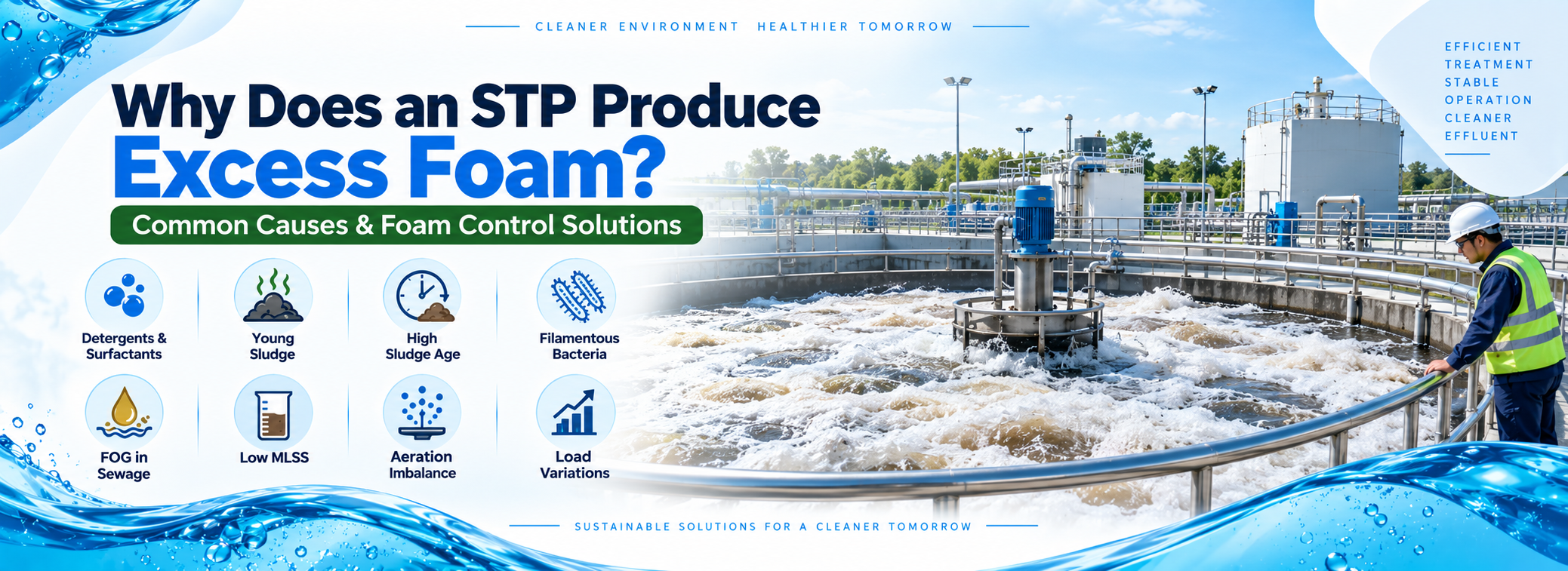
Excess foam in STP (Sewage Treatment Plant) systems is a common operational problem that can affect aeration tank performance, sludge management, and wastewater treatment efficiency. Foam may develop due to excessive detergents, surfactants, changes in microbial activity, high sludge age, filamentous bacteria, or sudden variations in wastewater characteristics.
Although a small amount of foam can occur during normal biological treatment, persistent or excessive foaming may indicate an imbalance in the treatment process.
Understanding the causes of STP foaming helps operators identify whether the problem is related to incoming sewage, aeration conditions, sludge characteristics, or biological activity.
Quick Answer: Why does an STP produce excess foam?
An STP may produce excess foam because of detergents and surfactants in wastewater, young activated sludge, excessive sludge age, foam-forming microorganisms, fats and grease, or changes in aeration and organic loading. White foam often appears during startup or low-biomass conditions, while persistent brown foam may be associated with hydrophobic microorganisms and older sludge. Foam colour alone cannot confirm the cause.
What Is Foam Formation in a Sewage Treatment Plant?
Foam formation occurs when air or gas becomes trapped in wastewater containing substances that stabilize bubbles, such as detergents, proteins, fats, or biological compounds.
In an activated sludge STP, aeration supplies oxygen to microorganisms that break down organic pollutants. During this process, bubbles naturally form at the water surface.
A small amount of temporary foam may be normal. However, thick, persistent foam can indicate changes in wastewater composition or biological treatment conditions.
Foaming commonly occurs in the aeration tank, but it may also spread to clarifiers and other treatment units.
What Are the Main Causes of Excess Foam in an STP?
- Excessive Detergents and Surfactants in Sewage
Detergents and cleaning chemicals are common contributors to white foam in sewage treatment plants.
Surfactants reduce the surface tension of water, allowing air bubbles to remain stable for longer.
Sources may include laundry wastewater, commercial cleaning operations, household detergents, and certain industrial discharges.
Common signs: White, soap-like foam that increases after a sudden change in incoming wastewater.
Recommended solution: Identify detergent sources, assess influent quality, and manage concentrated discharges where possible.
- Young Activated Sludge or Low MLSS
Newly commissioned STPs may develop excess white foam because the biological treatment process has not fully stabilized.
During startup, mixed liquor suspended solids (MLSS) concentrations may be low, leaving insufficient biomass to process the incoming organic load.
This condition is often associated with a high food-to-microorganism (F/M) ratio.
Recommended solution: Monitor MLSS, sludge age, and organic loading. Allow the biomass to develop under controlled operating conditions and adjust sludge wasting only after reviewing process data.
The US EPA identifies young sludge and low biomass concentration as important causes of white foaming during activated sludge startup.
EPA NERL
- Excessive Sludge Age
Sludge age, also called solids retention time (SRT), indicates how long biological solids remain in the treatment system.
When sludge age becomes excessive for the process conditions, certain foam-forming microorganisms may become more prevalent.
This can contribute to thick, persistent brown foam.
Recommended solution: Review SRT, MLSS, sludge wasting, treatment requirements, and microscopic examination results.
Do not reduce sludge age indiscriminately, particularly where nitrification requires a minimum SRT.
- Foam-Forming Filamentous Microorganisms
Certain microorganisms can produce stable biological foam in activated sludge systems.
Important examples include nocardioform organisms and Microthrix parvicella.
These organisms have hydrophobic properties that allow them to accumulate at the air-water interface and stabilize foam.
They are often associated with conditions such as longer sludge age, low F/M ratios, and elevated fats and grease.
Recommended solution: Arrange microscopic examination, identify the organisms involved, and correct the operating conditions that favour their growth.
New York State’s wastewater operator guidance emphasizes identifying filamentous microorganisms before selecting a control strategy.
NYSDEC
- Excessive Fats, Oils and Grease
Fats, oils and grease (FOG) can enter STPs through kitchens, restaurants, food preparation areas, and other wastewater sources.
High FOG loading may support the growth of certain foam-forming microorganisms.
It can also contribute to scum formation and operational problems.
Recommended solution: Maintain grease traps, inspect pretreatment systems, and control excessive FOG entering the biological treatment process.
- Improper Aeration Conditions
Aeration affects oxygen supply, mixing, and bubble formation.
Excessive airflow can increase visible frothing when foam-stabilizing substances are present.
Conversely, inadequate dissolved oxygen may favour some undesirable microbial populations.
Recommended solution: Measure dissolved oxygen (DO), inspect blowers and diffusers, and adjust aeration according to actual process demand.
Reducing aeration without confirming oxygen requirements can harm biological treatment.
- Sudden Changes in Organic Loading
STPs are designed to operate within specified hydraulic and organic loading ranges.
Sudden changes in wastewater flow, biochemical oxygen demand (BOD), or chemical oxygen demand (COD) can disturb biological treatment.
Examples include large cleaning discharges, temporary shutdowns, and unexpected changes in occupancy or production.
Recommended solution: Monitor influent flow and organic loading. Where appropriate, use equalization and controlled loading to reduce sudden process fluctuations.
- Nutrient Deficiency or Biological Imbalance
Biological treatment requires suitable nutrients and environmental conditions.
In some wastewater treatment systems, nutrient deficiencies can cause abnormal microbial growth and slimy foam.
This is particularly relevant where wastewater composition differs significantly from ordinary domestic sewage.
Recommended solution: Test nutrient availability, pH, organic loading, and biomass condition before making process adjustments.
White Foam vs Brown Foam in STP: What Does It Indicate?
Foam appearance provides useful initial clues, but laboratory testing and operating data are needed for confirmation.
| Foam appearance | Possible cause | Initial investigation | White, light and frothy | Detergents, young sludge, low MLSS | Check influent and biomass | White, thick and persistent | High surfactant loading or unstable treatment | Review cleaning discharges and F/M | Light brown or tan | Normal biological activity or developing process imbalance | Review trends and stability | Dark brown, thick and greasy | Foam-forming microorganisms, long sludge age, FOG | Check SRT, FOG and microscopy | Grey, slimy foam | Possible nutrient deficiency or biological imbalance | Test nutrients and examine biomass |
US EPA troubleshooting guidance distinguishes white startup foam from persistent brown biological foam associated with filamentous microorganisms.
US EPA
How to Reduce Excess Foam in an STP Aeration Tank
Effective foam control begins with identifying the cause rather than immediately applying chemicals.
Step 1: Inspect Foam Characteristics
Record foam colour, thickness, persistence, location, and the time it appears.
Step 2: Check STP Operating Parameters
Review dissolved oxygen, MLSS, SRT, F/M ratio, influent flow, pH, and relevant wastewater quality measurements.
Step 3: Identify Detergent and FOG Sources
Investigate sudden cleaning discharges, grease trap problems, or changes in incoming sewage.
Step 4: Examine Activated Sludge Microbiology
Microscopic examination can help identify filamentous microorganisms associated with persistent biological foam.
Step 5: Optimize Sludge Wasting
Adjust waste activated sludge removal according to the measured sludge age and biological process requirements.
Step 6: Maintain Proper Aeration
Ensure sufficient oxygen for treatment while avoiding unnecessary airflow that worsens foam accumulation.
Step 7: Remove Persistent Foam Where Appropriate
Surface skimming or controlled foam removal may be necessary for persistent biological foam.
Avoid continuously recycling foam-forming organisms into the treatment process.
Step 8: Use Antifoaming Chemicals Only When Appropriate
Antifoaming agents may provide temporary relief for some chemical foams.
However, they do not necessarily resolve biological foam caused by filamentous organisms.
Chemical dosing should be evaluated by a qualified wastewater treatment professional for process compatibility, safety, and effluent impact.
How Does Excess Foam Affect STP Performance?
Persistent foaming can create several operational problems.
Reduced Process Control: Foam may indicate changes in microbial balance, organic loading, or sludge age.
Sludge Carryover: Biological foam can move into clarifiers and contribute to solids-management problems.
Maintenance Difficulties: Foam accumulation can interfere with access, inspections, and routine operation.
Odour and Hygiene Concerns: Accumulated foam and scum may create unpleasant conditions around treatment units.
Effluent Quality Risks: Severe biological foaming and solids carryover can affect treated wastewater quality.
Foam should therefore be monitored as part of overall STP performance rather than treated only as a surface appearance problem.
How to Prevent Recurring Foam Formation in STPs
Long-term prevention depends on stable biological treatment and consistent operating practices.
- Monitor MLSS, SRT, F/M ratio, and dissolved oxygen regularly.
- Maintain grease traps and suitable upstream pretreatment.
- Prevent uncontrolled discharge of concentrated detergents and chemicals.
- Inspect aeration blowers, diffusers, and mixing conditions.
- Review sludge wasting and return activated sludge operation.
- Maintain an operating log of foam appearance and process conditions.
- Arrange periodic microscopic examination where persistent biological foaming occurs.
Frequently Asked Questions About Excess Foam in STP
- Why is there too much foam in my STP aeration tank?
Excess foam may result from detergents, young sludge, high sludge age, filamentous microorganisms, FOG, or unstable biological treatment conditions.
- What causes white foam in a sewage treatment plant?
White foam is commonly associated with surfactants, low MLSS, and young activated sludge during startup or after excessive sludge wasting.
- What causes brown foam in an STP?
Persistent brown foam may be associated with long sludge age, low F/M ratio, FOG loading, and foam-forming microorganisms such as nocardioform bacteria or Microthrix.
- Is foam in an STP normal?
Small amounts of temporary foam can occur during aeration. Thick, persistent, or rapidly increasing foam should be investigated.
- How can I reduce foam in an STP aeration tank?
Identify the foam type, review operating parameters, check wastewater composition, optimize sludge management, and correct the underlying cause.
- Can excessive aeration cause STP foaming?
Excessive airflow can increase visible foam when surfactants or other foam-stabilizing substances are present. Aeration changes must maintain adequate dissolved oxygen.
- Does low MLSS cause white foam?
Yes. Low MLSS, particularly during startup, can contribute to white, billowing foam because the biomass is not yet sufficiently established.
- Can antifoaming chemicals solve STP foam problems?
Antifoaming agents may temporarily reduce some foams, but they are not a substitute for correcting sludge age, microbial imbalance, or influent contamination.
- Can excess foam affect treated water quality?
Yes. Severe foaming can contribute to solids carryover and clarifier problems, potentially affecting treated effluent quality.
- How can STP foaming be prevented permanently?
Long-term control requires identifying and correcting the underlying cause, maintaining stable biological conditions, controlling influent contaminants, and following a consistent monitoring and maintenance programme.
Conclusion: Control STP Foaming by Identifying the Root Cause
Excess foam in an STP can develop because of detergents, unstable activated sludge, excessive sludge age, filamentous microorganisms, FOG, and changes in wastewater loading.
White foam often suggests surfactant loading or young sludge, while persistent brown foam may indicate biological foaming associated with particular microorganisms.
The most effective solution is to evaluate foam appearance alongside operating data, wastewater characteristics, and biological conditions.
Proper aeration control, sludge management, influent monitoring, and preventive maintenance can help reduce recurring foaming and maintain reliable sewage treatment performance.
Need Guidance on STP Performance and Wastewater Treatment?
Reliable sewage treatment depends on suitable plant design, stable biological treatment, and proper maintenance.
For information about sewage treatment plants, wastewater treatment solutions, and STP performance requirements, connect with Bluewatt through its official business channels.