
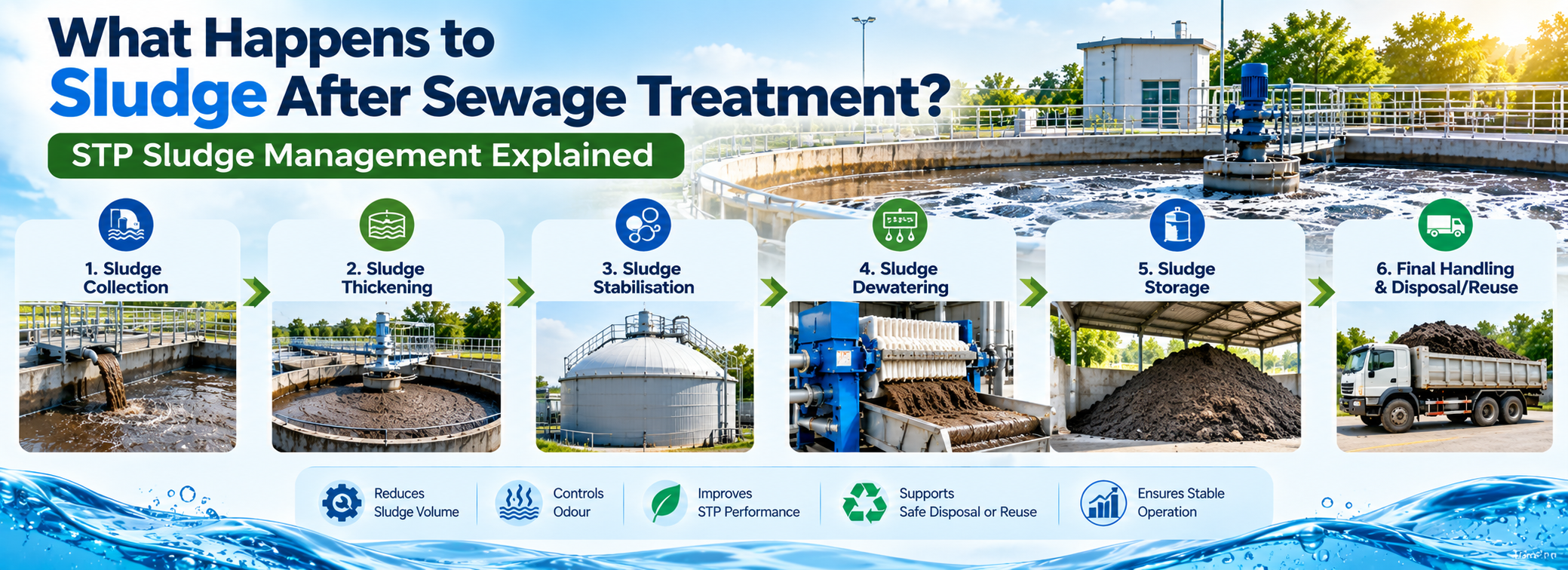
STP sludge management is an essential part of sewage treatment because every sewage treatment plant produces solid or semi-solid residual material as wastewater is treated.
During treatment, suspended solids are separated from sewage, while biological treatment produces additional biomass as microorganisms break down biodegradable organic matter. These solids eventually become what we commonly call sewage treatment plant sludge.
Sludge cannot simply remain inside the STP indefinitely.
If excess sludge is not removed and managed properly, it may:
- Reduce treatment efficiency
- Affect sludge settling
- Increase odour
- Create solids carryover
- Reduce clarifier performance
- Increase operational difficulties
- Affect final treated-water quality
The exact sludge treatment process depends on the sewage treatment technology, plant capacity, wastewater characteristics and final disposal or reuse requirements.
In many STPs, sludge moves through stages such as:
Collection → Thickening → Stabilisation → Dewatering → Storage → Final treatment, reuse or disposal
Understanding these stages helps facility owners, operators, consultants and maintenance teams improve plant performance and avoid common sludge-related problems.
Quick Answer: What Happens to Sludge After Sewage Treatment?
After sewage treatment, sludge is normally collected from treatment tanks or clarifiers and transferred to a sludge-handling system.
Depending on the plant design, it may then undergo:
- Sludge collection
- Sludge thickening
- Sludge stabilisation
- Sludge dewatering
- Sludge storage
- Transportation
- Further treatment, approved reuse or disposal
The objective of STP sludge management is to reduce sludge volume, improve handling, control odour and ensure that the residual solids are managed appropriately.
What Is Sludge in a Sewage Treatment Plant?
Sludge is the solid or semi-solid material separated or generated during wastewater treatment.
It may contain:
- Organic matter
- Suspended solids
- Microorganisms
- Biological biomass
- Fine particles
- Other materials removed from wastewater
The composition of sludge varies depending on the type of sewage entering the plant and the treatment process being used. Pasted text
Different treatment stages may also produce different forms of sludge.
Broadly, sludge may include:
Primary Sludge
Primary sludge consists of solids separated during physical treatment or sedimentation.
It can contain settleable suspended matter and organic material removed before biological treatment.
Biological or Secondary Sludge
Biological sludge is generated during secondary treatment when microorganisms consume biodegradable pollutants and multiply.
Part of this sludge may be returned to the biological treatment process, while excess sludge is removed for further handling.
Mixed Sludge
Some STPs may combine sludge generated from different treatment stages before thickening or dewatering.
The final sludge characteristics depend on the specific STP configuration.
Why Is STP Sludge Management Important?
Effective STP sludge management supports the overall performance of the sewage treatment plant.
Sludge is not simply waste that appears at the end of treatment. It is directly linked to biological treatment, clarification, treated-water quality, odour control and plant operation.
If sludge is allowed to accumulate excessively, it can reduce treatment capacity and create operational problems.
Proper sludge management can help:
- Maintain stable biological treatment
- Prevent excessive solids accumulation
- Improve sludge settling
- Support clarifier performance
- Reduce odour
- Reduce sludge volume
- Make handling easier
- Support appropriate disposal
- Improve overall STP reliability
For this reason, sludge management should be planned as part of the complete wastewater-treatment process.
What Happens to Sludge After Sewage Treatment?
The exact process differs from plant to plant, but sludge generally passes through several stages after it is removed from wastewater.
1. Sludge Collection
The first stage of STP sludge management is collecting the solids produced or separated during sewage treatment.
In a biological STP, microorganisms grow as they consume biodegradable organic matter.
Some of the resulting biomass may remain within the biological process, depending on the technology.
Excess biomass must eventually be removed.
Sludge may be collected from:
- Primary settling tanks
- Secondary clarifiers
- Biological reactors
- Sludge holding tanks
- Other solids-separation systems
The collected sludge is then transferred for additional treatment or handling. Pasted text
Why Can Sludge Not Stay Inside the STP?
An STP relies on maintaining the correct balance of active biomass and solids.
If sludge continues building up without controlled removal, the plant may experience:
- Excess solids concentration
- Poor settling
- Increased oxygen demand
- High sludge blanket
- Solids carryover
- Reduced treatment performance
Sludge removal should therefore be based on the process requirements rather than waiting until a tank appears visibly full.
2. Sludge Thickening
Fresh sludge generally contains a large quantity of water.
This means its overall volume can be much greater than the actual quantity of solid material present.
Sludge thickening is used to increase the concentration of solids while reducing the amount of water that needs to be handled in subsequent stages.
The main purpose is volume reduction.
Benefits may include:
- Lower downstream sludge volume
- Reduced storage requirements
- Easier pumping
- Reduced load on dewatering systems
- More manageable handling
Depending on the plant, thickening may use gravity-based or mechanical systems. Pasted text
Is Sludge Thickening the Same as Dewatering?
No.
Although both processes remove water, they are not exactly the same.
Thickening generally increases the concentration of solids and reduces the overall sludge volume.
Dewatering removes additional water to produce a material with a much higher solids concentration.
A simple process sequence may therefore look like:
Wet sludge → Thickened sludge → Dewatered sludge
3. Sludge Stabilisation
Untreated sludge may contain biodegradable organic matter that can continue decomposing.
If it remains untreated or stagnant, this decomposition may contribute to:
- Odour
- Gas formation
Unstable handling conditions
- Difficult storage
Sludge stabilisation aims to reduce the tendency of the sludge to decompose rapidly and make it more manageable.
The actual stabilisation method depends on:
- Plant technology
- Sludge characteristics
- Treatment capacity
- Final handling method
- Project requirements
The source draft correctly notes that untreated sludge can continue decomposing and that stabilisation is used to make subsequent handling more manageable. Pasted text
- Why Does Sludge Smell?
Odour is often associated with organic matter breaking down under stagnant or low-oxygen conditions.
If sludge remains stored too long without appropriate handling, anaerobic decomposition may develop and create unpleasant smells.
Strong sludge odour may therefore indicate:
- Excessive storage time
- Poor sludge handling
- Inadequate removal
- Stagnation
- Poor storage conditions
Regular removal and good sludge housekeeping can reduce many of these problems.
4. Sludge Dewatering
Sludge dewatering is one of the most important stages of sewage sludge treatment.
Even after thickening, sludge can still contain a substantial quantity of water.
Transporting highly diluted sludge may be inefficient because larger storage and transportation capacity is required.
Dewatering removes additional water and creates a material with a higher solids concentration.
Depending on the plant, sludge dewatering systems may include:
- Filter presses
- Centrifuges
- Screw presses
- Sludge drying beds
The objective is to reduce sludge volume and make storage, handling and transportation more practical. Pasted text
Why Is Sludge Dewatering Necessary?
Without dewatering, wet sludge can require significantly more space for storage and transport.
The main benefits of sludge dewatering may include:
- Lower sludge volume
- Easier handling
- Reduced storage requirements
- More efficient transportation
- Better preparation for further treatment
- Better preparation for disposal
The appropriate dewatering technology depends on:
- Sludge characteristics
- STP capacity
- Available space
- Operational requirements
- Equipment selection
- Project economics
The supplied draft highlights these same advantages and correctly notes that dewatering method selection depends on plant-specific conditions. Pasted text
What Happens to the Water Removed During Dewatering?
The liquid separated during sludge dewatering does not necessarily become final treated water.
Depending on the STP design, it may need to be:
- Returned to an earlier treatment stage
- Collected separately
- Further treated
The correct handling method depends on the overall plant configuration.
This is important because poorly managed return flows can increase the load on the STP.
5. Sludge Handling and Storage
After dewatering, sludge still needs to be handled and stored until it is transported, further treated, reused where permitted or sent for disposal.
Storage should be properly managed.
Poor storage can lead to:
- Leakage
- Strong odour
- Uncontrolled runoff
- Poor housekeeping
- Operational difficulties
The storage area should therefore be selected and maintained according to sludge condition and plant requirements. Pasted text
Good Sludge Storage Practices
Depending on the plant configuration, practical sludge-management measures may include:
- Avoiding unnecessary long-term storage
- Keeping sludge handling areas clean
- Preventing uncontrolled leakage
- Monitoring stored sludge volume
- Maintaining pumps and pipelines
- Preventing accumulation around equipment
- Planning transportation before storage becomes excessive
Good housekeeping is often one of the simplest ways to prevent recurring sludge-management issues.
6. STP Sludge Disposal
STP sludge disposal is not the same for every sewage treatment plant.
The appropriate route depends on:
- Sludge composition
- Treatment level
- Quantity
- Local requirements
- Available infrastructure
- Potential contaminants
- Intended final destination
Possible options may include:
- Further treatment
- Authorised disposal
- Approved beneficial use where permitted
One important point is that sewage sludge should not automatically be assumed suitable for agricultural or landscaping use.
Its suitability depends on:
- Sludge quality
- Treatment method
- Contaminants
- Pathogens
- Testing
- Applicable requirements
The original draft specifically cautions against automatically assuming that all sewage sludge is suitable for agricultural use and recommends testing and regulatory consideration before selecting the final management route. Pasted text
Can STP Sludge Be Used as Manure?
Not automatically.
This is a common misconception.
Although sewage sludge can contain organic matter, that does not mean every sludge is safe or suitable for use as manure.
Suitability depends on factors such as:
- Wastewater source
- Sludge treatment
- Potential contaminants
- Microbiological condition
- Testing
- Applicable environmental requirements
Therefore, reuse should be evaluated on a case-by-case basis.
Common STP Sludge Management Problems
Poor wastewater sludge management can affect both the sludge-handling system and the main sewage-treatment process.
1. Excessive Sludge Accumulation
If sludge is not removed at appropriate intervals, solids may accumulate in treatment tanks or clarifiers.
This can cause:
- Poor settling
- Increased sludge blanket
- Solids carryover
- Reduced clarification
- Lower treatment efficiency
Excess accumulation is often a sign that the sludge-wasting schedule needs review.
2. Strong Sludge Odour
Sludge that remains stagnant for extended periods can begin decomposing.
This may generate unpleasant odours around:
- Sludge tanks
- Dewatering equipment
- Storage areas
- Clarifiers
Regular sludge handling and appropriate storage can help reduce this problem. Pasted text
3. Poor Sludge Dewatering
Sometimes sludge remains too wet even after passing through a dewatering system.
Possible reasons may include:
- Sludge characteristics
- Equipment condition
- Operating settings
- Conditioning problems
- Inappropriate process control
The correct approach is to identify the root cause rather than simply increasing operating time or making random adjustments.
4. Solids Carryover
Poor sludge settling or excessive sludge levels may allow solids to escape with the treated water.
This may increase:
- Turbidity
- Suspended solids
- Cloudiness
- Final effluent instability
The relationship between sludge management and treated-water quality is therefore very important.
5. High Sludge Blanket in Clarifier
A high sludge blanket may develop if:
- Excess sludge is not removed
- Sludge withdrawal is inadequate
- Biological settling is poor
- Hydraulic conditions are unstable
If the sludge blanket rises too high, solids may escape with the outlet water.
6. Frequent Dewatering Problems
Repeated dewatering issues should be evaluated systematically.
Operators should inspect:
- Sludge feed
- Pump condition
- Equipment operation
- Sludge consistency
- Process settings
- Maintenance history
Equipment alone may not be the root cause.
How Can STP Sludge Generation Be Managed Efficiently?
Good STP sludge management starts before sludge reaches the dewatering equipment.
It begins with stable STP operation.
Maintain a Sludge Removal Schedule
Sludge wasting should follow the requirements of the biological process.
Do not wait until:
- Tanks are visibly full
- Odour becomes severe
- Sludge starts overflowing
- Treated water becomes cloudy
A planned schedule is more effective than reactive removal.
Monitor Biological Treatment
Stable biological treatment supports better sludge formation and settling.
Operators should observe:
- Sludge appearance
- Settling behaviour
- Clarifier performance
- Biomass condition
- Aeration
Sudden changes can indicate process imbalance.
Inspect Sludge Handling Equipment
Sludge-handling equipment should be maintained regularly.
This can include:
- Sludge pumps
- Pipelines
- Valves
- Dewatering equipment
- Mechanical components
A small equipment issue can disrupt the complete sludge-removal cycle.
Maintain Operational Records
Record keeping is an important part of professional wastewater sludge management.
Useful records may include:
- Sludge removal quantity
- Sludge wasting frequency
- Dewatering performance
- Operating hours
- Equipment problems
- Treated-water changes
Historical data can help identify recurring problems and changing plant behaviour. Pasted text
How Does Sludge Management Affect STP Treated Water Quality?
Poor sludge management can directly affect treated-water clarity.
When sludge accumulates excessively or settles poorly, solids may move into the clarified-water outlet.
This can create:
- Cloudy treated water
- Increased turbidity
- Visible solids
- Poor final-water appearance
Therefore, when an STP has poor treated-water clarity, operators should inspect sludge management as well as filtration.
A filter should not be expected to continuously compensate for poor sludge settling.
STP Sludge Management Troubleshooting Checklist
When sludge-related problems occur, operators can begin with a structured checklist:
- Check sludge accumulation in tanks.
- Inspect clarifier sludge blanket.
- Review sludge wasting frequency.
- Observe sludge settling.
- Check sludge pumps.
- Inspect sludge transfer pipelines.
- Check dewatering equipment.
- Review sludge storage duration.
- Inspect sludge handling areas.
- Check for odour.
- Review treated-water clarity.
- Check operational records.
- Compare current performance with previous conditions.
- Inspect for equipment failure.
- Review whether plant loading has changed.
This approach helps identify whether the problem is related to biology, settling, pumping, equipment or sludge-handling practice.
How Often Should Sludge Be Removed From an STP?
There is no single universal sludge-removal schedule.
The correct frequency depends on:
- STP technology
- Capacity
- Wastewater load
- Biomass concentration
- Operating conditions
- Sludge production rate
- Sludge settling
- Plant performance
Some plants generate sludge faster than others.
For this reason, sludge should be removed according to process requirements rather than using the same fixed interval for every STP.
Does More Sludge Mean Better Biological Treatment?
Not necessarily.
Biological treatment requires sufficient active biomass, but excessive solids can also create problems.
The objective is not to maximise sludge quantity.
The objective is to maintain the appropriate operating balance.
Too little active biomass may reduce treatment capacity, while excessive sludge may contribute to poor settling and solids carryover.
What Is the Difference Between Sludge Wasting and Sludge Dewatering?
These terms are sometimes confused.
Sludge Wasting
Sludge wasting refers to removing excess biological sludge from the treatment process.
Sludge Dewatering
Sludge dewatering refers to removing water from the sludge after it has been collected.
So:
Wasting controls biomass quantity inside the STP.
Dewatering reduces the volume of sludge that needs handling or disposal.
Both are important but they serve different purposes.
What Equipment Is Used for STP Sludge Dewatering?
Depending on STP design and capacity, common equipment can include:
- Filter presses
- Centrifuges
- Screw presses
- Drying beds
Each system has different requirements for:
- Space
- Operation
- Maintenance
- Sludge condition
- Capacity
The best option depends on project requirements rather than one technology being universally suitable.
Filter Press for Sludge Dewatering
A filter press separates water from sludge using filtration under pressure.
The solid material remains in the filter chambers while liquid passes through the filter media.
The resulting dewatered sludge is generally easier to store and transport than highly diluted sludge.
Screw Press for Sludge Dewatering
A screw press gradually compresses sludge as it passes through the equipment.
It may be selected in certain wastewater-treatment applications based on plant capacity and sludge characteristics.
Sludge Drying Beds
Drying beds may use drainage and evaporation to reduce sludge moisture.
Their suitability depends on:
- Space availability
- Climate
- Sludge volume
- Operating requirements
They may not be appropriate for every project.
How Does STP Capacity Affect Sludge Management?
Larger STPs generally produce larger quantities of sludge.
However, capacity alone does not determine sludge generation.
Actual sludge quantity also depends on:
- Wastewater strength
- Biological process
- Occupancy
- Operating conditions
- Treatment efficiency
Therefore, sludge handling should be designed according to actual plant requirements, not only the nominal flow capacity.
Sludge Management in Residential STPs
Residential societies and apartment projects often experience changing wastewater loads.
Occupancy variation can affect:
- Sludge production
- Biological activity
- Settling
- Sludge wasting frequency
Residential STPs therefore require consistent monitoring even when flow appears relatively stable.
Ignoring sludge because the plant is still producing water can eventually create treatment problems.
Sludge Management in Commercial Facilities
Hotels, hospitals, office buildings, malls and institutional facilities may experience different wastewater patterns.
Peak flow, occupancy and wastewater characteristics can vary significantly.
This may influence:
- Sludge generation
- Aeration requirements
- Clarifier loading
- Sludge handling
Operational records can help determine whether sludge production follows a predictable pattern.
Sludge Management in Industrial Facilities
Where sewage-treatment systems are installed at industrial facilities, it is important to understand which wastewater streams enter the STP.
Changes in wastewater characteristics may influence biological treatment and sludge properties.
The sludge-management strategy should therefore match the actual wastewater being treated.
STP Sludge Management and Sustainable Wastewater Treatment
Modern wastewater treatment increasingly focuses on the complete treatment cycle rather than only the liquid effluent.
A well-designed STP should consider:
- Incoming sewage
- Biological treatment
- Treated-water quality
- Treated-water reuse
- Sludge generation
- Sludge handling
- Sludge disposal
The supplied draft emphasizes that sludge management and treated-water reuse should be considered together as part of complete wastewater-treatment planning. Pasted text
Why Sludge Should Be Included in STP Design
Sludge management should not be added only after the STP begins operating.
The design stage should consider:
- Sludge production
- Collection
- Transfer
- Thickening
- Dewatering
- Storage
- Access for handling
- Final disposal strategy
If sludge handling is ignored during design, operators may later face:
- Insufficient storage
- Difficult equipment access
- Frequent sludge accumulation
- Higher operating difficulties
- Odour complaints
Planning sludge handling early can improve long-term STP operation.
When Should You Call an STP Expert?
Professional inspection may be required when:
- Sludge builds up unusually quickly
- Clarifier solids carryover is frequent
- Sludge does not settle properly
- Odour remains persistent
- Dewatering performance is poor
- Sludge pumps repeatedly fail
- Treated-water quality changes
- The STP is operating above its original load
- Operators cannot identify the cause of recurring sludge problems
An experienced wastewater-treatment specialist can evaluate the sludge issue together with biological treatment, hydraulics, aeration and clarification.
FAQs About STP Sludge Management
What is sludge in an STP?
STP sludge is the solid or semi-solid material separated or generated during sewage treatment. It may contain organic matter, microorganisms, suspended solids and other materials removed from wastewater.
What happens to sludge after sewage treatment?
After collection, sludge may undergo thickening, stabilisation, dewatering and storage before being further treated, reused where permitted or disposed of appropriately.
Why is STP sludge management important?
STP sludge management helps prevent excessive sludge accumulation, odour, poor settling, clarifier problems and solids carryover while supporting stable sewage-treatment performance.
How often should sludge be removed from an STP?
There is no universal schedule. Frequency depends on STP technology, wastewater load, biomass concentration, capacity and operating conditions. Pasted text
What is sludge dewatering?
Sludge dewatering is the process of removing water from thickened sludge to reduce its volume and make it easier to store, transport and manage.
Why is sludge dewatering necessary?
Dewatering can reduce sludge volume, storage requirements and transportation requirements while preparing sludge for further treatment or disposal.
Can STP sludge be used as manure?
It should not automatically be considered suitable for manure. Reuse depends on sludge characteristics, treatment, testing and applicable requirements.
What happens if sludge is not removed?
Excess sludge can contribute to poor settling, odour, reduced treatment performance and solids carryover into treated water.
What is the best method for STP sludge disposal?
There is no single method suitable for every plant. The appropriate route depends on sludge quality, quantity, treatment level, local infrastructure and applicable requirements.
Can excess sludge make STP treated water cloudy?
Yes. Excess sludge or poor sludge settling can allow solids to carry over into treated water, increasing turbidity and reducing clarity.
Why does sludge smell?
Sludge may produce unpleasant odours when biodegradable organic matter decomposes, particularly when sludge remains stagnant for extended periods.
What equipment is used for sludge dewatering?
Depending on plant requirements, equipment may include filter presses, centrifuges, screw presses or drying beds.
Conclusion
STP sludge management is an essential part of successful sewage treatment.
Once solids are removed or generated during wastewater treatment, they cannot simply remain inside the sewage treatment plant.
Depending on the plant design, sludge may need to pass through:
Collection → Thickening → Stabilisation → Dewatering → Storage → Final Management
Each stage has a specific purpose.
Collection removes excess solids from the treatment process.
Thickening reduces sludge volume.
Stabilisation improves sludge manageability.
Dewatering removes additional water.
Storage allows temporary controlled handling before final treatment, reuse or disposal.
Poor wastewater sludge management can contribute to:
- Odour
- Excess sludge accumulation
- Poor settling
- Clarifier problems
- Solids carryover
- Cloudy treated water
- Reduced STP efficiency
A planned sludge-management programme, supported by regular inspection, equipment maintenance, operating records and appropriate disposal practices, can help maintain reliable STP operation.
The original draft’s central conclusion is especially important: ignoring sludge can eventually affect both plant performance and treated-water quality, so sludge handling should be integrated into routine STP operation. Pasted text
Need Support With STP Sludge Management?
Bluewatt Ventures LLP provides professional solutions for STP design, sewage treatment, sludge management, sludge dewatering, operation, maintenance, troubleshooting and wastewater treatment systems.
If your sewage treatment plant is experiencing excessive sludge accumulation, poor sludge settling, frequent odour, dewatering problems or inconsistent treated-water quality, the right solution begins with evaluating the complete treatment process.
Connect with Bluewatt Ventures to assess your STP and develop a sludge-management and wastewater-treatment approach suited to your facility.