
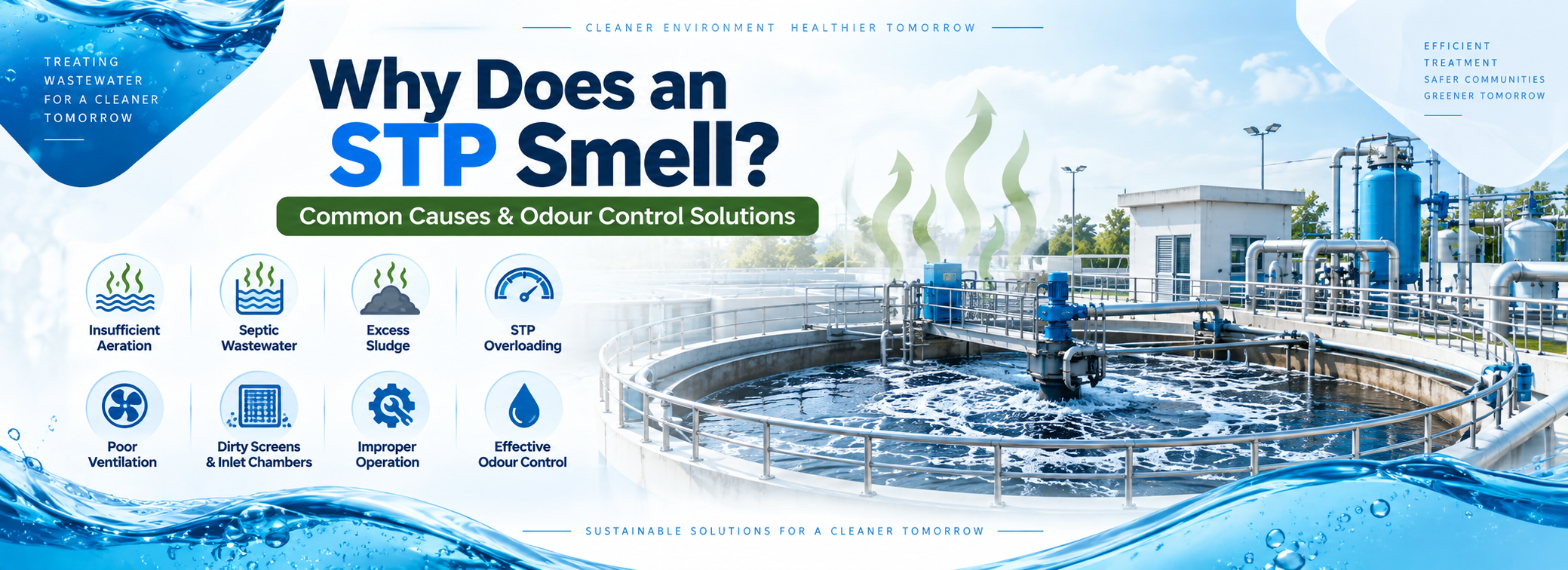
A persistent STP smell problem is usually a sign that some part of the sewage treatment process needs inspection or adjustment. Sewage Treatment Plants naturally handle wastewater containing organic matter, suspended solids and microorganisms, but a properly designed, operated and maintained STP should not continuously produce strong or offensive odours.
Common causes of sewage treatment plant smell include insufficient aeration, septic wastewater, sludge accumulation, overloading, stagnant wastewater, blocked screens and inadequate ventilation.
In many cases, the smell becomes noticeable when wastewater or sludge enters low-oxygen or anaerobic conditions. These conditions can produce gases such as hydrogen sulphide, which is often associated with a characteristic rotten-egg smell.
The correct approach to STP odour control is therefore not simply to mask the smell. The source must be identified, the operating conditions evaluated and the underlying process or maintenance issue corrected.
Why Does an STP Smell?
An STP can develop an unpleasant smell when wastewater, sludge or collected organic matter begins decomposing under unsuitable treatment conditions.
Some of the most common reasons include:
- Insufficient oxygen in the biological treatment tank
- Sewage becoming septic before treatment
- Excess sludge accumulation
- Inadequate sludge removal
- STP overloading
- Stagnant wastewater
- Blocked or dirty screens
- Poor ventilation
- Blower or diffuser problems
- Uneven aeration
- Long wastewater retention times
- Organic matter accumulating in tanks or channels
A strong odour should be treated as a troubleshooting signal because it may indicate an operational imbalance within the plant.
Quick Answer: What Causes Bad Smell in an STP?
The most common cause of STP bad smell is the decomposition of sewage or sludge under low-oxygen conditions.
When sufficient oxygen is unavailable, anaerobic biological activity may increase. This can generate gases and volatile compounds responsible for unpleasant smells.
However, odour should never be diagnosed from smell alone. Operators should inspect the aeration system, sludge condition, wastewater flow, screens, tanks, ventilation and biological treatment performance before deciding on corrective action.
What Causes a Rotten-Egg Smell in an STP?
A rotten-egg smell in a sewage treatment plant is commonly associated with hydrogen sulphide, or H₂S.
Hydrogen sulphide may form when sulphur-containing compounds in wastewater break down under anaerobic conditions.
It can commonly develop in areas such as:
- Collection tanks
- Equalisation tanks
- Sludge holding tanks
- Sewer lines
- Pumping stations
- Poorly aerated biological tanks
- Stagnant wastewater zones
Because hydrogen sulphide can present occupational and operational concerns at higher concentrations, enclosed STP areas should be properly ventilated and evaluated according to applicable engineering and safety practices.
1. Insufficient Aeration in the Biological Treatment Tank
Insufficient aeration is one of the first areas that should be checked when an aerobic STP begins producing persistent odour.
Aerobic microorganisms require adequate oxygen to break down organic matter effectively. If oxygen levels fall significantly, the biological treatment process may become unstable and anaerobic pockets may develop.
Common reasons for insufficient aeration include:
- Blower failure
- Reduced blower performance
- Damaged diffusers
- Blocked diffusers
- Incorrect air-flow settings
- Uneven air distribution
- Air leakage from pipelines
- Increased organic load
- Higher-than-designed wastewater flow
Operators should inspect the complete aeration system instead of assuming that a running blower automatically means sufficient oxygen is reaching the tank.
How Can Aeration Problems Be Identified?
Typical signs may include:
- Strong odour from the aeration tank
- Poor mixing
- Dead zones
- Dark or unhealthy-looking biomass
- Deteriorating treated-water quality
- Changes in sludge settling
- Unexpected dissolved oxygen readings
Monitoring dissolved oxygen and other biological operating parameters can help determine whether the aeration system is performing as intended.
2. Sewage Becoming Septic
Wastewater can become septic if it remains stagnant for too long before receiving adequate treatment or aeration.
Septic sewage can generate strong odours before it even reaches the main biological treatment stage.
This may occur in:
- Collection tanks
- Equalisation tanks
- Underground sumps
- Inlet chambers
- Long sewer pipelines
- Pumping systems
- Poorly circulated storage tanks
Common contributing factors include extended retention periods, low wastewater flow, irregular pumping, operational shutdowns and inadequate tank mixing.
Preventing excessive stagnation is therefore an important part of STP smell control.
3. Excess Sludge Accumulation
Sludge is a normal part of the sewage treatment process, but excessive sludge accumulation can become a major source of odour.
When sludge remains in tanks, clarifiers or holding areas longer than appropriate, it may begin decomposing.
Odour problems may develop in:
- Secondary clarifiers
- Sludge holding tanks
- Settling tanks
- Filter-feed tanks
- Sludge drying areas
- Dewatering systems
A proper STP maintenance programme should include routine monitoring of sludge quantity, sludge age, settling characteristics and sludge disposal or dewatering schedules.
Why Is Sludge Wasting Important?
Biological treatment systems continuously generate biomass.
If excess biomass is not removed at the appropriate rate, the plant can experience:
- Excess solids inventory
- Poor clarification
- Reduced oxygen-transfer efficiency
- Sludge carryover
- Increased odour
- Unstable biological treatment
Sludge wasting frequency should therefore be determined according to the STP process, loading and operating conditions.
4. STP Overloading
Every sewage treatment plant is designed for a particular hydraulic load and organic load.
Hydraulic loading refers primarily to the quantity of wastewater entering the STP, while organic loading relates to the concentration and quantity of biodegradable pollutants entering the system.
When either significantly exceeds the design capacity, treatment performance may deteriorate.
STP overloading may occur because of:
- Increased building occupancy
- Expansion of production or operations
- Additional wastewater connections
- Unexpected wastewater discharge
- Excessive inflow
- Higher organic concentration
- Changes in wastewater characteristics
For example, an STP originally designed for a residential complex with a certain number of occupants may struggle if actual occupancy increases substantially without corresponding upgrades.
What Happens When an STP Is Overloaded?
Possible effects include:
- Reduced treatment efficiency
- Lower dissolved oxygen
- Increased sludge production
- Poor settling
- Odour generation
- Untreated or partially treated wastewater carryover
- Increased stress on pumps and blowers
A detailed load assessment can help determine whether operational optimisation is sufficient or whether capacity modification is required.
5. Poor Ventilation Around the STP
Sometimes the biological treatment process may be functioning adequately, yet odours remain concentrated because the STP is located in a poorly ventilated area.
This is especially relevant for plants installed in:
- Basements
- Underground areas
- Enclosed utility rooms
- Parking structures
- Building service floors
- Confined plant rooms
Without adequate ventilation, even relatively low levels of odorous gases can accumulate and become noticeable.
Ventilation requirements should be evaluated according to the plant layout, wastewater characteristics, equipment arrangement and applicable engineering requirements.
6. Dirty Screens and Inlet Chambers
STP screens remove larger solids and debris before wastewater moves into the treatment process.
Screened material may include:
- Plastic
- Cloth
- Food waste
- Paper
- Hair
- Fibrous material
- Hygiene products
- Organic debris
If this material is allowed to accumulate, it can decompose and become a strong source of sewage smell.
Regular screen cleaning is one of the simplest but most important housekeeping activities in an STP.
7. Odour From Collection and Equalisation Tanks
Collection and equalisation tanks are frequent odour sources because wastewater may remain in these tanks before biological treatment.
Odour becomes more likely when there is:
- Long holding time
- Poor mixing
- Low oxygen
- Sludge deposition
- Dead zones
- Irregular pumping
Proper tank circulation and operational control can help reduce septic conditions.
8. Improper STP Operating Conditions
A sewage treatment plant is a biological and mechanical system. Even when individual equipment is functioning, incorrect operating conditions may affect the process.
Important parameters may include:
- Dissolved oxygen
- pH
- Temperature
- Flow rate
- Organic loading
- Sludge age
- Mixed liquor condition
- Settling characteristics
- Recirculation rate
- Sludge wasting rate
The appropriate operating range depends on the STP technology and design.
For this reason, operators should avoid relying on one universal operating value for every sewage treatment plant.
9. Poor Housekeeping Around the Plant
Odour does not always come directly from the main treatment tank.
Potential sources may include:
- Spilled sludge
- Dirty drains
- Screened waste
- Open sludge containers
- Unclean floor channels
- Dewatering equipment
- Leaking pipes
- Pump-room sumps
- Overflowed tanks
Routine housekeeping can therefore play an important role in STP odour management.
How to Control Odour in an STP
Effective STP odour control starts with identifying the actual source.
A structured troubleshooting approach is more effective than using perfumes, chemicals or masking agents without first correcting the process condition.
1. Check the Aeration System
Inspect:
- Blowers
- Air pipelines
- Valves
- Diffusers
- Air distribution
- Tank mixing
- Dissolved oxygen levels
If aeration is inadequate, determine whether the issue is mechanical, operational or related to excessive treatment load.
2. Monitor Dissolved Oxygen
Dissolved oxygen is an important indicator in aerobic biological treatment.
However, the required operating range depends on:
- Treatment technology
- Organic loading
- Tank configuration
- Biomass concentration
- Engineering design
Operators should therefore follow the plant’s approved operating procedures or engineering recommendations rather than applying generic values without evaluation.
3. Prevent Wastewater Stagnation
Inspect areas where sewage may remain stationary for extended periods.
These may include:
- Collection tanks
- Equalisation tanks
- Pump sumps
- Sewer lines
- Inlet chambers
Correcting poor circulation or irregular pumping can help reduce septic conditions.
4. Maintain Proper Sludge Management
Operators should routinely check:
- Sludge levels
- Sludge blanket
- Settling behaviour
- Sludge return
- Excess sludge wasting
- Dewatering schedule
- Sludge storage period
Allowing sludge to remain stagnant for long periods can contribute significantly to STP odour.
5. Clean Screens Frequently
Screens and inlet areas should be inspected and cleaned according to wastewater characteristics and solids loading.
Collected waste should also be removed and disposed of appropriately instead of being stored near the treatment plant for extended periods.
6. Inspect the STP for Overloading
Compare actual plant conditions with the original design assumptions.
Check:
- Daily wastewater flow
- Peak flow
- Organic loading
- Occupancy
- Additional wastewater sources
- Treatment performance
If actual loading has increased substantially, the STP may require process optimisation, equipment modification or capacity expansion.
7. Improve Ventilation
Where STPs are located indoors, ventilation should be evaluated carefully.
Depending on plant conditions, ventilation may include:
- Fresh-air supply
- Mechanical exhaust
- Ducted ventilation
- Localised extraction
- Dedicated odour exhaust
The system should be designed based on plant layout and engineering requirements.
8. Use Engineered Odour-Control Systems Where Required
Some STPs may require dedicated odour-control equipment, particularly where they are located close to occupied buildings or sensitive areas.
Possible technologies may include:
- Activated carbon systems
- Chemical scrubbers
- Biofilters
- Biological odour treatment
- Ventilation and extraction systems
- Tank covers with controlled exhaust
The appropriate technology depends on the type and concentration of odorous compounds, airflow, plant layout and operating environment.
Why Simply Masking STP Smell Is Not Enough
Using fragrances or temporary masking agents may make the surrounding area smell better for a short period, but it does not correct the process that is generating the odour.
If the root cause is:
- Inadequate aeration
- Septic wastewater
- Excess sludge
- Process overloading
- Mechanical failure
the problem will likely continue until the underlying condition is corrected.
The most reliable STP odour-control strategy is therefore:
Identify the source → measure operating conditions → diagnose the cause → correct the process → monitor the result.
Why You Should Not Ignore Persistent STP Smell
Persistent odour should not be treated as only an inconvenience.
It may be an early indication of:
- Biological process imbalance
- Mechanical equipment failure
- Septic wastewater
- Excess sludge accumulation
- STP overloading
- Poor housekeeping
- Ventilation problems
Ignoring these signs can allow a small operational problem to develop into a larger treatment issue.
For residential societies, commercial buildings, hospitals, hotels and industrial facilities, persistent STP smell can also lead to complaints from occupants, employees, visitors or neighbouring properties.
Early troubleshooting can therefore help reduce operational disruption.
How Regular STP Maintenance Helps Prevent Odour
Preventive STP operation and maintenance is one of the most effective ways to reduce recurring smell problems.
A practical maintenance programme may include:
- Blower inspection
- Pump maintenance
- Diffuser inspection
- Aeration-line inspection
- Screen cleaning
- Sludge-level monitoring
- Sludge wasting
- Clarifier inspection
- Tank cleaning
- Flow monitoring
- pH monitoring
- Dissolved oxygen monitoring
- Inspection of ventilation systems
- Checking odour-control equipment
- Inspection for leaks or overflow
- Review of treated-water quality
Maintenance frequency should be determined based on plant capacity, STP technology, wastewater characteristics, equipment recommendations and operating conditions.
STP Odour Troubleshooting Checklist
When an STP develops a strong smell, operators can begin by checking the following:
- Are the blowers operating properly?
- Is air reaching all areas of the aeration tank?
- Are diffusers blocked or damaged?
- Is wastewater becoming stagnant?
- Is sludge accumulating excessively?
- Are screens being cleaned regularly?
- Has wastewater flow increased?
- Has organic loading changed?
- Is the STP operating above design capacity?
- Are collection tanks being mixed properly?
- Is there adequate ventilation?
- Are there leaks, spills or dirty drains?
- Is sludge being removed according to schedule?
- Have operating parameters changed recently?
- Has treated-water quality deteriorated?
This checklist can help narrow down the likely cause before detailed troubleshooting begins.
STP Odour Problems in Residential Buildings and Housing Societies
STP smell is particularly noticeable in residential projects because treatment plants are often located close to basements, parking areas or occupied buildings.
Common reasons may include:
- Low occupancy during certain periods
- Sudden increase in occupancy
- Irregular maintenance
- Poor ventilation
- Long sewage retention time
- Inadequate aeration
- Improper sludge removal
- Plant capacity mismatch
Residential STPs therefore require continuous monitoring even when the plant appears to be operating normally.
STP Smell in Commercial Buildings
Commercial complexes, malls, hotels, offices and institutional buildings can experience different wastewater-flow patterns during the day.
Peak wastewater generation may occur during specific hours, while flow may reduce significantly overnight.
These variations can affect:
- Equalisation
- Aeration
- Biological loading
- Sludge generation
- Pump operation
STP operation should therefore be adjusted according to actual wastewater-generation patterns.
When Should You Call an STP Expert?
Professional inspection may be advisable when:
- The STP smells continuously despite routine cleaning
- The blower is running but aeration appears weak
- Treated-water quality has deteriorated
- Sludge is settling poorly
- Odour suddenly increases
- Wastewater flow has increased substantially
- There are repeated mechanical failures
- The plant frequently overflows
- The STP is receiving complaints from nearby occupants
- Existing odour-control measures are ineffective
An STP specialist can evaluate both the mechanical system and the biological treatment process instead of treating odour as an isolated issue.
Frequently Asked Questions About STP Smell
Is it normal for an STP to smell?
A mild wastewater-related odour may occasionally be noticeable around certain treatment areas. However, a persistent strong sewage smell usually indicates that the plant should be inspected for process, maintenance, ventilation or operational issues.
Why does my STP smell like rotten eggs?
A rotten-egg smell is commonly associated with hydrogen sulphide. This gas may form when wastewater or sludge remains under anaerobic or low-oxygen conditions.
Can insufficient aeration cause STP smell?
Yes. In an aerobic sewage treatment system, insufficient aeration can create low-oxygen conditions and affect biological treatment, potentially increasing odour generation.
Can excess sludge cause bad smell in an STP?
Yes. Sludge that accumulates or remains stagnant for too long can begin decomposing and become a significant source of odour.
Can an overloaded STP smell?
Yes. If wastewater flow or organic loading exceeds the plant’s design capacity, treatment performance may become unstable and odour may increase.
How can I reduce STP smell?
The correct solution depends on the cause. Common actions include checking aeration, preventing wastewater stagnation, managing sludge properly, cleaning screens, reviewing plant loading and improving ventilation.
Does an STP need regular maintenance to prevent smell?
Yes. Preventive maintenance can identify blower problems, sludge accumulation, blocked screens, pump problems and changing process conditions before they develop into recurring odour problems.
Can ventilation solve STP smell?
Ventilation can reduce odour accumulation in enclosed areas, but it may not solve an underlying treatment problem. Both the process condition and ventilation system should be evaluated.
Why does the STP smell more at night?
Changes in wastewater flow, ventilation, atmospheric conditions and operational cycles can sometimes make odour more noticeable at certain times. The actual cause should be confirmed through plant inspection rather than assumed from timing alone.
How do you permanently control STP odour?
Long-term odour control requires identifying and correcting the root cause. Depending on the STP, this may involve aeration optimisation, sludge management, flow balancing, ventilation improvements, maintenance changes or a properly engineered odour-control system.
Conclusion
A persistent sewage treatment plant smell should be considered a warning sign that deserves investigation rather than something that should simply be covered with fragrances or chemicals.
Common STP bad smell causes include:
- Insufficient aeration
- Septic sewage
- Stagnant wastewater
- Excess sludge
- STP overloading
- Dirty screens
- Poor housekeeping
- Inadequate ventilation
The most effective approach to STP odour control is to identify the source, review plant operating conditions and correct the underlying treatment or maintenance issue.
Regular inspection, preventive maintenance, appropriate sludge management and systematic monitoring can help keep a sewage treatment plant operating more reliably and reduce recurring odour problems.
Need Help With STP Odour, Performance or Maintenance?
Bluewatt Ventures LLP provides solutions for Sewage Treatment Plants, wastewater treatment systems, STP design, STP installation, operation, maintenance, troubleshooting and process optimisation.
Whether you are dealing with persistent STP smell, inadequate treatment performance, increased wastewater load or recurring operational issues, the right solution begins with understanding the actual condition of the plant.
Contact Bluewatt Ventures for an evaluation of your STP requirements and a wastewater-treatment solution suited to your facility.