
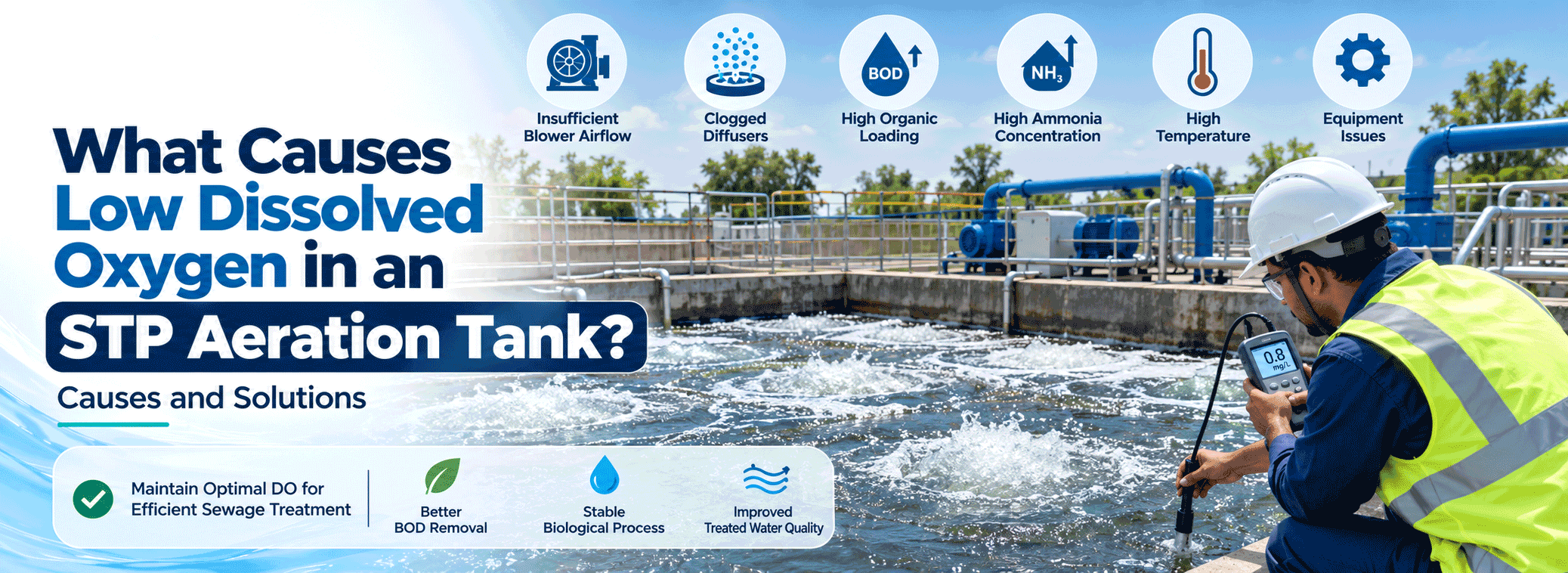
Low dissolved oxygen in STP aeration tanks is a common wastewater treatment problem that can reduce biological treatment efficiency, affect treated water quality, and create operational difficulties.
In a sewage treatment plant (STP), dissolved oxygen (DO) supports aerobic microorganisms responsible for breaking down organic pollutants. It also plays an important role in nitrification, where ammonia is converted into nitrate.
When microorganisms consume oxygen faster than the aeration system can replenish it, DO levels decrease. Prolonged oxygen deficiency can lead to poor BOD removal, incomplete ammonia treatment, unpleasant odours, and unstable biological processes.
Understanding the causes of low dissolved oxygen helps STP operators, maintenance engineers, and facility managers identify problems and take corrective action.
This guide explains the 10 common causes of low dissolved oxygen in STP aeration tanks, recommended operating levels, troubleshooting methods, and preventive maintenance practices.
What Causes Low Dissolved Oxygen in an STP Aeration Tank?
Low dissolved oxygen in an STP aeration tank is commonly caused by insufficient blower airflow, clogged aeration diffusers, excessive organic loading, increased ammonia concentration, poor mixing, and inefficient oxygen transfer.
Other contributing factors include high wastewater temperature, excessive biomass oxygen demand, incorrect aeration control settings, and faulty DO sensors.
The appropriate solution depends on identifying whether oxygen supply is inadequate, biological oxygen demand has increased, or the recorded dissolved oxygen measurement is inaccurate.
What Is Dissolved Oxygen in an STP Aeration Tank?
Dissolved oxygen is the concentration of oxygen present in wastewater and available for aerobic biological treatment.
In conventional activated sludge sewage treatment plants, oxygen is supplied through air blowers, diffusers, or mechanical aerators.
Aerobic microorganisms use dissolved oxygen to break down biodegradable organic pollutants in sewage.
Dissolved oxygen is measured in milligrams per litre (mg/L).
Maintaining adequate dissolved oxygen supports:
- Effective biological wastewater treatment.
- Breakdown of biodegradable organic matter.
- Stable activated sludge operation.
- Nitrification and ammonia removal where required.
- Consistent treated wastewater quality.
- Proper operation of aerobic treatment zones.
What Is the Ideal DO Level in an STP Aeration Tank?
Many conventional activated sludge treatment systems operate with dissolved oxygen concentrations of approximately 1–3 mg/L.
A DO concentration around 2 mg/L is a common starting target when reliable nitrification is required.
However, the ideal dissolved oxygen concentration varies depending on STP design, wastewater characteristics, organic loading, ammonia removal requirements, and aeration equipment.
A reading below 1 mg/L may indicate oxygen limitation in many conventional aerobic systems, particularly when biological treatment performance is deteriorating.
The correct operating target must be determined according to the treatment process and plant performance requirements.
10 Common Causes of Low Dissolved Oxygen in STP Aeration Tanks
1. Insufficient Air Supply From Blowers
Aeration blowers supply air to biological treatment tanks through diffusers or other air distribution equipment.
When airflow is insufficient, oxygen transfer may not meet the demand of aerobic microorganisms.
Common reasons include:
- Blocked blower inlet filters.
- Worn or damaged blower components.
- Incorrect blower speed settings.
- Faulty motors or electrical systems.
- Air leakage in pipelines.
- Reduced blower performance.
Solution: Inspect blower operation, discharge pressure, actual airflow, motor current, and inlet filter condition. Compare operating readings with manufacturer specifications and maintenance records.
2. Clogged or Damaged Aeration Diffusers
Aeration diffusers release air bubbles into wastewater, allowing oxygen to transfer into the liquid.
Over time, biological deposits, mineral scaling, and accumulated solids may block diffuser openings.
Clogged diffusers can reduce oxygen transfer, increase blower backpressure, and create uneven aeration across the tank.
Solution: Inspect diffuser performance, airflow distribution, and bubble patterns. Clean or replace damaged diffusers using approved maintenance procedures.
3. Excessive Organic Loading
When incoming wastewater contains higher concentrations of biodegradable organic pollutants, microorganisms require more oxygen for treatment.
High biochemical oxygen demand (BOD) can rapidly reduce dissolved oxygen if the aeration system cannot meet the increased oxygen requirement.
Excessive loading may result from sudden high-strength wastewater discharges, increased sewage flow, or insufficient equalization capacity.
Solution: Monitor influent BOD, COD, wastewater flow, and peak loading conditions. Investigate sudden changes in sewage characteristics and assess whether the aeration system has adequate capacity.
4. High Ammonia Concentration
Nitrification is a biological process in which microorganisms convert ammonia into nitrite and then nitrate.
This process requires oxygen.
Increased ammonia concentrations can increase the oxygen demand of the biological treatment system.
The theoretical oxygen requirement for complete nitrification is approximately 4.57 mg of oxygen per mg of ammonia-nitrogen oxidized, excluding other process factors.
Solution: Measure ammonia-nitrogen concentrations, monitor nitrification performance, and evaluate whether the aeration system can provide sufficient oxygen for the actual treatment load.
5. Poor Mixing and Dead Zones
Even when aeration blowers are functioning, oxygen may not be distributed uniformly throughout the tank.
Poor mixing can create localized areas with insufficient dissolved oxygen.
Common causes include damaged mixing equipment, improper diffuser arrangement, and uneven airflow distribution.
Solution: Measure dissolved oxygen at different tank locations and depths. Inspect mixing equipment and verify that wastewater circulation is adequate for the treatment process.
6. High Wastewater Temperature
Temperature affects the amount of oxygen that can dissolve in water.
Warm wastewater generally has lower oxygen saturation concentrations than cold wastewater.
Higher temperatures may also increase biological oxygen consumption within suitable microbial operating conditions.
These factors can make maintaining adequate dissolved oxygen more difficult.
Solution: Monitor wastewater temperature and evaluate aeration system performance under actual operating conditions.
7. High MLSS and Biomass Oxygen Demand
Mixed Liquor Suspended Solids (MLSS) represent the concentration of suspended solids in the biological treatment tank.
A high concentration of active biomass can increase microbial oxygen consumption, particularly when wastewater contains substantial biodegradable organic matter.
However, MLSS concentration alone does not determine oxygen demand.
Solution: Evaluate MLSS, MLVSS, sludge retention time (SRT), sludge wasting, and organic loading together before changing operating conditions.
8. Incorrect Aeration Timer or Control Settings
Some sewage treatment plants use fixed blower schedules, timer-based aeration, or automatic dissolved oxygen control systems.
Incorrect operating settings can result in insufficient aeration during peak wastewater loading periods.
For example, an STP serving a residential complex may experience higher sewage loading during certain hours.
Solution: Compare blower operating schedules with actual DO trends and wastewater loading. Adjust aeration controls according to process requirements and approved equipment limits.
9. Poor Oxygen Transfer Efficiency
The quantity of air supplied to an aeration tank is different from the amount of oxygen actually transferred into wastewater.
Oxygen transfer efficiency depends on diffuser condition, bubble distribution, wastewater composition, temperature, tank depth, and mixing.
Even a continuously operating blower may not provide adequate dissolved oxygen if oxygen transfer is inefficient.
Solution: Evaluate actual oxygen transfer performance, diffuser condition, and airflow distribution rather than relying only on blower operating hours.
10. Faulty DO Sensors or Incorrect Measurements
A faulty dissolved oxygen sensor may display inaccurate readings.
Common measurement problems include sensor fouling, poor calibration, equipment damage, and installation in an unrepresentative location.
Incorrect readings may lead operators to make unnecessary adjustments to aeration equipment.
Solution: Clean and calibrate DO sensors according to manufacturer recommendations. Verify readings using a calibrated portable dissolved oxygen meter.
Low DO in STP: Troubleshooting Chart
| Observation | Possible Cause | Recommended Action |
|---|---|---|
| Sudden decrease in DO | Blower failure or organic shock loading | Check blower operation and influent loading |
| Low DO in specific tank sections | Poor mixing or blocked diffusers | Inspect airflow distribution |
| Low DO with high BOD | Excessive organic loading | Review influent BOD and aeration capacity |
| Low DO with high ammonia | Increased nitrification oxygen demand | Check ammonia concentration |
| DO decreases during peak hours | Variable sewage loading | Monitor hourly operating trends |
| Low DO despite blower operation | Inefficient oxygen transfer | Inspect diffusers and blower performance |
| Online and portable DO readings differ | Sensor or calibration problem | Verify instrument accuracy |
These observations are diagnostic indicators. Confirm the root cause through operating measurements before performing corrective maintenance.
How to Increase Dissolved Oxygen in an STP Aeration Tank
Improving dissolved oxygen requires a systematic examination of oxygen supply, biological oxygen demand, and aeration equipment performance.
Step 1: Verify Dissolved Oxygen Measurements
Measure DO at multiple locations and depths within the aeration tank.
Compare readings during peak and low-load operating conditions.
A single DO reading may not represent the entire tank.
Step 2: Check Blower Performance
Inspect blower discharge pressure, actual airflow, motor condition, inlet filters, and control settings.
Identify mechanical or electrical problems that may be restricting air supply.
Step 3: Inspect Aeration Diffusers
Check air distribution, diffuser performance, and visible bubble patterns.
Look for clogged diffusers, damaged components, and excessive backpressure.
Step 4: Measure Wastewater Loading
Review influent BOD, COD, ammonia-nitrogen, and wastewater flow.
Determine whether increased organic or ammonia loading is creating excessive oxygen demand.
Step 5: Evaluate Biomass Conditions
Monitor MLSS, MLVSS, sludge age, and sludge wasting practices.
Evaluate biological process conditions in relation to actual influent loading.
Step 6: Optimize Aeration Controls
Review blower operation schedules, dissolved oxygen setpoints, and variable-frequency drive settings.
Adjust aeration according to plant requirements and equipment operating limits.
Step 7: Review Aeration System Capacity
If dissolved oxygen remains consistently low despite properly functioning equipment, the installed aeration system may not have sufficient capacity for current treatment requirements.
A professional wastewater treatment assessment may be necessary to identify appropriate improvements.
Safety Note: Blowers, electrical systems, wastewater tanks, and confined spaces present serious hazards. Equipment isolation, electrical maintenance, and tank entry must follow approved safety procedures and be handled by authorized personnel.
How to Calculate Organic Loading in an STP
Organic loading is an important parameter when investigating low dissolved oxygen in sewage treatment plants.
The daily BOD load can be calculated using:
BOD Load (kg/day) = Wastewater Flow (m³/day) × BOD Concentration (mg/L) ÷ 1000
Example of STP Organic Loading
Consider a sewage treatment plant receiving:
- Wastewater flow: 100 m³/day
- Influent BOD concentration: 250 mg/L
Initial BOD load:
100 × 250 ÷ 1000 = 25 kg/day
Now suppose the influent BOD concentration increases to 400 mg/L while wastewater flow remains unchanged.
New BOD load:
100 × 400 ÷ 1000 = 40 kg/day
The organic loading has increased from 25 kg/day to 40 kg/day, representing a 60% increase.
This additional organic load may increase biological oxygen consumption and reduce dissolved oxygen if the aeration system cannot meet the higher demand.
Actual oxygen requirements also depend on biomass activity, ammonia loading, sludge production, and treatment objectives.
What Happens When Dissolved Oxygen Is Too Low in an STP?
Reduced Biological Treatment Efficiency
Insufficient oxygen can slow down the breakdown of biodegradable organic pollutants, potentially reducing BOD removal efficiency.
Incomplete Ammonia Removal
Oxygen limitation can interfere with nitrification, resulting in higher ammonia concentrations in treated wastewater.
Unpleasant Odours
Prolonged oxygen-deficient conditions can encourage septic or anaerobic activity, contributing to unpleasant odours.
Sludge Settling Problems
Certain low-oxygen conditions may favour filamentous microorganisms associated with sludge bulking and poor settling.
Deterioration in Treated Water Quality
Inadequate biological treatment may increase residual BOD, ammonia, and other pollutants in treated wastewater.
Unstable STP Operation
Fluctuating dissolved oxygen can affect biological treatment stability, particularly during sudden changes in sewage loading.
How to Prevent Low Dissolved Oxygen in an STP
Preventive maintenance helps maintain reliable aeration and biological treatment performance.
1. Maintain Aeration Blowers
Inspect blowers, motors, air filters, and pipelines according to manufacturer recommendations.
2. Inspect and Clean Diffusers
Regularly check aeration diffuser condition and airflow distribution.
3. Monitor DO Levels
Record dissolved oxygen during different operating periods to identify unusual trends.
4. Track Influent Wastewater Quality
Monitor BOD, COD, ammonia, wastewater flow, and temperature.
5. Maintain Proper Biomass Conditions
Review MLSS, sludge retention time, and sludge wasting practices.
6. Ensure Adequate Mixing
Inspect mixing equipment and maintain proper circulation throughout aerobic treatment zones.
7. Calibrate DO Sensors
Regularly verify the accuracy of online and portable dissolved oxygen instruments.
8. Review Aeration Capacity
Reassess oxygen requirements when wastewater loading, occupancy, or treatment objectives change.
Frequently Asked Questions About Low Dissolved Oxygen in STP
1. What causes low dissolved oxygen in an STP aeration tank?
Common causes include insufficient blower airflow, clogged diffusers, excessive organic loading, increased ammonia demand, poor mixing, and inefficient oxygen transfer.
2. What is the ideal dissolved oxygen level in an STP?
Many conventional activated sludge systems operate at approximately 1–3 mg/L. Around 2 mg/L is a common starting target for nitrification, but the appropriate concentration depends on plant design and treatment requirements.
3. How can I increase dissolved oxygen in an aeration tank?
Check blower performance, diffuser condition, airflow distribution, wastewater loading, and aeration control settings. Correct the underlying cause before increasing aeration.
4. Can high BOD cause low dissolved oxygen?
Yes. Higher biodegradable organic loading increases microbial oxygen consumption. DO may decrease if oxygen demand exceeds available aeration capacity.
5. Does high MLSS cause low DO?
High active biomass concentrations can contribute to oxygen consumption, but actual oxygen demand depends on biomass activity, sludge age, and wastewater loading.
6. Can clogged diffusers reduce dissolved oxygen?
Yes. Clogged aeration diffusers can restrict airflow and reduce oxygen transfer, contributing to low DO levels.
7. Why is DO low even when the blower is running?
The blower may be delivering insufficient airflow, diffusers may be blocked, oxygen demand may be unusually high, or mixing may be inadequate.
8. Can low dissolved oxygen affect ammonia removal?
Yes. Nitrifying microorganisms require oxygen to convert ammonia into nitrate. Sustained oxygen limitation can reduce nitrification efficiency.
9. Does increasing aeration always improve STP performance?
No. Increasing aeration helps when oxygen supply is inadequate, but excessive aeration may increase energy consumption and interfere with other biological treatment objectives.
10. How often should dissolved oxygen be measured in an STP?
Monitoring frequency depends on plant design, operating variability, and compliance requirements. Continuous measurements or checks during peak and low-load periods provide more useful information than a single daily reading.
Conclusion: Maintain Proper Dissolved Oxygen for Efficient STP Operation
Low dissolved oxygen in STP aeration tanks can result from inadequate blower airflow, clogged diffusers, excessive organic loading, high ammonia concentrations, poor mixing, or reduced oxygen transfer efficiency.
The most effective troubleshooting approach starts with accurate DO measurements, systematic equipment inspections, and evaluation of biological oxygen demand.
Regular monitoring, proper blower maintenance, diffuser inspections, and optimized aeration controls can help maintain stable sewage treatment plant performance and consistent treated wastewater quality.
Need Assistance With STP Aeration and Wastewater Treatment?
Effective aeration is essential for reliable biological wastewater treatment.
Bluewatt Ventures LLP provides industrial water and wastewater treatment solutions, including sewage treatment plants (STPs), effluent treatment plants (ETPs), and reverse osmosis (RO) systems.
For enquiries related to STP aeration systems, wastewater treatment requirements, or sewage treatment plant solutions, connect with Bluewatt Ventures LLP through its official business channels.