
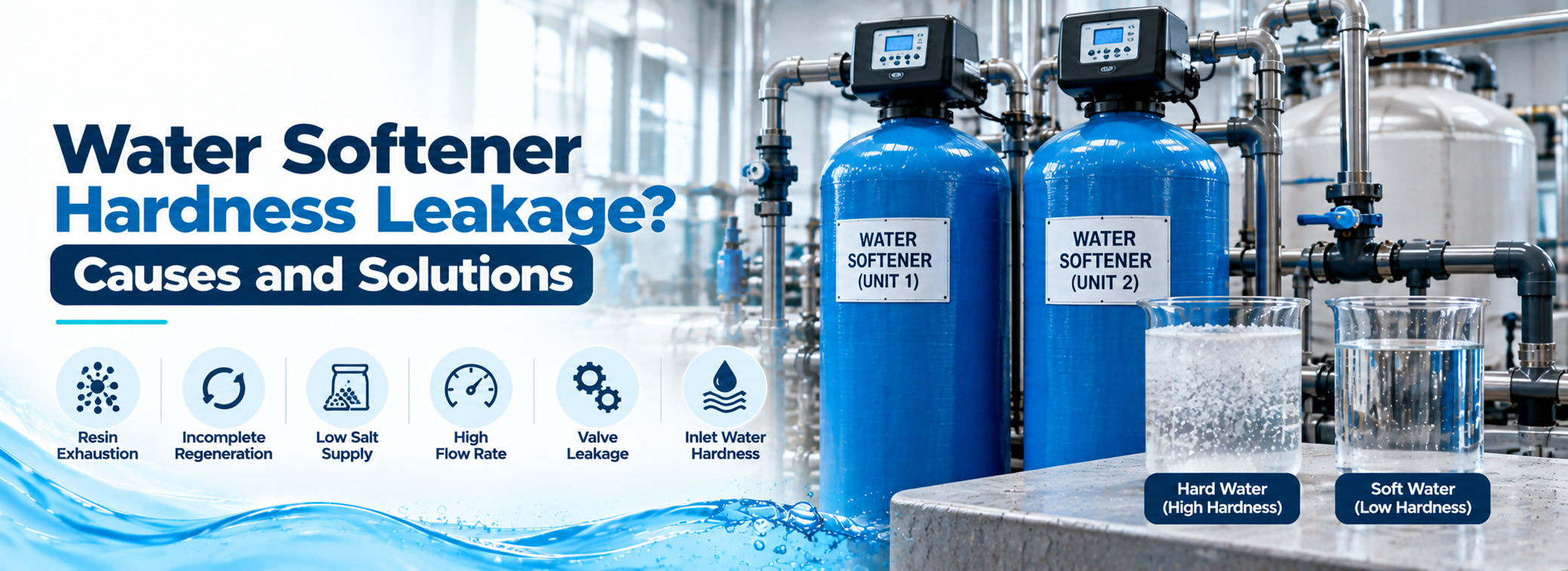
Water softener hardness leakage occurs when calcium and magnesium ions pass through a water softening system instead of being adequately removed by ion exchange resin. This problem can reduce soft water quality, increase scale formation, and affect the performance of boilers, cooling systems, heat exchangers, and other industrial equipment.
Industrial water softeners are designed to remove hardness-causing minerals from water using ion exchange technology. However, even when the softener is operating, treated water may contain higher hardness than expected.
This can happen because of exhausted resin, incomplete regeneration, excessive water flow, high inlet hardness, valve leakage, or deterioration of the resin bed.
Understanding the causes of hardness leakage helps plant operators identify the problem, restore softener performance, and prevent scaling in downstream equipment.
Quick Answer: Why does a water softener allow hardness leakage?
Water softener hardness leakage commonly occurs because the ion exchange resin is exhausted, regeneration is incomplete, water flow exceeds the design capacity, or untreated water bypasses the resin bed. Resin fouling, channeling, and damaged internal components can also contribute. The correct solution involves checking outlet hardness, resin capacity, salt consumption, regeneration settings, and valve operation.
What Is Hardness Leakage in a Water Softener?
Hardness leakage refers to calcium and magnesium ions remaining in water after it passes through a softening system.
A conventional sodium-cycle water softener uses strong acid cation exchange resin. During operation, calcium and magnesium ions are exchanged for sodium ions held on the resin.
As the resin approaches exhaustion, its ability to remove hardness decreases, allowing more calcium and magnesium to appear in the outlet water.
Small residual hardness levels may occur even in properly operating systems. However, a significant increase beyond the specified outlet limit indicates a performance problem.
Veolia
What Is the Acceptable Hardness Leakage in Softened Water?
There is no universal acceptable hardness leakage value for every industrial water softener.
The required outlet hardness depends on the application, feed-water composition, softener design, and downstream equipment requirements.
For example, boiler feed-water pretreatment may require much tighter hardness control than general-purpose industrial softening.
Operators should follow the specified outlet hardness limit rather than assuming every softener must achieve the same result.
What Are the Main Causes of Water Softener Hardness Leakage?
- Ion Exchange Resin Exhaustion
Ion exchange resin has a limited capacity to remove calcium and magnesium.
As more water passes through the softener, exchange sites become occupied by hardness ions. Eventually, hardness begins to break through into the treated water.
Common signs: Outlet hardness increases toward the end of the service cycle.
Recommended solution: Review treated-water volume, inlet hardness, and resin capacity. Regenerate the softener before unacceptable hardness breakthrough occurs.
- Incomplete Water Softener Regeneration
Regeneration restores resin capacity using sodium chloride brine.
If insufficient brine reaches the resin, some exchange sites remain occupied by calcium and magnesium.
Possible causes include incorrect salt dosage, inadequate contact time, improper brine concentration, or incorrect regeneration sequencing.
Recommended solution: Verify salt consumption, brine concentration, regeneration flow, contact time, and control settings against manufacturer recommendations.
- Insufficient Salt or Brine Supply
A softener may fail to regenerate properly if the brine tank has insufficient salt or the brine-draw system is malfunctioning.
Problems may include salt bridging, blocked injectors, damaged brine tubing, or incorrect refill levels.
Recommended solution: Inspect the brine tank, injector, float assembly, and brine-draw operation.
- Excessive Water Flow Rate
Water must remain in contact with the resin long enough for effective ion exchange.
When service flow exceeds the equipment’s recommended range, hardness removal may deteriorate.
Recommended solution: Measure actual flow and compare it with the manufacturer’s rated service flow. Avoid operating continuously beyond design limits.
Veolia identifies excessive service flow as a possible cause of premature hardness breakthrough and resin-bed channeling.
Veolia
- Increased Inlet Water Hardness
Changes in raw-water quality can increase the calcium and magnesium load entering the softener.
Even when regeneration is functioning correctly, higher inlet hardness may exhaust the resin sooner.
Recommended solution: Test inlet hardness regularly and adjust regeneration frequency or capacity settings based on the actual hardness load.
- Resin Fouling by Iron, Manganese or Suspended Solids
Iron, manganese, and suspended particles can accumulate within the resin bed.
Fouling reduces effective resin capacity and may interfere with uniform water distribution.
Recommended solution: Review upstream filtration and pretreatment. Arrange resin assessment and manufacturer-approved cleaning or replacement when necessary.
- Channeling Inside the Resin Bed
Channeling occurs when water travels through preferential pathways rather than contacting the entire resin bed.
It can result from poor backwashing, damaged distributors, accumulated solids, or unsuitable flow conditions.
Recommended solution: Inspect the inlet distributor, backwash operation, resin-bed condition, and internal components.
- Internal Valve Leakage or Bypass
A leaking service valve, damaged seal, or incorrectly positioned bypass can allow untreated water to mix with softened water.
This may cause a sudden increase in outlet hardness even when the resin is functioning correctly.
Recommended solution: Check bypass valves, control-valve seals, and regeneration valve sequencing.
- Resin Loss or Physical Damage
Resin beads may be lost through damaged strainers, excessive backwashing, or failed internal components.
Resin can also degrade because of ageing, oxidants, or unsuitable operating conditions.
Recommended solution: Check resin-bed depth, inspect strainers, and evaluate resin condition before deciding on replacement.
- Incorrect Regeneration Frequency
Timer-based softeners may regenerate at fixed intervals regardless of changes in water demand.
If water consumption increases, the resin may become exhausted before the next scheduled regeneration.
Recommended solution: Compare actual water consumption and inlet hardness with the softener’s usable exchange capacity. Consider demand-based regeneration where suitable.
Water Softener Hardness Leakage Troubleshooting Chart
| Observation | Possible cause | Recommended action |
| Hardness increases near the end of the cycle | Resin exhaustion | Review capacity and regeneration timing |
| High hardness immediately after regeneration | Incomplete regeneration | Check salt, brine draw and cycle settings |
| Sudden hardness increase | Valve leakage or bypass | Inspect valves and seals |
| Shorter soft-water service cycles | Higher inlet hardness or demand | Recalculate hardness loading |
| Persistent hardness at normal flow | Resin fouling or channeling | Inspect resin and distributors |
| Hardness increases during peak demand | Excessive service flow | Check flow against rated capacity |
| Inconsistent hardness test results | Sampling or test-kit problem | Verify sampling and testing method |
How to Troubleshoot Hardness Leakage in an Industrial Water Softener
Step 1: Verify Outlet Hardness
Collect representative inlet and outlet samples and test total hardness using a suitable calibrated or verified method.
Step 2: Check the Brine System
Inspect salt levels, brine concentration, injector operation, and brine-draw performance.
Step 3: Review Regeneration Records
Confirm that the softener completes backwash, brining, slow rinse, and fast rinse as specified.
Step 4: Compare Actual Flow With Design Flow
Check whether peak water demand exceeds the softener’s operating capacity.
Step 5: Evaluate Resin Capacity
Review resin quantity, inlet hardness, treated-water volume, and the interval between regenerations.
Step 6: Inspect Valves and Internals
Investigate possible untreated-water bypass, channeling, resin loss, or damaged distribution components.
Step 7: Confirm Performance After Corrective Action
Measure outlet hardness immediately after the approved rinse procedure and at intervals throughout the next service cycle.
Safety: Industrial softeners may contain pressurized water and automated valves. Isolate and depressurize equipment before internal maintenance. Use trained personnel and manufacturer-approved procedures.
How to Calculate Water Softener Hardness Loading
Hardness loading helps determine whether the softener is regenerating frequently enough.
For hardness expressed as mg/L as CaCO₃:
\[ \text{Hardness Load (kg/day)} =\frac{Q\times H}{1000} \]
Where:
- \(Q\) = Water flow in m³/day
- \(H\) = Inlet hardness in mg/L as CaCO₃
Example
Suppose an industrial softener treats:
- Water flow: 50 m³/day
- Inlet hardness: 300 mg/L as CaCO₃
\[ \frac{50\times300}{1000}=15\text{ kg/day} \]
The softener receives a hardness load of 15 kg/day as CaCO₃.
If inlet hardness rises to 450 mg/L at the same flow:
\[ \frac{50\times450}{1000}=22.5\text{ kg/day} \]
The hardness load increases by 50%.
This means the resin may reach exhaustion sooner unless operating conditions or regeneration frequency are adjusted.
Actual regeneration planning must use the resin’s usable exchange capacity at the selected salt dosage and the manufacturer’s design criteria.
Hardness Leakage vs Resin Exhaustion: What Is the Difference?
Hardness leakage is the presence of residual calcium and magnesium in the softened-water outlet.
Resin exhaustion occurs when the resin’s available exchange capacity becomes insufficient to continue removing hardness at the required level.
Therefore, resin exhaustion is one possible cause of hardness leakage, but not the only one.
Hardness leakage can also occur because of valve bypass, poor regeneration, channeling, or excessive flow.
How to Prevent Hardness Leakage in Water Softeners
Monitor Inlet and Outlet Hardness
Track hardness trends throughout the service cycle, particularly in critical industrial applications.
Maintain Proper Regeneration
Verify salt supply, brine-draw operation, chemical contact time, and rinse completion.
Control Water Flow
Operate within the manufacturer’s rated service-flow range.
Protect Ion Exchange Resin
Use appropriate pretreatment to control iron, manganese, suspended solids, and other contaminants.
Inspect Control Valves
Check seals, bypass arrangements, automatic sequences, and valve operation.
Review Resin Performance
Investigate reduced capacity, frequent regeneration, or abnormal pressure drop before replacing resin.
Maintain Operating Records
Record inlet hardness, outlet hardness, water volume treated, salt consumption, and regeneration frequency.
Frequently Asked Questions About Water Softener Hardness Leakage
- What causes hardness leakage in a water softener?
Common causes include exhausted resin, incomplete regeneration, insufficient brine, excessive water flow, resin fouling, channeling, and untreated-water bypass.
- What is hardness leakage in a water softener?
Hardness leakage occurs when calcium and magnesium ions remain in the treated water after passing through the softener.
- Can exhausted resin cause hardness leakage?
Yes. As the resin approaches exhaustion, its ability to exchange calcium and magnesium decreases, allowing hardness to appear in the outlet.
- Why is softened water hard after regeneration?
Possible causes include insufficient salt, poor brine draw, incorrect regeneration settings, valve leakage, or resin deterioration.
- Can high water flow cause hardness leakage?
Yes. Excessive flow can reduce effective resin contact and contribute to premature hardness breakthrough.
- Does inlet water hardness affect softener performance?
Yes. Higher inlet hardness increases the load on the resin and may shorten the service cycle.
- Can iron fouling cause hardness leakage?
Yes. Iron deposits can reduce effective resin capacity and interfere with regeneration and water distribution.
- How can I stop hardness leakage in an industrial softener?
Verify outlet hardness, inspect regeneration, review resin capacity, check valves, and correct flow or pretreatment problems.
- Does hardness leakage always mean the resin needs replacement?
No. Problems with regeneration, brine supply, bypass valves, or operating flow can also cause hardness leakage.
- How often should water softener hardness be tested?
Testing frequency depends on application criticality and operating conditions. Critical industrial systems may require continuous monitoring or frequent checks, while other systems can follow a documented routine sampling schedule.
Conclusion: Prevent Hardness Leakage Through Proper Softener Maintenance
Water softener hardness leakage can occur because of resin exhaustion, incomplete regeneration, excessive water flow, changes in inlet hardness, resin fouling, or mechanical problems.
The most effective troubleshooting approach is to confirm the outlet hardness, review regeneration performance, and investigate resin and valve conditions.
Regular hardness testing, appropriate salt dosing, effective pretreatment, and preventive maintenance help maintain consistent soft-water quality and protect downstream industrial equipment from scaling.
Looking for Industrial Water Softening and Water Treatment Solutions?
Consistent water softening is important for protecting industrial equipment, reducing scale formation, and maintaining reliable water quality.
For enquiries related to industrial water softeners, RO plants, DM plants, and water treatment solutions, connect with Bluewatt through its official business channels.
SEO, AEO, GEO and Rank Math Publishing Recommendations
Suggested internal links: Connect this article to published Bluewatt blogs about high conductivity in DM water, RO plant permeate flow problems, industrial water treatment maintenance, and RO vs DM plants.
Featured image filename: water-softener-hardness-leakage.webp
Image alt text: Water softener hardness leakage in an industrial ion exchange system being checked with a hardness test kit.
Featured image concept: A realistic industrial water softening plant showing resin vessels, a brine tank, and a technician testing inlet and outlet water hardness.
Recommended technical references:
- Veolia – Ion Exchange and Water Demineralization Handbook — softener regeneration, hardness breakthrough, resin fouling, channeling, and equipment troubleshooting.
Veolia
- Veolia Water Technologies – Industrial Ion Exchange Softeners — industrial softening principles and hardness leakage control.
Veolia Water Technologies