
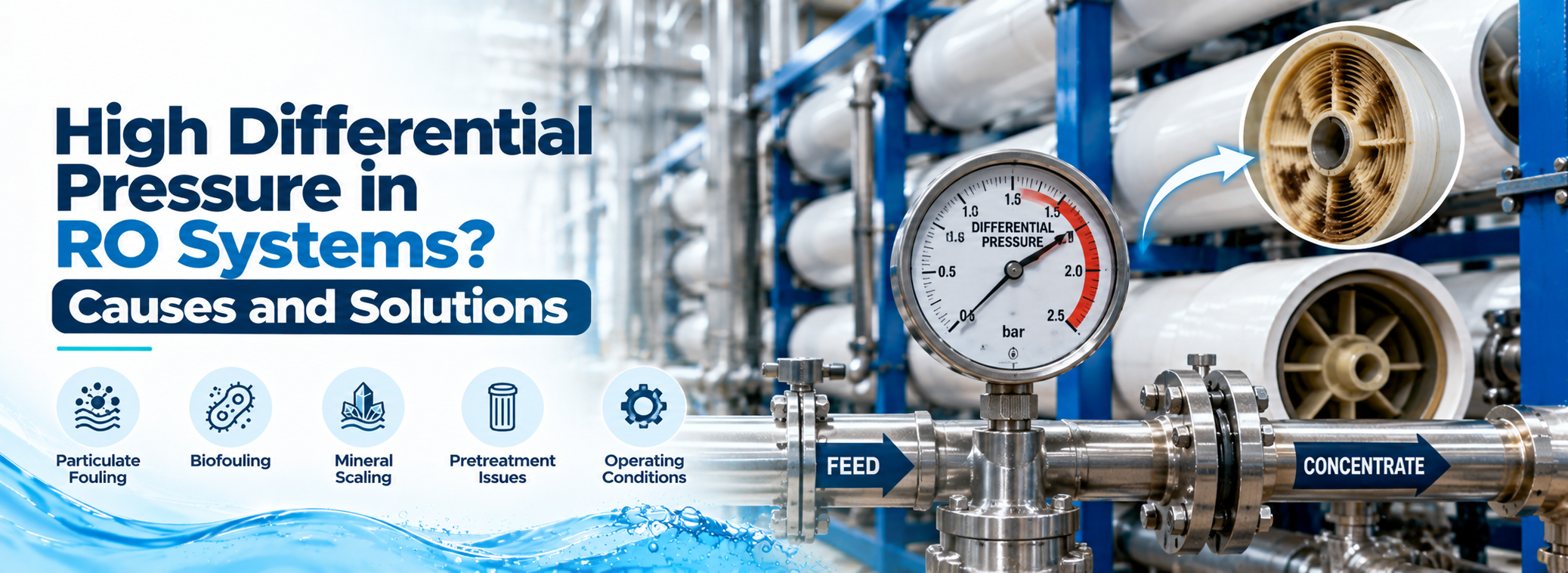
High differential pressure in RO systems is an important warning sign that can indicate membrane feed-channel fouling, suspended solids accumulation, biological growth, mineral scaling, or restrictions in the water flow path. When pressure loss across an RO membrane stage increases beyond its normal operating range, the system may require more pumping energy and can experience reduced operating reliability.
In industrial reverse osmosis plants, differential pressure is used to monitor resistance to water flowing through membrane feed channels. A gradual or sudden increase can help maintenance teams detect problems before severe membrane damage or production loss occurs.
However, differential pressure should not be confused with the pressure required to push water through the membrane. These measurements describe different aspects of RO performance.
Quick Answer: What causes high differential pressure in an RO system?
High differential pressure in an RO system is commonly caused by particulate fouling, biofouling, colloidal deposits, mineral scaling, or mechanical restrictions in membrane feed channels. Increased feed flow and changes in operating conditions can also raise pressure drop. The correct diagnosis requires comparing normalized differential pressure, stage-by-stage pressure readings, feed-water quality, and membrane operating history.
What Is Differential Pressure in an RO System?
Differential pressure (ΔP), also called feed-to-concentrate pressure drop, is the difference between the pressure at the inlet and outlet of an RO membrane stage.
As feed water travels through the membrane elements, it experiences hydraulic resistance. This creates a pressure drop between the feed and concentrate sides.
How to Calculate RO Membrane Differential Pressure
\[ \Delta P=P_{\text{feed}}-P_{\text{concentrate}} \]
Where:
- \(P_{\text{feed}}\) = Feed pressure at the membrane stage inlet
- \(P_{\text{concentrate}}\) = Concentrate pressure at the stage outlet
Example:
- Feed pressure: 14 bar
- Concentrate pressure: 12.5 bar
\[ \Delta P=14-12.5=1.5\text{ bar} \]
The RO stage differential pressure is 1.5 bar.
This reading must be compared with the membrane manufacturer’s limits and the system’s baseline operating data.
Differential Pressure vs Transmembrane Pressure
These two measurements should not be confused.
| Parameter | Differential pressure | Transmembrane pressure |
| Meaning | Pressure loss along the feed channel | Pressure difference driving water across the membrane |
| Measurement | Feed pressure minus concentrate pressure | Feed-side pressure relative to permeate pressure |
| Main purpose | Identify hydraulic restrictions and fouling | Evaluate membrane driving pressure |
| Common concern | Blocked feed channels | Inadequate water flux or excessive membrane pressure |
For RO performance calculations, net driving pressure also accounts for osmotic pressure.
What Are the Main Causes of High Differential Pressure in RO Systems?
- Suspended Solids and Particulate Fouling
Suspended particles such as silt, clay, rust, and other debris can enter an RO system when pretreatment is ineffective.
These particles accumulate inside membrane feed channels and increase resistance to water flow.
Common signs: Increasing pressure drop, particularly in the first RO stage, and possible reduction in permeate production.
Recommended solution: Inspect pretreatment filters, cartridge filter seals, and feed-water quality. Check the Silt Density Index (SDI) where appropriate.
- Biological Fouling of RO Membranes
Biofouling occurs when microorganisms grow on membrane surfaces and feed spacers.
The resulting biofilm restricts water movement through the membrane channels.
Biofouling can cause a substantial increase in differential pressure, particularly when combined with particulate deposits.
Recommended solution: Review microbial contamination, pretreatment effectiveness, shutdown procedures, and membrane-compatible cleaning practices.
DuPont identifies biofouling as an important cause of elevated RO pressure drop.
DuPont
- Mineral Scaling
Scaling occurs when dissolved minerals precipitate as the concentration of salts increases within the RO system.
Potential deposits include calcium carbonate, calcium sulfate, and silica-related scale.
Scaling may become more pronounced in later RO stages where dissolved salts are more concentrated.
Recommended solution: Review recovery rate, feed-water chemistry, antiscalant dosing, and membrane scaling potential.
- Ineffective RO Pretreatment
Pretreatment protects RO membranes from particles, organic matter, and other foulants.
Poor backwashing, exhausted filter media, inadequate clarification, or damaged cartridge filter seals can allow contaminants to enter the RO membranes.
Recommended solution: Inspect pretreatment equipment and verify that feed-water quality meets the membrane manufacturer’s requirements.
- Excessive Feed Flow Rate
Pressure drop depends partly on the volume of water flowing through membrane feed channels.
If feed flow exceeds the recommended operating range, differential pressure may increase even without severe fouling.
Recommended solution: Verify feed, permeate, and concentrate flow rates against the system design and membrane specifications.
- Organic and Colloidal Fouling
Natural organic matter, industrial organic compounds, and colloidal particles can accumulate within membrane channels.
These deposits may combine with biological or particulate fouling and restrict water movement.
Recommended solution: Evaluate organic loading, colloidal fouling potential, and upstream treatment effectiveness.
- Damaged Brine Seals or Membrane Components
Incorrectly installed or damaged brine seals can alter internal water flow.
Hydraulic surges and improper membrane installation may also contribute to mechanical damage or abnormal pressure distribution.
Recommended solution: Review pressure trends and installation history. Arrange qualified inspection of membrane elements and pressure-vessel components where necessary.
- Blocked Concentrate Piping or Valves
A partially closed valve, obstructed concentrate line, or malfunctioning control valve can create additional hydraulic resistance.
This may appear as an abnormal system pressure reading.
Recommended solution: Check pressure at individual stages and across external piping to distinguish membrane pressure drop from downstream restrictions.
- Sudden Pressure Surges During Startup
Rapid pressurization, trapped air, and hydraulic shock can damage membrane elements and internal components.
Such damage may lead to abnormal hydraulic performance.
Recommended solution: Follow manufacturer-approved startup procedures, including appropriate air removal and controlled pressurization.
- Incorrect Pressure Measurements
Faulty gauges, blocked pressure taps, or poorly calibrated transmitters can create misleading differential-pressure readings.
Recommended solution: Verify pressure instruments before making operating adjustments or deciding that membranes require cleaning.
RO Differential Pressure Troubleshooting Chart
| Observation | Possible cause | Recommended action |
| First-stage ΔP increases | Particulate or biological fouling | Check pretreatment and biofouling |
| Last-stage ΔP increases | Possible mineral scaling | Review recovery and scaling control |
| All stages show increasing ΔP | Widespread fouling or flow changes | Review normalized stage data |
| ΔP rises after flow adjustment | Increased hydraulic flow | Compare readings at equivalent flow |
| Sudden ΔP increase | Debris, valve problem, or instrument fault | Inspect equipment and verify gauges |
| High ΔP with declining permeate flow | Feed-channel fouling or scaling | Investigate foulants and cleaning needs |
| High pressure drop after startup | Possible hydraulic surge or trapped air | Review startup procedure and equipment |
The location of the pressure increase provides useful diagnostic information, but it does not confirm the foulant without additional testing.
DuPont Water
How to Troubleshoot High Differential Pressure in an RO Plant
Step 1: Confirm Pressure Measurements
Verify feed and concentrate pressure readings using calibrated instruments.
Step 2: Measure Differential Pressure Across Each Stage
Record stage-wise pressure drop instead of relying only on the overall RO system pressure difference.
Step 3: Compare Normalized Performance
Pressure drop changes with flow and temperature.
Compare normalized differential pressure with the commissioning baseline using the membrane manufacturer’s recommended method.
Step 4: Inspect Pretreatment Performance
Check filtration equipment, cartridge filters, SDI, turbidity, and relevant feed-water quality parameters.
Step 5: Review Membrane Operating Conditions
Record feed flow, concentrate flow, permeate flow, recovery, conductivity, and temperature.
Step 6: Identify the Likely Fouling Mechanism
Determine whether the evidence points toward particulates, biofouling, scaling, or a mechanical restriction.
Step 7: Plan Corrective Maintenance
Select the appropriate cleaning or maintenance procedure based on the diagnosed problem.
Avoid increasing pressure to compensate for restricted membrane channels, as this may worsen operating conditions or damage equipment.
When Should RO Membranes Be Cleaned?
Membrane cleaning should be based on normalized performance trends and manufacturer recommendations.
DuPont’s FilmTec membrane guidance identifies the following typical cleaning indicators:
- Normalized permeate flow decreases by approximately 10%.
- Normalized salt passage increases by approximately 5–10%.
- Normalized pressure drop increases by approximately 10–15%.
These are manufacturer-specific guidelines, not universal limits for every RO membrane.
DuPont Water
How to Calculate Differential Pressure Increase
\[ \text{DP Increase (\%)}= \frac{\Delta P_{\text{current}}-\Delta P_{\text{baseline}}} {\Delta P_{\text{baseline}}}\times100 \]
Example:
- Baseline differential pressure: 1.5 bar
- Current differential pressure: 1.8 bar
\[ \frac{1.8-1.5}{1.5}\times100=20\% \]
The differential pressure has increased by 20%.
If this increase persists after accounting for changes in flow and temperature, it warrants investigation and may indicate a need for membrane cleaning.
Safety: RO systems operate under pressure. Never open pressure vessels or loosen connections before complete isolation and depressurization. Cleaning chemicals must be selected and handled according to membrane compatibility and approved safety procedures.
How to Prevent High Differential Pressure in RO Systems
Maintain Effective Pretreatment
Monitor filter performance, SDI, turbidity, and feed-water quality.
Control Biological Growth
Maintain appropriate pretreatment and follow approved membrane-preservation and sanitation procedures.
Prevent Mineral Scaling
Review antiscalant dosing, feed-water chemistry, and operating recovery.
Monitor Stage-Wise Pressure Drop
Record differential pressure across each membrane stage to detect early changes.
Maintain Correct Operating Flow
Avoid exceeding membrane feed-flow and pressure-drop limits.
Follow Proper Startup and Shutdown Procedures
Prevent hydraulic shock, trapped air, and prolonged stagnant conditions.
Perform Timely Cleaning
Use normalized performance data to determine when cleaning is required.
Frequently Asked Questions About High Differential Pressure in RO
- What causes high differential pressure in an RO system?
Common causes include particulate fouling, biological growth, mineral scaling, blocked feed channels, excessive feed flow, and mechanical restrictions.
- What is differential pressure in an RO membrane?
It is the pressure difference between the feed inlet and concentrate outlet of an RO membrane stage.
- Does high differential pressure indicate membrane fouling?
It often indicates increased hydraulic resistance, which may result from fouling. However, flow changes, mechanical restrictions, and instrument errors should also be checked.
- Can biofouling increase RO differential pressure?
Yes. Biofilm accumulation can obstruct feed channels and significantly increase pressure drop.
- Can scaling cause high RO pressure drop?
Yes. Mineral deposits can restrict membrane feed channels, particularly in later stages.
- What is the normal differential pressure in an RO system?
There is no universal normal value. Acceptable pressure drop depends on membrane type, vessel configuration, flow rate, temperature, and manufacturer limits.
- How can I reduce high differential pressure in RO?
Identify the cause, correct pretreatment or operating problems, and use approved cleaning procedures when fouling or scaling is confirmed.
- When should RO membranes be cleaned?
Cleaning should follow manufacturer guidance and normalized performance trends, rather than a single uncorrected pressure reading.
- Can high differential pressure damage RO membranes?
Yes. Excessive pressure drop can create mechanical stress and may damage membrane elements or internal components.
- Why does RO differential pressure increase after startup?
Possible causes include trapped air, rapid pressurization, debris movement, abnormal valve settings, or existing fouling. Check startup conditions and stage-wise readings.
Conclusion: Control RO Differential Pressure Through Early Diagnosis
High differential pressure in RO systems is often associated with membrane feed-channel fouling, biofouling, scaling, or hydraulic restrictions.
However, operating flow, temperature, equipment condition, and measurement accuracy must also be considered.
The most effective approach is to monitor normalized stage-wise pressure drop, maintain reliable pretreatment, and investigate abnormal trends before severe membrane fouling develops.
Proper monitoring and preventive maintenance can help maintain stable RO plant performance, reduce unnecessary cleaning, and protect membrane equipment.
Looking for Industrial RO Plant and Water Treatment Solutions?
Reliable reverse osmosis operation depends on proper system design, suitable pretreatment, and consistent membrane maintenance.
For industrial RO plants, water treatment systems, and wastewater treatment requirements, connect with Bluewatt through its official business channels.
- SEO, AEO and GEO publishing recommendations
Suggested internal links: Connect this article to Bluewatt’s published blogs about decreasing RO permeate flow, RO vs DM plants, industrial RO maintenance, membrane scaling, and common RO plant problems.
Featured image filename: high-differential-pressure-ro-system.webp
Featured image alt text: High differential pressure in RO system caused by membrane fouling and feed channel blockage.
Featured image concept: A realistic industrial reverse osmosis plant showing membrane pressure vessels, inlet and outlet pressure gauges, and an operator checking stage-wise pressure readings.
Technical reference: DuPont FilmTec Reverse Osmosis/Nanofiltration Membranes Technical Manual — membrane fouling, feed-channel pressure drop, troubleshooting, and cleaning guidance.
DuPont