
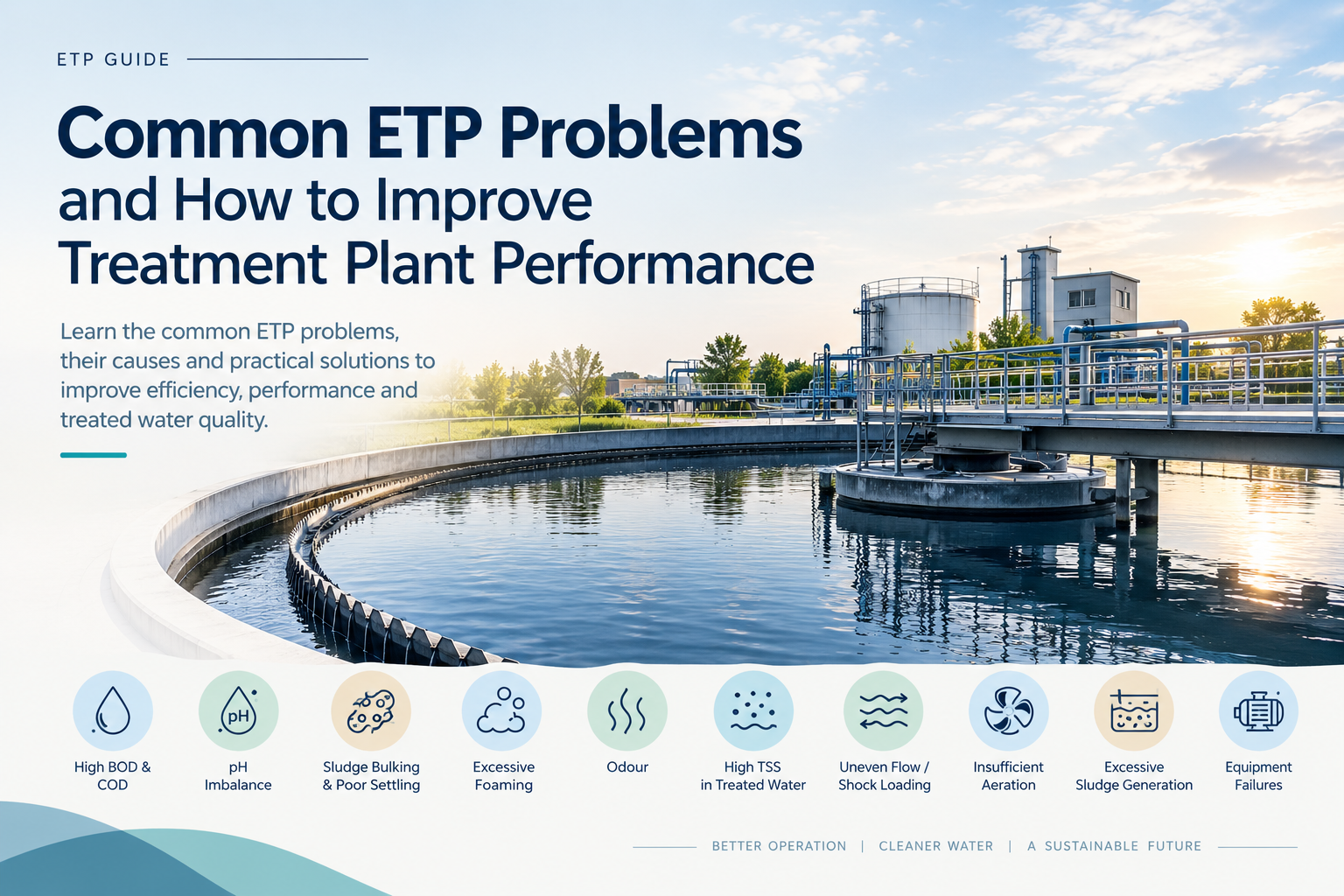
Common ETP problems can reduce treatment efficiency, increase operating costs and affect the quality of treated industrial wastewater. Problems such as high BOD and COD, improper pH, sludge bulking, excessive foaming, poor settling, odour and equipment failure can prevent an Effluent Treatment Plant (ETP) from performing efficiently.
Understanding the causes of these ETP problems and solutions is essential for industries that depend on reliable wastewater treatment. Regular monitoring, proper operation, preventive maintenance and timely corrective action can significantly improve ETP plant performance and help maintain consistent treated-water quality.
In this guide, we explain the most common Effluent Treatment Plant problems, why they occur, how they can be corrected and what industries can do to improve overall ETP efficiency.
Quick Answer: What Are the Most Common ETP Problems?
The most common ETP problems include:
- High BOD and COD in treated wastewater
- Incorrect or fluctuating pH
- Sludge bulking and poor sludge settling
- Excessive foaming
- Unpleasant odour
- High TSS in treated water
- Uneven wastewater flow or shock loading
- Insufficient aeration
- Excessive sludge generation
- Pumps, blowers and other equipment failures
Most of these problems can be controlled through proper ETP operation and maintenance, routine testing, optimized chemical dosing, balanced biological treatment and preventive equipment maintenance.
Why Does ETP Plant Performance Matter?
An Effluent Treatment Plant is designed to remove pollutants from industrial wastewater before the water is discharged, reused or sent for further treatment.
Industrial effluent may contain suspended solids, oils, chemicals, organic matter, dissolved contaminants and other pollutants depending on the manufacturing process.
When an ETP does not operate correctly, industries may experience:
- Poor treated-water quality
- Increased chemical consumption
- Higher electricity consumption
- Excessive sludge generation
- Frequent equipment breakdowns
- Increased operating expenses
- Difficulty maintaining required discharge parameters
- Reduced potential for wastewater reuse
Improving ETP plant performance therefore involves much more than simply keeping pumps and blowers running. The physical, chemical and biological stages of treatment must work together as one balanced system.
Common ETP Problems and Solutions
1. High BOD and COD in Treated Water
High Biochemical Oxygen Demand (BOD) and Chemical Oxygen Demand (COD) are among the most common indicators of inadequate wastewater treatment.
What Causes High BOD and COD in an ETP?
Possible causes include:
- Excessive organic load entering the plant
- Sudden changes in wastewater characteristics
- Insufficient aeration
- Poor biological activity
- Incorrect chemical dosing
- Inadequate retention time
- Toxic compounds affecting microorganisms
- Poor sludge management
How to Reduce High BOD and COD
Start by identifying whether the problem originates in the influent wastewater or within the treatment process.
Operators should monitor influent and treated-water parameters, check aeration performance, inspect biological activity and review chemical dosing.
Equalization is particularly important where industrial processes generate wastewater with large variations in flow and pollutant concentration.
Rather than simply increasing chemical dosage, the underlying cause should be identified and corrected.
2. Incorrect or Fluctuating pH Levels
pH is a critical parameter in industrial wastewater treatment because both chemical treatment and biological processes operate effectively only within suitable conditions.
Why Does ETP pH Fluctuate?
Common causes include:
- Acidic industrial wastewater
- Alkaline process wastewater
- Irregular chemical dosing
- Sudden production-process changes
- Inadequate mixing
- Failure of pH sensors or dosing systems
How to Control pH in an Effluent Treatment Plant
Industries should continuously or routinely monitor pH at critical treatment stages.
Automatic dosing systems can help maintain more consistent conditions where wastewater characteristics change frequently.
However, dosing systems themselves must be calibrated and inspected periodically. Excessive acid or alkali addition can create another treatment problem instead of solving the original one.
3. Sludge Bulking and Poor Settling
Sludge bulking occurs when biological sludge does not settle effectively in the clarifier.
Instead of forming a compact sludge layer, solids remain suspended or escape with treated wastewater.
What Causes Sludge Bulking in an ETP?
Potential causes include:
- Imbalanced microbial growth
- Insufficient dissolved oxygen
- Nutrient imbalance
- Organic overloading
- Unstable operating conditions
- Poor sludge-return management
How to Improve Sludge Settling
Operators should evaluate:
- Dissolved oxygen
- Organic loading
- Sludge characteristics
- Return sludge rate
- Nutrient availability
- Clarifier performance
Sludge should not be managed based only on its visual appearance. Routine process monitoring helps determine whether the problem originates in biological treatment or clarification.
4. Excessive Foaming in the Aeration Tank
Some foam during biological wastewater treatment can occur, but persistent or excessive foam may indicate an operational imbalance.
Why Does Foaming Occur in an ETP?
Possible reasons include:
- Surfactants or detergents in wastewater
- Excessive aeration
- Changes in microbial population
- High organic loading
- Oils and grease
- Young or unstable biological sludge
How to Control ETP Foaming
The first step is to identify the type and source of the foam.
Operators should check wastewater characteristics, aeration rates, sludge condition and incoming oil, grease or detergent loads.
Long-term improvement should focus on correcting the root cause rather than relying continuously on defoaming chemicals.
5. Unpleasant Odour from the ETP
A strong smell from an Effluent Treatment Plant can indicate anaerobic conditions, accumulated sludge or insufficient aeration.
What Causes Bad Odour in an ETP?
Typical causes include:
- Wastewater remaining stagnant
- Insufficient oxygen
- Septic conditions
- Sludge accumulation
- Poor housekeeping
- Inadequate sludge handling
- High organic loading
How to Reduce ETP Odour
Maintain adequate mixing and aeration, remove accumulated sludge regularly and prevent wastewater from remaining stagnant for unnecessary periods.
Tanks, screens and sludge-handling areas should also be cleaned as part of routine ETP maintenance.
Odour should be treated as an operational warning sign, not simply a housekeeping issue.
6. High TSS in Treated Water
High Total Suspended Solids (TSS) can make treated water appear cloudy and may indicate ineffective settling or filtration.
Causes of High TSS in ETP Outlet Water
Common causes include:
- Poor clarifier performance
- Sludge carryover
- Hydraulic overloading
- Excessive sludge accumulation
- Poor coagulation or flocculation
- Filter problems
How to Improve ETP Treated Water Quality
Check the clarifier loading and sludge-withdrawal system first.
Chemical dosing, floc formation and downstream filtration should then be inspected.
The solution should be based on identifying where solids are escaping rather than automatically increasing chemical dosage.
7. Shock Loading and Uneven Wastewater Flow
Industrial wastewater characteristics can change significantly depending on production schedules, cleaning operations, raw materials and manufacturing processes.
A sudden increase in pollutant concentration or wastewater volume can create shock loading.
How Does Shock Loading Affect ETP Performance?
It can:
- Disturb biological treatment
- Reduce treatment efficiency
- Cause pH fluctuations
- Increase BOD and COD
- Affect sludge settling
- Overload downstream treatment units
How Can Shock Loading Be Controlled?
A properly designed and operated equalization tank helps balance variations in wastewater flow and pollutant concentration.
Industries should also coordinate production and wastewater-treatment operations wherever possible so that unusual discharges can be identified before they disrupt the ETP.
8. Insufficient Aeration
Aeration is critical in many biological ETP systems because microorganisms require oxygen to break down organic pollutants.
Signs of Insufficient Aeration
Possible indicators include:
- Poor BOD reduction
- Strong odour
- Dark or unhealthy biological sludge
- Poor settling
- Low dissolved oxygen
- Reduced biological activity
How to Improve ETP Aeration Efficiency
Operators should inspect:
- Blowers
- Diffusers
- Air pipelines
- Dissolved oxygen levels
- Tank mixing
- Aeration distribution
Blocked diffusers or poorly performing blowers can increase energy consumption while still failing to provide effective oxygen transfer.
9. Excessive Sludge Generation
Sludge is an unavoidable part of wastewater treatment, but unusually high sludge production may indicate inefficient chemical dosing or unstable plant operation.
What Causes Excessive ETP Sludge?
Potential causes include:
- Overdosing coagulants
- Excessive lime addition
- High suspended solids
- Changes in wastewater characteristics
- Poor biological process control
How to Reduce Excessive Sludge
Optimize chemical dosing through proper testing and process monitoring.
Sludge should also be properly thickened, dewatered and handled according to applicable requirements.
Reducing unnecessary chemical use can lower both sludge-management costs and overall ETP operating costs.
10. Pumps, Blowers and Equipment Failures
Even a well-designed ETP cannot operate efficiently when critical mechanical equipment is unreliable.
Common ETP Equipment Problems
These include:
- Pump blockage
- Blower failure
- Diffuser choking
- Dosing pump malfunction
- Sensor calibration issues
- Pipeline leakage
- Filter clogging
- Electrical control faults
How Preventive ETP Maintenance Helps
Instead of waiting for equipment to fail, industries should follow a planned preventive maintenance schedule.
Critical equipment should be inspected regularly, and essential spare parts should be readily available.
Preventive ETP operation and maintenance reduces unexpected downtime and supports consistent treatment performance.
How to Improve ETP Plant Performance
Solving individual problems is important, but long-term ETP performance improvement requires systematic plant management.
1. Monitor Important ETP Parameters Regularly
Routine monitoring allows operators to identify problems before they become serious.
Important parameters may include:
- pH
- BOD
- COD
- TSS
- Dissolved oxygen
- Flow rate
- Sludge characteristics
- Chemical consumption
- Treated-water quality
Monitoring requirements will vary according to wastewater characteristics, ETP design and applicable operating requirements.
2. Optimize Chemical Dosing
More chemicals do not automatically mean better treatment.
Overdosing can increase operating expenses and sludge generation, while underdosing may reduce pollutant removal.
Chemical dosing should therefore be optimized according to actual wastewater characteristics and treatment requirements.
3. Maintain Stable Biological Treatment
Biological systems perform best under reasonably stable conditions.
Large changes in:
- pH
- Organic loading
- Temperature
- Toxicity
- Dissolved oxygen
can affect microorganisms and reduce treatment efficiency.
Proper equalization and process monitoring help protect biological treatment from sudden changes.
4. Improve Aeration Efficiency
Aeration can represent a significant part of the energy requirement of biological wastewater treatment.
Instead of operating blowers without reference to process conditions, aeration should be aligned with the actual oxygen requirement of the system.
Regular diffuser cleaning and blower maintenance can also improve performance.
5. Maintain Proper Sludge Management
Sludge should be removed and managed at appropriate intervals.
Allowing excessive sludge to accumulate can affect clarifiers, reduce treatment capacity and create odour.
Effective sludge management therefore plays an important role in overall wastewater treatment plant performance.
6. Follow a Preventive Maintenance Schedule
Create daily, weekly, monthly and annual maintenance activities for important ETP components.
This can include:
- Pumps
- Blowers
- Mixers
- Dosing systems
- Sensors
- Filters
- Valves
- Electrical panels
Preventive maintenance is usually more efficient than repeatedly responding to emergency breakdowns.
7. Train ETP Operators
Operator knowledge has a direct influence on treatment performance.
Operators should understand not only how to switch equipment on and off but also how to interpret changes in pH, DO, sludge condition, flow and treated-water quality.
A trained operator can often identify an abnormal condition before it develops into a major plant problem.
ETP Troubleshooting: Problem, Possible Cause and Corrective Action
| ETP Problem | Possible Cause | Corrective Approach |
| High BOD/COD | Organic overload, low aeration | Check loading, aeration and biological activity |
| pH fluctuation | Acidic/alkaline discharge | Improve equalization and pH control |
| Sludge bulking | Biological imbalance | Review DO, loading and sludge management |
| Excessive foam | Surfactants, oils or biological imbalance | Identify source and optimize process |
| Bad odour | Anaerobic conditions | Improve aeration and sludge removal |
| High TSS | Poor settling | Inspect clarifier and sludge withdrawal |
| Shock loading | Sudden wastewater changes | Improve equalization |
| Low DO | Poor aeration | Inspect blowers and diffusers |
| Excessive sludge | Chemical overdosing | Optimize chemical dosage |
| Equipment failure | Poor maintenance | Implement preventive maintenance |
How Can Industries Maintain Consistent ETP Performance?
The most effective approach is to treat the ETP as an important part of the production facility rather than as an isolated utility.
Production changes can alter wastewater flow, pH, organic load and chemical composition. Communication between the production team and ETP operators therefore helps identify potential treatment problems early.
Industries should combine:
Regular monitoring + optimized chemical dosing + stable biological treatment + preventive maintenance + trained operators.
Together, these practices can improve treatment consistency, reduce avoidable operating costs and increase the reliability of the Effluent Treatment Plant.
When Should You Consider an ETP Performance Audit?
An ETP performance assessment may be useful when:
- BOD or COD remains consistently high
- Treated water quality changes frequently
- Chemical consumption keeps increasing
- Electricity consumption appears unusually high
- Sludge generation has increased
- Odour or foaming occurs repeatedly
- Equipment breakdowns are frequent
- The plant cannot handle current wastewater load
- You are planning to reuse treated wastewater
A detailed assessment should evaluate the wastewater characteristics, hydraulic and pollutant loading, treatment stages, equipment condition, chemical consumption and operational practices before recommending modifications.
Improve ETP Performance with Bluewatt Ventures
Efficient industrial wastewater treatment requires the right combination of ETP design, process control, monitoring, operation and maintenance.
Bluewatt Ventures provides water and wastewater treatment solutions for industries and commercial facilities, including Effluent Treatment Plants (ETP), Sewage Treatment Plants (STP), Water Treatment Plants (WTP), RO systems, DM plants and wastewater treatment solutions.
Whether you are facing recurring ETP problems, inconsistent treated-water quality, high operating costs or are planning a new wastewater treatment system, a systematic assessment can help identify the right approach for improving plant performance.
Looking to improve your ETP plant performance? Contact Bluewatt Ventures to discuss your industrial wastewater treatment requirements.
Frequently Asked Questions About ETP Problems and Performance
1. What are the most common problems in an ETP?
Common ETP problems include high BOD and COD, pH fluctuations, sludge bulking, excessive foam, unpleasant odour, high TSS, insufficient aeration, shock loading, excessive sludge generation and mechanical equipment failures.
2. How can ETP performance be improved?
ETP performance can be improved through regular wastewater monitoring, optimized chemical dosing, proper aeration, stable biological treatment, effective sludge management, preventive maintenance and operator training.
3. Why is COD high in ETP treated water?
High COD may result from excessive pollutant loading, inadequate chemical or biological treatment, insufficient aeration, short retention time, toxic compounds or sudden changes in wastewater characteristics.
4. Why does an ETP produce bad odour?
ETP odour commonly develops when wastewater or sludge becomes anaerobic due to insufficient oxygen, stagnant wastewater, accumulated sludge or excessive organic loading.
5. How can sludge bulking be controlled in an ETP?
Sludge bulking should first be diagnosed by checking dissolved oxygen, organic loading, sludge characteristics, nutrient balance and sludge-return conditions. Corrective action depends on the actual cause of poor settling.
6. Why is pH control important in an Effluent Treatment Plant?
Correct pH helps chemical reactions and biological processes operate effectively. Extreme or rapidly changing pH can reduce treatment efficiency and disturb biological microorganisms.
7. How often should an ETP be maintained?
ETP monitoring and maintenance should follow a planned schedule that includes daily operational checks and periodic preventive maintenance. The exact frequency depends on plant design, wastewater characteristics, equipment and operating conditions.
8. How can industries reduce ETP operating costs?
Operating costs can often be improved by optimizing chemical dosing, improving aeration efficiency, preventing equipment failures, controlling sludge generation, balancing wastewater loads and maintaining equipment proactively.
9. What causes foaming in an ETP aeration tank?
Foaming may be caused by detergents, surfactants, oils and grease, high organic loading, excessive aeration or changes in the biological sludge population. Identifying the source is essential before selecting corrective measures.
10. Can an existing ETP be upgraded to improve performance?
Yes. Depending on the existing plant condition, wastewater load and treatment objectives, improvements may involve process optimization, equipment replacement, better aeration, additional treatment stages, automation or modifications to increase treatment capacity. A technical assessment should be completed before deciding on an upgrade.
Suggested Internal Links
Add internal links naturally to relevant Bluewatt Ventures pages or future blogs using anchor text such as:
- Effluent Treatment Plant
- Sewage Treatment Plant
- Water Treatment Plant
- Industrial RO Plant
- DM Plant
- ETP operation and maintenance
- Industrial wastewater treatment
- Zero Liquid Discharge system
- STP vs ETP
- BOD and COD in wastewater treatment