
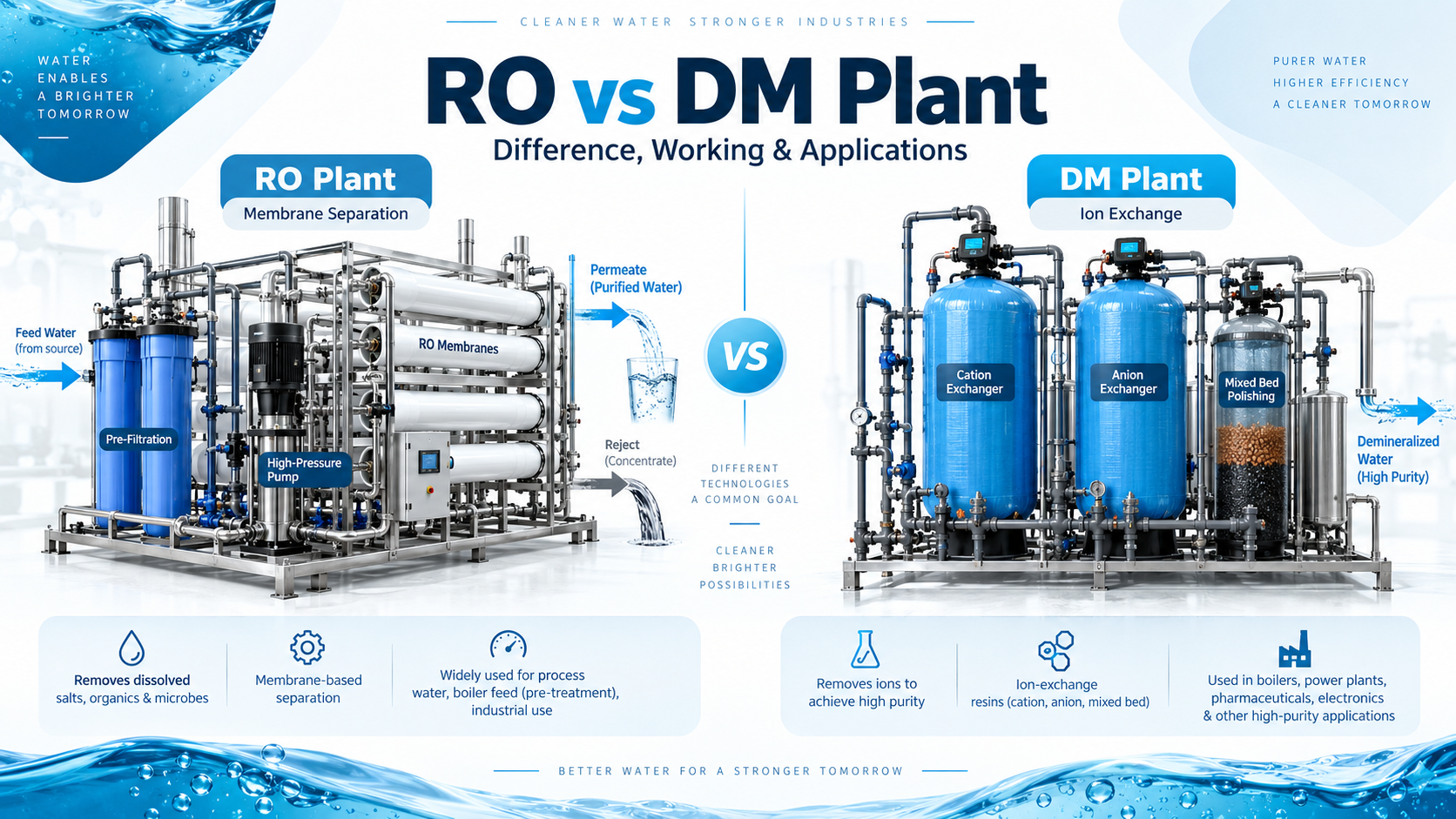
RO vs DM Plant is a common comparison when industries need to select the right system for purified water. While both RO plants and DM plants are used in industrial water treatment, they work differently and are designed to achieve different water-quality requirements. An RO plant (Reverse Osmosis Plant) uses a semi-permeable membrane to remove dissolved salts and many other impurities, whereas a DM plant (Demineralization Plant) typically uses ion-exchange resins to remove positively and negatively charged dissolved ions from water.
Understanding the difference between RO and DM plants, their working principles, applications, advantages and limitations can help industries select an appropriate water treatment solution for their process requirements.
What Is an RO Plant?
An RO plant, or Reverse Osmosis Plant, is a water treatment system that uses membrane technology to reduce dissolved salts and other contaminants in water.
In reverse osmosis, pressure is applied to feed water, forcing water through a semi-permeable membrane. The membrane allows water molecules to pass while rejecting a large proportion of dissolved salts and many other impurities.
Industrial RO systems are widely used where feed water needs substantial purification before being reused, supplied to a process or sent for further treatment.
How Does an RO Plant Work?
The RO plant working process usually includes several stages depending on the feed-water quality and the intended use of the treated water.
- Pretreatment
Raw water first undergoes pretreatment. Depending on the water analysis, this may include filtration, chemical dosing, activated carbon treatment, softening or other processes.
Pretreatment helps protect RO membranes from suspended particles, scaling, fouling and other contaminants.
- High-pressure pumping
A high-pressure pump increases the pressure of the pretreated feed water so that it can pass through the RO membrane system.
- Reverse osmosis membrane
Pressurized water enters the membrane housing. The membrane separates the feed into two streams:
- Permeate: Purified water that passes through the membrane.
- Reject or concentrate: Water containing a higher concentration of rejected salts and contaminants.
- Post-treatment
Depending on the application, RO permeate may undergo pH adjustment, disinfection, remineralization, polishing or further treatment through another purification system.
What Is a DM Plant?
A DM plant, or Demineralization Plant, is designed primarily to remove dissolved mineral ions from water.
Conventional DM water treatment commonly uses ion-exchange resins. These resins exchange unwanted dissolved ions in the feed water with hydrogen (H⁺) and hydroxide (OH⁻) ions. These subsequently combine to form water.
DM systems are particularly useful when an industrial process requires very low levels of ionic impurities.
How Does a DM Plant Work?
A conventional DM plant working process commonly involves cation and anion exchange stages.
Cation Exchange
Water first passes through a cation-exchange unit. The resin exchanges positively charged ions such as calcium, magnesium and sodium for hydrogen ions.
Anion Exchange
The water then passes through an anion-exchange unit. Here, negatively charged ions such as chloride, sulphate and nitrate are exchanged for hydroxide ions.
The released hydrogen and hydroxide ions combine to form water.
Mixed Bed Polishing
Where higher-purity water is required, a mixed bed unit containing both cation and anion exchange resins can be used as a final polishing stage.
The exact configuration of a DM plant depends on the feed-water chemistry and the required treated-water quality.
RO vs DM Plant: What Is the Difference?
The main difference between an RO and DM plant is the purification mechanism.
An RO plant primarily relies on membrane separation, while a conventional DM plant relies on ion exchange.
| Parameter | RO Plant | DM Plant |
| Full Form | Reverse Osmosis Plant | Demineralization Plant |
| Main Technology | Semi-permeable membrane | Ion-exchange resin |
| Main Purpose | Reduce dissolved salts and various impurities | Remove dissolved ionic minerals |
| Separation Method | Pressure-driven membrane separation | Ion exchange |
| Water Streams | Produces permeate and reject | Conventional ion exchange does not operate like RO membrane reject |
| Chemical Requirement | Depends on pretreatment and cleaning requirements | Chemicals are typically required for resin regeneration |
| Pretreatment | Important for membrane protection | Depends on feed-water chemistry and resin design |
| Typical Role | Primary or intermediate purification | Demineralization/final ionic purification |
| Common Combination | Can be followed by DM/mixed bed | Often receives pretreated or RO water |
The correct choice cannot be made from this table alone. Feed-water analysis, flow requirement, operating cost, final water specifications and the industrial process must also be evaluated.
RO Plant vs DM Plant Working Principle
Understanding the RO vs DM plant working principle makes the distinction clearer.
RO Plant Working Principle
Reverse osmosis uses pressure to overcome the natural osmotic process. Feed water is pushed against a selective membrane, allowing purified water to pass while much of the dissolved salt content remains in the concentrate stream.
Therefore, RO is fundamentally a physical membrane-separation process.
DM Plant Working Principle
Demineralization uses chemical ion exchange. Dissolved positively and negatively charged ions interact with specialized resins and are exchanged for hydrogen and hydroxide ions.
Therefore, conventional DM treatment is fundamentally an ion-exchange process.
Applications of RO Plants
Because industrial water sources and quality requirements vary significantly, industrial RO plants can be used across many sectors.
1. Manufacturing Industries
RO systems can treat incoming water for manufacturing processes where reduced dissolved solids are required.
2. Pharmaceutical Industry
RO can form part of a multi-stage water purification system for pharmaceutical facilities. The complete treatment train depends on the required water standard and applicable regulations.
3. Food and Beverage Industry
RO treatment may be used for process water, ingredient water and other applications where controlled water quality is important.
4. Boiler Feed Water Treatment
RO can reduce the dissolved salt load before water undergoes further boiler-feed treatment.
5. Cooling Water Applications
Depending on system design and water chemistry, RO-treated water can be used to improve the quality of makeup water for cooling systems.
6. Wastewater Reuse
RO is also used as an advanced treatment stage in certain industrial wastewater-recycling and reuse systems after suitable upstream treatment.
Applications of DM Plants
DM plants are generally selected when removing ionic minerals to a very low level is important for the industrial process.
1. Boiler Feed Water
DM water is widely associated with boiler water treatment because mineral ions in feed water can contribute to scale, deposits and operational problems.
2. Power Plants
Power-generation facilities can require highly purified water for boiler and steam-cycle applications, depending on their operating pressure and system design.
3. Pharmaceutical Facilities
Demineralization can be incorporated into water-treatment trains where controlled ionic purity is required.
4. Chemical and Process Industries
Chemical manufacturing processes may require low-mineral water to maintain product quality and process consistency.
5. Electronics and Precision Manufacturing
High-purity water systems may incorporate demineralization and polishing technologies where very low ionic contamination is required.
RO vs DM Plant: Which One Provides Better Water Quality?
There is no universal answer because RO and DM plants perform different treatment functions.
RO can substantially reduce the dissolved salt concentration while also rejecting many non-ionic contaminants depending on their properties and the membrane system.
A DM plant is specifically focused on removing dissolved ions. When designed with appropriate polishing stages, it can produce water with very low ionic content.
For applications demanding high-purity water, the question therefore may not be “RO or DM?” but rather “Should RO and DM be used together?”
Can RO and DM Plants Be Used Together?
Yes. RO and DM plants can be combined in an industrial water treatment system.
A common treatment concept is:
Raw Water → Pretreatment → RO Plant → DM/Polishing System → Treated Water
Using RO upstream can reduce the ionic load reaching downstream ion-exchange units. The final configuration should be determined from actual feed-water characteristics and the required product-water specifications.
This integrated approach may be considered for industries that need consistently high-quality treated water.
Advantages of an RO Plant
An industrial Reverse Osmosis Plant offers several potential advantages:
- Reduces a broad range of dissolved contaminants
- Reduces dissolved salt load substantially
- Can serve as pretreatment for high-purity water systems
- Modular systems can be designed for different capacities
- Suitable for many industrial water-treatment applications
- Can support wastewater recycling and water-reuse strategies
However, membrane fouling, scaling, reject management and appropriate pre………………………………………treatment must be considered during system design and operation.
Advantages of a DM Plant
A properly designed Demineralization Plant can offer:
- Very effective removal of ionic contaminants
- Low-mineral treated water
- Suitability for high-purity industrial applications
- Mixed-bed polishing for improved ionic purity
- Integration with RO and other water-treatment technologies
Conventional ion-exchange DM plants also require appropriate resin monitoring, regeneration, chemical handling and maintenance.
RO vs DM Plant: Which Should You Choose?
Choosing between an RO plant and DM plant should begin with the required water quality—not simply with the treatment technology.
Consider the following factors:
Feed-Water Quality
Test parameters such as TDS, hardness, alkalinity, silica, suspended solids and relevant ionic contaminants before designing the treatment system.
Required Treated-Water Quality
Determine exactly what the industrial process requires. General process water, boiler feed and high-purity manufacturing applications can have very different specifications.
Plant Capacity
Calculate the actual water demand, peak demand and future requirements before selecting system capacity.
Operating and Maintenance Requirements
Consider membrane replacement and cleaning, resin regeneration, chemical consumption, power requirements, manpower and routine maintenance.
Reject and Waste Management
RO produces a concentrate stream that needs appropriate management. Conventional DM systems generate regeneration waste when resins are chemically regenerated.
End Application
The intended application ultimately determines the required treatment train. An RO system may be sufficient for some processes, while others may require RO followed by DM or another polishing technology.
RO vs DM Plant for Industrial Water Treatment
For industrial facilities, there is rarely a one-size-fits-all solution.
A manufacturing facility with moderately high TDS may need an RO-based treatment system, while a process requiring very low ionic contamination may need DM treatment or additional polishing.
In other cases, combining RO + DM can provide a practical treatment train.
The best approach is to analyze:
Raw-water quality → Required product-water quality → Flow requirement → Process application → Operating conditions → Treatment design
This prevents both under-treatment and unnecessary overdesign.
Why Proper RO and DM Plant Design Matters
Selecting equipment only on the basis of plant capacity can create long-term operational problems.
An effective industrial water treatment plant should be designed around actual water analysis and operating conditions.
Poorly selected treatment systems can lead to:
- Frequent membrane fouling
- Scaling
- Excessive chemical consumption
- Shorter resin life
- Poor treated-water quality
- Higher operating costs
- Increased downtime
- Excessive reject or regeneration waste
A properly engineered system considers the complete water-treatment process rather than treating the RO or DM unit as an isolated piece of equipment.
RO and DM Plant Solutions from Bluewatt Ventures
At Bluewatt Ventures LLP, we provide water and wastewater treatment solutions designed around industrial requirements and actual water conditions.
Our solutions include RO plants, DM plants, Water Treatment Plants (WTP), Sewage Treatment Plants (STP), Effluent Treatment Plants (ETP) and integrated water-management systems.
Instead of selecting a system based only on capacity, the treatment approach should consider feed-water quality, required output quality, industrial application, operating conditions and long-term maintenance requirements.
Whether your facility requires an industrial RO plant, DM plant or an integrated RO + DM water treatment system, a properly engineered solution can help achieve reliable water quality and efficient plant operation.
Frequently Asked Questions About RO vs DM Plants
1. What is the main difference between an RO plant and a DM plant?
The primary difference between an RO and DM plant is the treatment technology. RO uses a semi-permeable membrane and pressure to separate water from many dissolved contaminants, while a conventional DM plant uses ion-exchange resins to remove dissolved ionic minerals.
2. Which is better, an RO plant or a DM plant?
Neither technology is universally better. The appropriate choice depends on feed-water quality and the required treated-water specification. Some applications need RO, some need DM treatment, and others benefit from a combination of both.
3. Does RO produce DM water?
Not necessarily. RO substantially reduces dissolved salts, but RO permeate should not automatically be considered equivalent to water produced by a properly designed demineralization and polishing system. The required water specification determines whether additional treatment is necessary.
4. Can an RO plant be used before a DM plant?
Yes. RO can be used before DM treatment to reduce the dissolved salt load reaching the ion-exchange system. The appropriate configuration depends on the water analysis and required final quality.
5. What is DM water used for?
DM water is commonly used where low ionic mineral content is required, including certain boiler-feed, power-generation, chemical, pharmaceutical and high-purity process applications.
6. Does an RO plant remove TDS?
RO is commonly used to substantially reduce total dissolved solids (TDS). Actual rejection depends on membrane selection, feed-water composition, pressure, temperature, recovery and system operating conditions.
7. Does a DM plant reduce TDS?
A conventional DM plant removes dissolved ionic species through ion exchange and therefore significantly reduces the ionic contribution to dissolved solids. Conductivity or resistivity is commonly monitored when evaluating demineralized water quality.
8. What is an industrial RO plant?
An industrial RO plant is a reverse-osmosis system designed to treat water at capacities and operating conditions required by industrial processes. It may include pretreatment, high-pressure pumps, membrane systems, instrumentation, dosing and post-treatment.
9. How do I choose between RO and DM water treatment?
Start with a laboratory analysis of the feed water and clearly define the required treated-water quality. TDS, hardness, silica, alkalinity, organic load, flow requirement and end use should be considered before finalizing the system.
10. Can RO and DM plants be part of a complete WTP?
Yes. Depending on the raw-water quality and application, RO and DM technologies can form part of a larger Water Treatment Plant (WTP) that includes pretreatment, filtration, softening, disinfection, polishing and other treatment processes.
Conclusion
The RO vs DM plant decision depends on what contaminants must be removed and the quality of water required by the process.
An RO plant uses membrane separation to reduce dissolved salts and many other contaminants, while a DM plant uses ion-exchange technology to target dissolved mineral ions. For some applications, one technology may be sufficient; for higher-purity requirements, RO and DM treatment may be integrated into the same water-treatment train.
Before selecting an RO plant, DM plant or industrial water treatment plant, analyze the feed water, define the required product-water specifications and consider long-term operating and maintenance requirements.
A correctly designed treatment system does more than produce purified water—it helps deliver consistent water quality, reliable plant operation and efficient industrial water management.
Need help selecting the right RO, DM or integrated water treatment system? Contact Bluewatt Ventures for a water-quality assessment and application-specific treatment solution.