
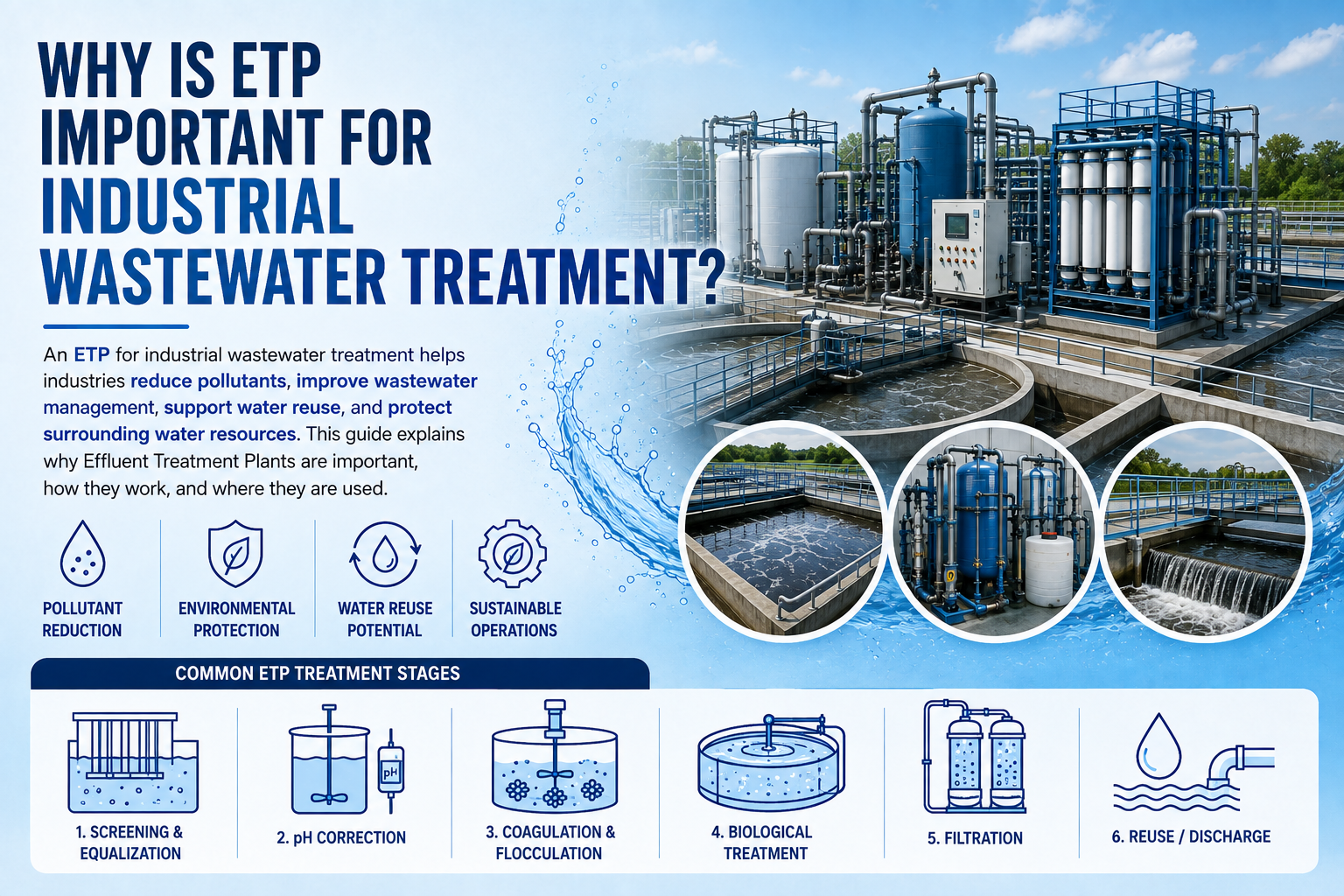
Why Is ETP Important for Industrial Wastewater Treatment?
An ETP for industrial wastewater treatment plays a critical role in helping industries manage contaminated water generated during manufacturing and processing activities. An Effluent Treatment Plant (ETP) is designed to treat industrial wastewater by reducing or removing pollutants such as suspended solids, organic matter, oils, chemicals, metals, and other contaminants before the treated water is discharged or reused.
Industries such as pharmaceuticals, chemicals, food and beverages, sugar, rubber and other manufacturing sectors can generate wastewater with very different characteristics. This means industrial effluent cannot always be treated using a single standard process.
A properly designed industrial wastewater treatment system therefore considers the type of industry, wastewater characteristics, flow rate, pollutant load, treatment objectives and intended use or discharge of the treated water.
In simple terms, an ETP helps industries turn wastewater from an environmental and operational challenge into water that can be managed more responsibly.
What Is an Effluent Treatment Plant (ETP)?
An Effluent Treatment Plant, commonly known as an ETP plant, is a wastewater treatment system used primarily for treating industrial effluent.
Industrial processes can produce wastewater containing:
- Suspended and dissolved solids
- Oils and grease
- Organic pollutants
- Acids and alkalis
- Process chemicals
- Heavy metals in certain industries
- High BOD and COD
- Colour and odour
- Other process-specific contaminants
The purpose of an ETP system is to reduce these contaminants through an appropriate combination of physical, chemical and biological treatment processes.
The exact ETP process varies from one facility to another because wastewater from a pharmaceutical unit, for example, can be significantly different from wastewater generated by a food-processing or chemical manufacturing facility.
Why Is ETP Important for Industrial Wastewater Treatment?
The importance of an ETP for industrial wastewater treatment goes beyond simply cleaning dirty water. A well-designed ETP supports environmental protection, responsible water management, operational reliability and opportunities for treated-water reuse.
1. ETP Helps Remove Industrial Wastewater Pollutants
Industrial wastewater can contain contaminants that should not be released directly into the environment.
An industrial effluent treatment plant uses different treatment stages to reduce pollutants depending on the characteristics of the wastewater.
Processes may include screening, equalization, pH correction, coagulation, flocculation, sedimentation, biological treatment, filtration and advanced treatment where required.
The final treatment configuration should always be selected according to actual wastewater characteristics rather than applying the same design to every industry.
2. ETP Supports Environmental Protection
Untreated or inadequately treated industrial wastewater can negatively affect rivers, lakes, soil, groundwater and surrounding ecosystems.
High organic loads can reduce dissolved oxygen in receiving water bodies, while chemicals and other contaminants may create additional environmental risks.
Effective industrial wastewater treatment helps reduce these pollutant loads before wastewater leaves an industrial facility.
An ETP is therefore an important part of responsible industrial environmental management.
3. ETP Helps Industries Manage BOD and COD
Biochemical Oxygen Demand (BOD) and Chemical Oxygen Demand (COD) are important parameters used when evaluating wastewater quality.
Higher values can indicate a significant organic or chemically oxidizable pollutant load.
Depending on the wastewater characteristics, an ETP process may combine physicochemical and biological treatment methods to reduce BOD, COD and other relevant parameters.
Regular testing is also important because plant operators need to understand whether the treatment process is performing as intended.
4. ETP Creates Opportunities for Treated Water Reuse
Water availability and responsible resource use are increasingly important considerations for industrial facilities.
Instead of treating wastewater purely as waste, industries can explore whether appropriately treated effluent can be reused for suitable non-potable applications.
Depending on the required water quality and additional treatment provided, potential applications may include:
- Gardening and landscaping
- Floor or area washing
- Utility applications
- Cooling-related applications
- Process reuse where technically appropriate
The suitability of treated water for a particular application depends on its final quality and the requirements of that application.
This makes wastewater recycling and reuse an important consideration when designing modern industrial water-management systems.
5. ETP Can Reduce Freshwater Demand
Reusing properly treated wastewater can help certain facilities reduce their dependence on freshwater for applications where potable-quality water is unnecessary.
For industries with significant water consumption, this can support a broader water-conservation strategy.
Rather than looking at an ETP plant only as a wastewater-disposal system, industries can consider it part of an integrated approach involving treatment, recovery and reuse.
6. ETP Supports More Sustainable Industrial Operations
Sustainability is increasingly connected with how efficiently industries use water and manage waste.
A properly operated industrial wastewater treatment plant can contribute to:
- Reduced wastewater pollution
- Better water utilization
- Increased potential for water reuse
- Responsible resource management
- Improved environmental performance
For water-intensive industries, these benefits can make ETP systems an important component of long-term sustainability planning.
How Does an ETP Work?
The ETP process is generally divided into multiple treatment stages. However, the exact sequence depends on wastewater composition and the required treated-water quality.
Preliminary Treatment
Preliminary treatment removes larger solids and materials that could interfere with downstream equipment.
Typical processes may include:
- Screening
- Oil and grease removal
- Grit removal
- Collection and equalization
Equalization is particularly useful for industrial wastewater because wastewater flow and pollutant concentrations can fluctuate throughout the day.
Primary Treatment
Primary treatment focuses on removing suspended and settleable pollutants.
Depending on the wastewater, this stage can involve:
- pH adjustment
- Coagulation
- Flocculation
- Sedimentation
- Chemical precipitation
These processes help separate pollutants from water before subsequent treatment stages.
Secondary or Biological Treatment
Where wastewater contains biodegradable organic matter, biological treatment may be used.
Microorganisms break down organic pollutants under controlled conditions.
The appropriate biological process depends on several factors, including organic load, wastewater characteristics, available space and treatment objectives.
Tertiary and Advanced Treatment
Additional treatment may be required when higher-quality treated water is needed, particularly for reuse applications.
Depending on the requirement, tertiary treatment can include:
- Pressure sand filtration
- Activated carbon filtration
- Membrane filtration
- Disinfection
- Other polishing processes
Advanced systems should be selected according to the desired final water quality rather than added unnecessarily.
What Industries Need Effluent Treatment Plants?
ETP plants are relevant to many industries that generate process wastewater.
Examples include:
Chemical Industry
Chemical manufacturing wastewater can contain complex contaminants, variable pH and high pollutant concentrations. Treatment systems therefore need to be designed around the specific chemicals and production processes involved.
Pharmaceutical Industry
Pharmaceutical manufacturing can generate wastewater containing organic compounds, chemicals and process residues. An appropriate ETP system helps manage these complex effluent streams.
Food & Beverage Industry
Food and beverage processing can generate wastewater with high organic loads, oils, grease and suspended matter.
Effective biological treatment can be particularly important for managing biodegradable pollutants in these applications.
Sugar and Process Industries
Sugar and other process industries can generate wastewater containing substantial organic loads. Proper equalization and biological treatment can play an important role in maintaining treatment efficiency.
Rubber and Manufacturing Industries
Manufacturing wastewater varies greatly depending on the production process, chemicals and raw materials involved. This is why wastewater characterization should be performed before finalizing the ETP plant design.
Why Should ETP Design Be Customized?
One of the most important principles in industrial wastewater treatment is that there is no universal ETP design suitable for every factory.
Before designing an ETP, engineers should evaluate factors such as:
- Daily wastewater generation
- Peak wastewater flow
- pH
- BOD
- COD
- TSS
- Oil and grease
- Dissolved solids
- Industry-specific contaminants
- Required treated-water quality
- Available installation space
- Intended reuse or discharge application
This information allows the treatment process and equipment to be selected according to actual operating conditions.
A properly engineered ETP is therefore not simply a collection of tanks and pumps—it is a treatment system designed around the wastewater it needs to handle.
What Happens When an ETP Is Not Maintained Properly?
Installing an ETP is only the beginning. Regular operation and maintenance are essential for consistent treatment performance.
Poorly maintained plants can experience problems such as:
- Reduced treatment efficiency
- Unstable biological processes
- Excessive sludge accumulation
- Pump and equipment failures
- Filter clogging
- Abnormal odour
- Increased energy consumption
- Poor treated-water quality
Preventive maintenance, routine inspections, operator training and regular monitoring of inlet and outlet water quality can help identify problems before they become major failures.
How Can Industries Improve ETP Performance?
Industries can improve ETP plant performance by focusing on both plant design and day-to-day operation.
Monitor Wastewater Regularly
Changes in manufacturing processes can change wastewater characteristics. Periodic testing helps operators understand changes in pH, BOD, COD, TSS and other relevant parameters.
Maintain Equipment Proactively
Pumps, blowers, mixers, dosing systems, filters and control equipment should be inspected and maintained according to their operating requirements.
Avoid Hydraulic and Pollutant Shock Loads
Sudden changes in wastewater volume or contaminant concentration can affect treatment performance. Equalization and proper process management can help minimize these fluctuations.
Optimize Chemical Dosing
Excessive chemical dosing increases operating costs, while insufficient dosing can reduce treatment effectiveness. Dosing should therefore be optimized according to wastewater characteristics and treatment performance.
Evaluate Existing ETP Capacity
Industrial expansion or production changes can cause wastewater generation to exceed the capacity for which an older ETP was originally designed.
In such cases, ETP revamping or upgrading may be more appropriate than continuing to operate an overloaded system.
ETP vs STP: What Is the Difference?
Although both systems treat wastewater, their typical applications differ.
An ETP (Effluent Treatment Plant) is primarily designed to treat wastewater generated by industrial processes.
An STP (Sewage Treatment Plant) primarily treats domestic sewage generated from toilets, bathrooms, kitchens and other domestic wastewater sources.
Industrial effluent is often more variable and may contain chemicals, oils, metals or other process-specific contaminants. As a result, ETP design usually requires detailed wastewater characterization.
Facilities that generate both domestic sewage and industrial wastewater may require separate or appropriately integrated treatment strategies.
What Are the Main Benefits of an ETP Plant?
A properly designed and maintained ETP for industrial wastewater treatment can provide several important benefits:
- Reduces harmful pollutants in industrial effluent
- Supports responsible wastewater discharge
- Protects surrounding water resources and ecosystems
- Helps manage BOD, COD, TSS and other wastewater parameters
- Creates opportunities for treated-water reuse
- Can reduce freshwater consumption for suitable applications
- Supports sustainable manufacturing practices
- Improves overall industrial water management
- Helps facilities adapt to changing wastewater loads when systems are properly designed or upgraded
For many industries, wastewater treatment should therefore be viewed as an essential operational system rather than simply an end-of-pipe requirement.
Choosing the Right ETP Solution for Your Industry
Selecting the right Effluent Treatment Plant begins with understanding the wastewater.
Before choosing an ETP solution, industries should consider wastewater quantity, contaminant characteristics, treatment goals, available space, operating requirements, opportunities for reuse and future expansion.
Bluewatt Ventures LLP provides solutions for water and wastewater management, including Effluent Treatment Plants, Sewage Treatment Plants, Water Treatment Plants, ETP/STP revamping and WTP/WWTP maintenance services.
A customized engineering approach can help industries develop treatment systems that match their specific process and wastewater requirements.
Conclusion
So, why is ETP important for industrial wastewater treatment?
An Effluent Treatment Plant helps industries reduce contaminants in process wastewater, protect water resources, improve wastewater management and create opportunities for treated-water reuse.
However, effective industrial wastewater treatment depends on more than simply installing an ETP. Wastewater characterization, correct process selection, professional engineering, regular monitoring and preventive maintenance all influence long-term plant performance.
As industries work toward more efficient and sustainable water management, properly designed ETP systems can become an important part of both environmental responsibility and operational planning.
For industries evaluating a new ETP, upgrading an existing plant or improving wastewater-treatment performance, working with an experienced water and wastewater treatment company can help identify the most suitable treatment approach.
Frequently Asked Questions About ETP for Industrial Wastewater Treatment
What is an ETP in wastewater treatment?
An ETP, or Effluent Treatment Plant, is a system designed primarily to treat industrial wastewater. It uses physical, chemical and biological processes as required to reduce contaminants before the water is discharged or considered for reuse.
Why is ETP important for industries?
ETP is important because industrial wastewater can contain organic pollutants, chemicals, suspended solids, oils and other contaminants. Treatment helps reduce these pollutants and supports responsible water management and potential wastewater reuse.
What is the difference between ETP and STP?
An ETP primarily treats industrial effluent, while an STP primarily treats domestic sewage. Because industrial wastewater can contain process-specific pollutants, ETP systems generally require treatment designs based on detailed wastewater characteristics.
Which industries use ETP plants?
ETP plants are commonly used in chemical, pharmaceutical, food and beverage, sugar, rubber, manufacturing and other industries that generate process wastewater requiring treatment.
Can treated ETP water be reused?
Yes, treated ETP water may be reused for suitable applications when it meets the required quality for that use. Depending on treatment level and application requirements, reuse can include gardening, washing, utilities, cooling-related uses or selected industrial processes.
What are BOD and COD in an ETP?
BOD (Biochemical Oxygen Demand) indicates the oxygen required by microorganisms to break down biodegradable organic matter. COD (Chemical Oxygen Demand) measures oxygen demand associated with chemically oxidizable substances. Both are commonly used to assess wastewater characteristics and treatment performance.
How often should an ETP be maintained?
ETP monitoring and maintenance should be ongoing. Different components require daily, weekly, monthly or periodic checks depending on plant design, operating hours, wastewater characteristics and equipment manufacturer recommendations.
Can an old ETP plant be upgraded?
Yes. Existing ETP systems can often be revamped or upgraded when wastewater load increases, treatment requirements change, equipment becomes inefficient or existing plant performance needs improvement.
What should be checked before installing an ETP?
Important parameters include wastewater flow, pH, BOD, COD, TSS, oils and grease, dissolved solids, process-specific contaminants, required outlet quality, available space and intended treated-water reuse or discharge.
How do I choose the right ETP for my industry?
Start with detailed wastewater characterization rather than choosing an ETP only on plant capacity. The treatment process should then be designed around pollutant load, wastewater variability, treatment objectives, operational requirements and future expansion.