
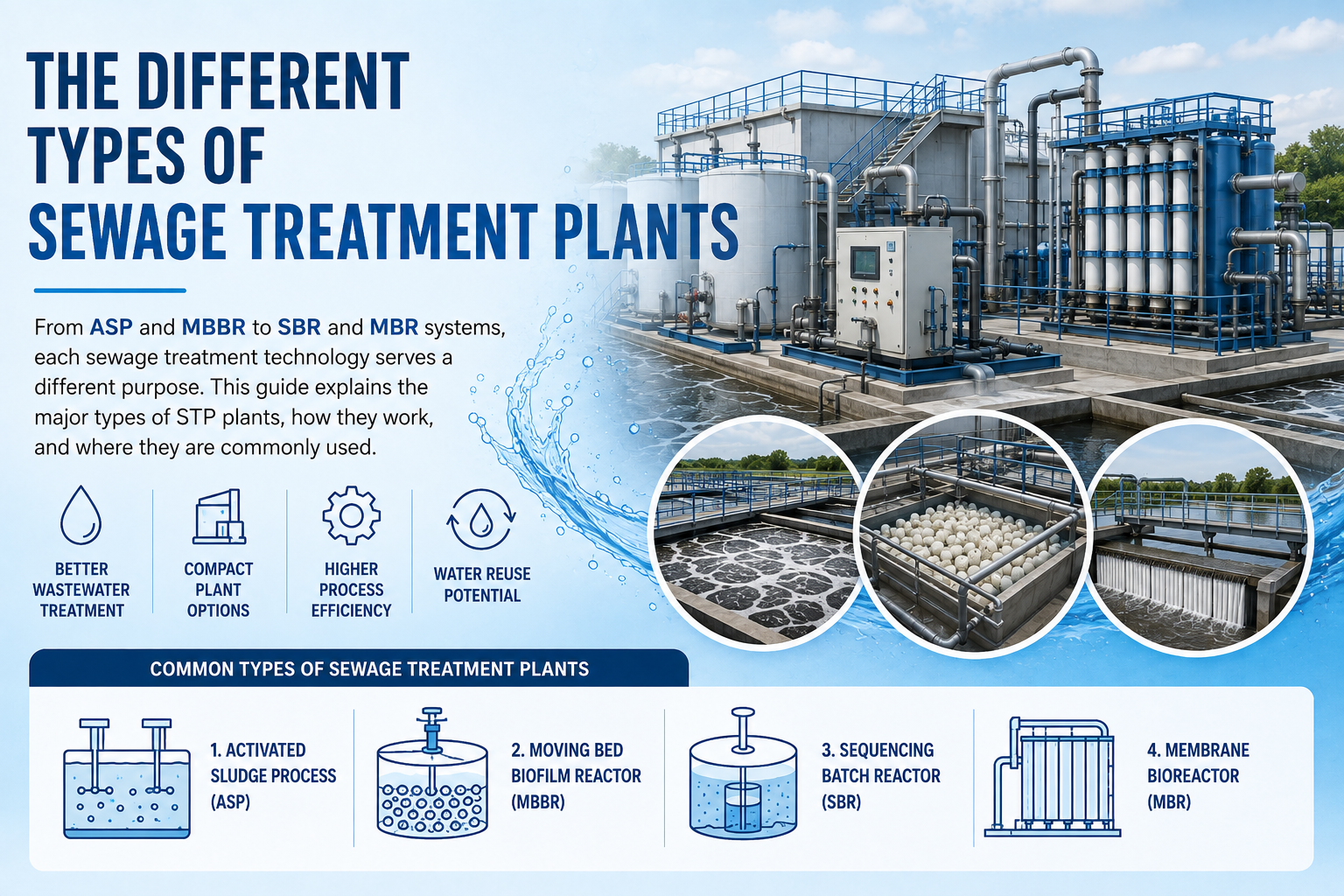
Choosing the right sewage treatment plant is not simply a matter of selecting a system based on capacity. Different types of sewage treatment plants use different biological and physical treatment processes, and the right choice depends on wastewater characteristics, available space, treatment goals, operating conditions, maintenance requirements and the intended reuse or discharge of treated water.
Common STP technologies include Activated Sludge Process (ASP), Moving Bed Biofilm Reactor (MBBR), Sequencing Batch Reactor (SBR) and Membrane Bioreactor (MBR). Each technology has its own advantages and is suitable for different residential, commercial, institutional and industrial applications.
Understanding how these types of STP plants work can help facility owners, consultants, developers and operations teams make a more informed wastewater-management decision.
What Is a Sewage Treatment Plant (STP)?
A Sewage Treatment Plant (STP) is a system designed to treat wastewater generated from toilets, bathrooms, kitchens and other domestic or commercial activities.
The objective is to remove contaminants such as suspended solids, biodegradable organic matter and other pollutants so that the treated water can meet the required quality for its intended discharge or reuse.
A typical sewage treatment process may involve:
- Preliminary screening
- Equalization
- Biological treatment
- Solid-liquid separation
- Filtration
- Disinfection
- Sludge handling
- Treated-water storage or reuse
The exact process varies according to the STP technology selected.
What Are the Main Types of Sewage Treatment Plants?
There is no single sewage treatment technology that is ideal for every facility. The most appropriate system depends on wastewater flow, pollutant load, available area, treatment objectives and operational requirements.
Some of the most commonly used types of sewage treatment plants are:
1. Activated Sludge Process (ASP) Sewage Treatment Plant
The Activated Sludge Process, commonly known as ASP, is one of the established biological wastewater treatment methods.
In an ASP system, sewage enters an aeration tank where microorganisms break down biodegradable organic matter in the presence of oxygen. The wastewater then moves to a secondary clarifier, where biological solids settle and treated water is separated.
Part of the settled sludge is typically returned to maintain an active microbial population in the biological process.
ASP may be suitable for:
- Large residential developments
- Municipal wastewater applications
- Institutional facilities
- Facilities with relatively stable wastewater flows
Key consideration: ASP performance depends heavily on maintaining suitable biological conditions, aeration and sludge management.
2. MBBR Sewage Treatment Plant
A Moving Bed Biofilm Reactor (MBBR) sewage treatment plant uses specially designed plastic media inside an aeration tank.
Beneficial microorganisms grow as a biofilm on these carriers. As the media continuously moves through the wastewater, microorganisms come into contact with organic pollutants and biologically degrade them.
The large surface area provided by the media enables a significant amount of biomass to remain within the treatment system.
MBBR STP technology can be considered for:
- Residential societies
- Hotels and resorts
- Hospitals
- Educational institutions
- Commercial buildings
- Industrial facilities generating domestic sewage
What Are the Advantages of MBBR STP Technology?
Some potential advantages of an MBBR sewage treatment plant include:
- Compact biological treatment
- Ability to handle variations in wastewater load
- High concentration of active biomass
- Relatively simple biological process
- Suitable for upgrading or revamping certain existing STPs
- Can be combined with downstream filtration and disinfection for reuse applications
The final system configuration should, however, be designed according to actual inlet characteristics and required treated-water quality.
3. SBR Sewage Treatment Plant
A Sequencing Batch Reactor (SBR) performs biological treatment and settling in a time-controlled sequence.
Unlike conventional continuous-flow processes, SBR treatment generally occurs through cycles within a reactor.
Typical stages include:
Fill → React → Settle → Decant
During the react stage, aeration supports biological treatment. Aeration then stops, allowing solids to settle. Treated water is subsequently decanted before the next cycle begins.
SBR sewage treatment plants are commonly considered for:
- Housing developments
- Commercial complexes
- Hotels
- Hospitals
- Institutional campuses
- Municipal sewage treatment
What Are the Advantages of SBR Sewage Treatment Plants?
SBR technology can offer:
- Biological treatment and clarification within a controlled process
- Flexible operating cycles
- Good process control when properly automated
- Reduced requirement for separate secondary clarification in many configurations
- Adaptability to varying wastewater conditions
Because the system operates in cycles, proper controls, instrumentation and operator understanding are important for reliable performance.
4. MBR Sewage Treatment Plant
A Membrane Bioreactor (MBR) combines biological wastewater treatment with membrane filtration.
Instead of relying only on conventional settling to separate treated water from biological solids, membranes provide a physical separation barrier.
This allows MBR systems to produce high-quality treated water and maintain a high biomass concentration within the biological process.
Where Is MBR Technology Used?
An MBR sewage treatment plant can be considered where:
- Space is limited
- High-quality treated water is required
- Water reuse is a priority
- Conventional clarification is difficult
- Consistent treated-water quality is important
Applications may include premium residential developments, hospitals, hotels, commercial facilities and projects with stringent reuse requirements.
What Are the Advantages of MBR STP Technology?
Potential advantages include:
- High-quality treated effluent
- Compact footprint
- Excellent solid-liquid separation
- High biomass concentration
- Strong potential for treated-water reuse
However, membrane systems require appropriate pretreatment, monitoring, membrane cleaning and planned maintenance. Capital and operating requirements therefore need to be evaluated against the project’s water-quality objectives.
MBBR vs SBR vs MBR vs ASP: Which STP Technology Is Better?
There is no universally “best” sewage treatment plant technology. Each technology addresses different project conditions.
| Factor | ASP | MBBR | SBR | MBR |
| Biological Process | Suspended growth | Attached biofilm | Batch biological treatment | Biological + membrane |
| Space Requirement | Generally higher | Compact | Compact | Very compact |
| Process Control | Moderate | Moderate | Higher automation | Advanced |
| Treated Water Quality | Good with proper treatment | Good with polishing | High when properly operated | Very high |
| Load Variation Handling | Moderate | Good | Good | Good |
| Maintenance Complexity | Moderate | Moderate | Moderate | Higher |
| Water Reuse Potential | Requires polishing | Good with tertiary treatment | Good with tertiary treatment | Excellent |
| Typical Application | Larger conventional plants | Residential/commercial | Residential/commercial | High-quality reuse |
The correct comparison should always be based on actual wastewater data rather than technology name alone.
How Do You Choose the Right Sewage Treatment Plant Technology?
Selecting the correct STP technology for your facility requires an engineering assessment.
1. Calculate Daily Sewage Generation
The first step is determining how much wastewater the facility generates.
An STP that is significantly undersized may become overloaded, while inappropriate oversizing can also create operational challenges.
Design should consider both average and peak wastewater conditions.
2. Analyse Inlet Wastewater Characteristics
Treatment technology should be selected after understanding relevant wastewater parameters.
Depending on the project, these can include:
- pH
- BOD
- COD
- TSS
- Oil and grease
- Nutrient concentrations
- Flow variations
Actual testing and project-specific engineering provide a stronger basis for design than assumptions alone.
3. Determine the Required Treated-Water Quality
Ask an important question:
What will happen to the water after treatment?
The answer can significantly influence STP design.
Treated sewage may potentially be intended for uses such as landscaping, flushing, cooling or other suitable non-potable applications, subject to applicable requirements and appropriate treatment.
Higher reuse-quality requirements may require tertiary treatment such as filtration and disinfection or more advanced treatment technologies.
4. Evaluate Available Space
Space can be a major constraint, particularly in:
- Commercial developments
- Hotels
- Hospitals
- Urban residential projects
- Existing facilities undergoing STP upgrades
Compact technologies such as MBBR, SBR or MBR may therefore be considered where footprint is an important design factor.
5. Consider Operation and Maintenance Requirements
A sewage treatment plant is not a “install and forget” system.
Its long-term performance depends on:
- Routine monitoring
- Equipment maintenance
- Biological process management
- Sludge handling
- Pump and blower maintenance
- Filter cleaning
- Instrument calibration
- Membrane maintenance where applicable
A technology that performs well on paper may not be appropriate if the facility cannot provide the required operational support.
6. Evaluate Lifecycle Cost, Not Just STP Installation Cost
The lowest initial quotation does not necessarily represent the lowest long-term cost.
Facility owners should consider:
Capital Cost + Electricity + Chemicals + Maintenance + Consumables + Sludge Management + Replacement Costs
This gives a more realistic understanding of the sewage treatment plant’s lifecycle cost.
Which STP Technology Is Suitable for Different Facilities?
STP for Residential Societies
Residential developments typically require a system capable of handling domestic sewage and variations between peak and low-flow periods.
Depending on project conditions, MBBR or SBR sewage treatment plants may be considered because of their compact configuration and adaptability.
STP for Hotels and Resorts
Hotels may experience fluctuations in wastewater generation depending on occupancy, events and seasonal demand.
The selected STP should therefore be designed around realistic occupancy patterns and wastewater characteristics rather than only the maximum room count.
STP for Hospitals
Hospital projects require careful wastewater assessment and appropriate treatment design.
The STP should be selected according to actual sewage characteristics, applicable regulatory requirements, reuse objectives and facility-specific conditions.
STP for Commercial Buildings
Office buildings, IT parks, shopping complexes and other commercial developments often have limited utility space.
Compact STP technologies such as MBBR, SBR or MBR may be evaluated depending on capacity, treatment objectives and available footprint.
STP for Educational Institutions
Schools, colleges and institutional campuses can experience significant variations in sewage generation based on operating hours, holidays and occupancy.
The STP design should therefore consider these changing load patterns.
Can an Existing Sewage Treatment Plant Be Upgraded?
Yes. An inefficient or outdated STP does not always need to be completely replaced.
Depending on the condition of the existing civil structures and equipment, an STP revamping or upgrading project may involve:
- Improving aeration
- Replacing inefficient pumps or blowers
- Adding or modifying biological treatment
- Upgrading control panels and automation
- Improving filtration
- Adding disinfection
- Optimizing sludge handling
- Increasing treatment efficiency
- Modifying the plant for improved water reuse
A detailed performance assessment should be carried out before deciding whether revamping or complete replacement is the better option.
Why Choosing the Right STP Technology Matters
The performance of a sewage treatment plant depends on much more than installing tanks and equipment.
A properly engineered wastewater treatment system can help a facility:
- Treat sewage effectively
- Improve treated-water consistency
- Support water reuse
- Reduce freshwater demand where reuse is feasible
- Manage wastewater more responsibly
- Improve long-term plant reliability
- Meet project-specific treatment objectives
Poor technology selection, on the other hand, can result in odour, inconsistent outlet quality, excessive sludge, high operating costs and repeated maintenance issues.
Bluewatt Ventures: Customized Sewage Treatment Solutions
Every wastewater-treatment project has different requirements.
Bluewatt Ventures LLP provides customized solutions for sewage treatment, wastewater treatment, effluent treatment and water treatment applications. Rather than treating STP selection as a one-size-fits-all decision, the system should be engineered around wastewater characteristics, capacity, site conditions, available space and the required treated-water quality.
For new STP projects as well as revamping of existing STP/ETP systems, selecting the appropriate technology and designing the complete treatment process are essential for reliable long-term performance.
Frequently Asked Questions About Types of Sewage Treatment Plants
1. What are the main types of sewage treatment plants?
Common types of sewage treatment plants include Activated Sludge Process (ASP), Moving Bed Biofilm Reactor (MBBR), Sequencing Batch Reactor (SBR) and Membrane Bioreactor (MBR). The appropriate technology depends on wastewater characteristics, capacity, space and required outlet-water quality.
2. Which sewage treatment plant technology is best?
There is no single STP technology that is best for every project. MBBR, SBR, MBR and ASP have different advantages. A wastewater assessment and engineering evaluation should be completed before selecting a technology.
3. What is the difference between MBBR and SBR?
MBBR uses moving carrier media on which microorganisms grow as a biofilm, while SBR treats sewage through controlled batch cycles involving filling, biological reaction, settling and decanting.
4. Is MBBR suitable for residential societies?
MBBR can be suitable for residential sewage treatment because it provides compact biological treatment and can handle variations in organic loading. Final suitability depends on capacity, inlet sewage characteristics, outlet requirements and system design.
5. What is the difference between MBR and MBBR?
MBBR primarily uses biofilm carriers for biological treatment, whereas MBR combines biological treatment with membrane filtration. MBR can provide higher-quality solid-liquid separation but generally involves more advanced membrane operation and maintenance.
6. Can STP-treated water be reused?
Treated sewage can potentially be reused for suitable non-potable purposes such as flushing and landscaping when the treatment process achieves the necessary water quality and applicable requirements are satisfied.
7. How do I select the correct STP capacity?
STP capacity should be determined from expected wastewater generation, occupancy, operating patterns, peak flows and relevant project design requirements. Capacity should not be selected purely from a generic building-size estimate.
8. Can an old sewage treatment plant be upgraded?
Yes. Existing STPs can often be revamped by improving biological treatment, aeration, filtration, automation, equipment, disinfection and sludge management. A technical audit should determine whether upgrading or replacement is more practical.
9. What factors affect the cost of a sewage treatment plant?
STP cost depends on plant capacity, technology, inlet wastewater quality, civil requirements, equipment, automation, tertiary treatment, treated-water requirements and operation and maintenance needs.
10. How often does an STP require maintenance?
STPs require ongoing monitoring and scheduled preventive maintenance. Pumps, blowers, screens, filters, biological processes, sludge systems, instrumentation and other components should be inspected and serviced according to the plant design and equipment manufacturers’ recommendations.
Conclusion
Understanding the different types of sewage treatment plants is the first step toward selecting an efficient wastewater-management solution.
ASP, MBBR, SBR and MBR sewage treatment plants each offer different advantages. The right technology depends on sewage characteristics, daily capacity, available space, required treated-water quality, reuse objectives, operating capability and lifecycle cost.
Instead of asking, “Which STP technology is the best?”, facility owners should ask:
“Which sewage treatment technology is best suited to our wastewater, site conditions and long-term requirements?”
A project-specific assessment can help answer that question and lead to a sewage treatment plant that is reliable, maintainable and appropriate for the facility.