
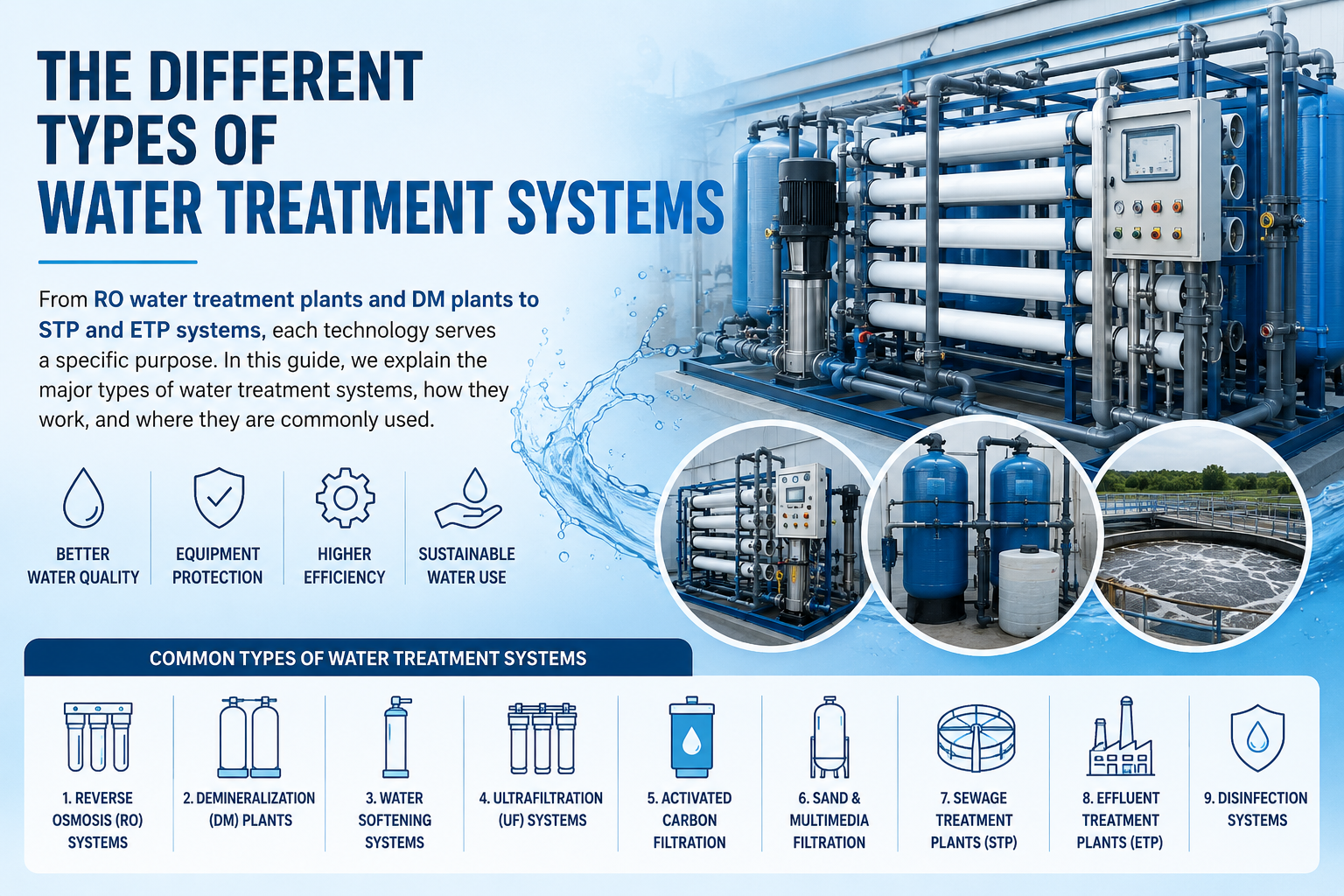
Water quality requirements are different for every application. The water required by a manufacturing plant may need a completely different treatment process from water used in a hotel, hospital, commercial building or residential complex. This is why understanding the different types of water treatment systems is important before selecting a treatment solution.
Modern water treatment systems are designed to remove suspended solids, dissolved salts, hardness, microorganisms, organic matter and other unwanted contaminants depending on the quality of the source water and its intended use.
From RO water treatment plants and DM plants to STP and ETP systems, each technology serves a specific purpose. In this guide, we explain the major types of water treatment systems, how they work, and where they are commonly used.
What Is a Water Treatment System?
A water treatment system is a combination of physical, chemical and/or biological processes used to improve water quality for a specific purpose.
Depending on the application, a water treatment plant may be designed to make water suitable for:
- Industrial processes
- Boiler and cooling tower feed
- Drinking and general utility purposes
- Manufacturing operations
- Hotels and hospitals
- Commercial buildings
- Residential complexes
- Wastewater reuse
- Irrigation and landscaping
The right water treatment solution depends on several factors, including the source of water, contaminant levels, required output quality, daily water demand and intended application.
What Are the Different Types of Water Treatment Systems?
Some of the most commonly used types of water treatment systems include:
- Reverse Osmosis (RO) systems
- Demineralization (DM) plants
- Water softening systems
- Ultrafiltration (UF) systems
- Activated carbon filtration
- Sand and multimedia filtration
- Sewage Treatment Plants (STP)
- Effluent Treatment Plants (ETP)
- Disinfection systems
Each water treatment technology addresses a different water-quality challenge.
1. Reverse Osmosis (RO) Water Treatment System
A Reverse Osmosis water treatment system, commonly known as an RO plant, uses a semi-permeable membrane to separate many dissolved salts and other contaminants from water.
How Does an RO Water Treatment Plant Work?
Water is pressurized and passed through RO membranes. The membrane allows treated water to pass while rejecting a significant portion of dissolved salts and other impurities.
Pre-treatment is usually provided before the RO membranes to help control suspended solids, hardness, chlorine and membrane fouling.
Where Are RO Water Treatment Systems Used?
RO water treatment plants are commonly used in:
- Manufacturing industries
- Pharmaceutical facilities
- Food and beverage plants
- Hotels and resorts
- Hospitals
- Commercial buildings
- Boiler feed pre-treatment
- Process-water applications
- Drinking-water systems
Industrial RO systems are particularly useful when the source water has elevated dissolved solids and the process requires better-quality water.
2. Demineralization (DM) Plant
A Demineralization Plant or DM plant is designed to remove dissolved ionic minerals from water.
DM plants typically use ion-exchange technology to remove positively and negatively charged ions, producing water with very low mineral content when appropriately designed and operated.
Where Are DM Plants Used?
DM water treatment systems are commonly used for:
- High-pressure boilers
- Power plants
- Pharmaceutical manufacturing
- Chemical industries
- Process industries
- Laboratories
- Steam generation
- Industrial manufacturing processes
RO Plant vs DM Plant
An RO plant uses membrane separation to reduce dissolved contaminants, whereas a DM plant primarily uses ion-exchange processes to remove dissolved ions.
In some industrial applications, RO and DM systems can be used together to achieve the required final water quality while optimizing the overall treatment process.
3. Water Softening System
Hard water contains minerals, particularly calcium and magnesium, that can cause scale formation.
A water softening system typically uses ion-exchange resin to replace hardness-causing calcium and magnesium ions with sodium ions.
Where Are Water Softeners Used?
Water softening systems are commonly installed in:
- Hotels
- Hospitals
- Laundries
- Residential complexes
- Commercial buildings
- Boiler-feed systems
- Cooling systems
- Manufacturing facilities
Reducing hardness can help control scale formation in pipelines, heat exchangers, boilers and other equipment.
4. Ultrafiltration (UF) System
Ultrafiltration or UF is a membrane-based water treatment process used primarily to remove suspended particles, colloids and many microorganisms.
Unlike RO, UF is generally not intended to remove most dissolved salts.
Where Are UF Water Treatment Systems Used?
UF systems can be used for:
- RO pre-treatment
- Industrial process water
- Wastewater recycling
- Food and beverage processing
- Commercial water treatment
- Surface-water treatment
UF can also improve the consistency of water supplied to downstream treatment processes.
5. Activated Carbon Filtration System
An activated carbon filter uses highly porous carbon media to adsorb certain organic compounds and reduce chlorine, colour, taste and odour depending on the water chemistry and system design.
Where Are Activated Carbon Filters Used?
Activated carbon filtration is commonly found in:
- RO pre-treatment systems
- Drinking-water treatment
- Food and beverage industries
- Hotels and restaurants
- Commercial buildings
- Industrial process-water systems
Activated carbon filters are frequently one stage of a larger water purification system rather than a complete treatment solution on their own.
6. Sand and Multimedia Filtration Systems
Sand filters and multimedia filters are among the most widely used physical water treatment systems.
These filters pass water through layers of selected filtration media to reduce suspended particles and turbidity.
Where Are Sand Filters Used?
Sand and multimedia filtration systems are commonly used for:
- Industrial water treatment
- Pre-treatment before RO
- Swimming pools
- Commercial water systems
- Process-water treatment
- STP tertiary treatment
- ETP treatment systems
They are often installed as an initial treatment stage before more advanced membrane or chemical treatment.
7. Sewage Treatment Plant (STP)
A Sewage Treatment Plant (STP) treats domestic wastewater generated from toilets, bathrooms, kitchens and other sanitary activities.
STP treatment generally involves a combination of physical and biological processes followed by clarification and, where required, tertiary treatment and disinfection.
Where Are Sewage Treatment Plants Used?
STPs are commonly installed at:
- Residential societies
- Apartment complexes
- Hotels and resorts
- Hospitals
- Shopping malls
- Educational institutions
- IT parks
- Commercial complexes
- Industrial facilities with domestic sewage generation
Properly treated sewage can potentially be reused for suitable non-potable applications such as landscaping, flushing or certain utility purposes, subject to applicable water-quality and regulatory requirements.
8. Effluent Treatment Plant (ETP)
An Effluent Treatment Plant (ETP) is designed to treat wastewater generated from industrial processes.
Unlike domestic sewage, industrial effluent can vary significantly depending on the industry, raw materials, production process and chemicals used.
Therefore, industrial wastewater treatment systems often need to be customized according to the characteristics of the incoming effluent.
Where Are ETP Systems Used?
ETP plants are commonly required in industries such as:
- Chemical manufacturing
- Pharmaceutical manufacturing
- Food processing
- Textile industries
- Engineering industries
- Automobile and component manufacturing
- Surface treatment industries
- Manufacturing facilities
An appropriately designed ETP helps reduce contaminants in industrial wastewater before discharge, reuse or further treatment.
9. Water Disinfection Systems
Disinfection is used to control harmful microorganisms in treated water.
Common water-disinfection technologies include:
UV Disinfection
Ultraviolet light is used to inactivate microorganisms without adding disinfecting chemicals directly to the water.
Chlorination
Chlorine-based chemicals are used for microbial control and can provide a residual disinfectant effect.
Ozonation
Ozone is a strong oxidizing agent used in selected water and wastewater treatment applications.
Disinfection is commonly used as a final treatment stage in drinking-water systems, STPs, wastewater-reuse systems and various commercial and industrial applications.
STP vs ETP vs WTP: What Is the Difference?
Understanding the difference between STP, ETP and WTP systems makes selecting the appropriate treatment solution easier.
| System | Full Form | Main Purpose | Common Applications |
| WTP | Water Treatment Plant | Treats raw/source water for a required use | Industries, hotels, hospitals, commercial facilities |
| STP | Sewage Treatment Plant | Treats domestic sewage | Societies, hotels, hospitals, malls, institutions |
| ETP | Effluent Treatment Plant | Treats industrial wastewater | Manufacturing and process industries |
| RO | Reverse Osmosis | Reduces dissolved salts and contaminants | Industrial and commercial water treatment |
| DM Plant | Demineralization Plant | Removes dissolved ionic minerals | Boilers, power, pharma and process industries |
The correct system should therefore be selected based on what is present in the water and what water quality is required after treatment, rather than simply selecting a technology by name.
How to Choose the Right Water Treatment System
Choosing an appropriate water treatment system starts with understanding both the incoming water and the required treated-water quality.
1. Test the Source Water
A water analysis can identify parameters such as:
- pH
- TDS
- Hardness
- Turbidity
- Suspended solids
- Chlorides
- Iron
- Organic contamination
- Microbiological contamination
For wastewater, additional parameters such as BOD, COD and TSS may also need to be evaluated.
2. Define the Required Water Quality
The treatment process should be selected according to the final application.
For example, water used for landscaping does not require the same quality as water used for a high-pressure boiler or sensitive industrial manufacturing process.
3. Determine Treatment Capacity
The required plant capacity should consider daily consumption, peak demand, operating hours and future requirements.
4. Consider Operating and Maintenance Requirements
A good industrial water treatment system should be evaluated not only on installation cost but also on:
- Energy consumption
- Chemical consumption
- Membrane and media replacement
- Sludge generation
- Operator requirements
- Maintenance frequency
- System reliability
- Water recovery
5. Consider Water Reuse Opportunities
Where technically and legally appropriate, treated wastewater can be reused for non-potable applications.
This can help facilities reduce freshwater consumption and support more sustainable water-management practices.
Which Water Treatment System Is Best for Industrial Applications?
There is no single water treatment technology that is best for every industry.
An industrial facility may require a combination such as:
Raw Water → Filtration → Softener → RO → DM Plant
Another facility dealing with industrial wastewater may require:
Collection → Equalization → Chemical Treatment → Biological Treatment → Clarification → Filtration → Reuse/Discharge
The appropriate configuration depends on the source-water characteristics, process requirements, wastewater composition, required treated-water quality and applicable regulations.
This is why professional water testing and engineering evaluation should be completed before finalizing an industrial water treatment plant.
Benefits of Choosing the Right Water Treatment System
A properly designed and maintained water treatment system can help organizations:
- Improve treated-water quality
- Reduce scaling and fouling
- Protect process equipment
- Improve operational reliability
- Reduce unnecessary freshwater consumption
- Enable appropriate wastewater reuse
- Support environmental compliance
- Improve long-term water-management efficiency
The goal should not simply be to install a water treatment plant—it should be to develop a treatment system that consistently delivers the water quality required by the application.
Water Treatment Solutions from Bluewatt Ventures
Bluewatt Ventures provides customized water and wastewater treatment solutions for industrial, commercial and institutional requirements.
Our solutions include water treatment and wastewater-management systems such as STP, ETP and RO plants, designed around application requirements, water characteristics, performance and sustainable water management.
Rather than following a one-size-fits-all approach, the treatment process should be selected according to the source water, required output quality, capacity and intended use.
If you are planning a new water treatment plant, STP, ETP, RO plant or industrial wastewater treatment system, a detailed assessment can help identify the appropriate treatment technology and plant configuration.
Frequently Asked Questions About Water Treatment Systems
1. What are the main types of water treatment systems?
The main types of water treatment systems include RO systems, DM plants, water softeners, ultrafiltration systems, activated carbon filters, sand and multimedia filters, sewage treatment plants (STPs), effluent treatment plants (ETPs) and disinfection systems. The right technology depends on the source water and required treated-water quality.
2. What is the difference between STP, ETP and WTP?
A WTP treats raw or source water to achieve a required quality. An STP treats domestic sewage from toilets, kitchens and sanitary activities. An ETP treats wastewater generated by industrial processes.
3. Which water treatment system is best for industries?
There is no universal system for every industry. RO, DM, softening, filtration, UF, ETP or combinations of these technologies may be required depending on source-water quality, manufacturing processes and required output quality.
4. What is an industrial RO water treatment plant?
An industrial RO plant uses membrane technology to reduce dissolved salts and various contaminants from water. It is commonly used for process water, boiler-feed pre-treatment and other industrial applications requiring controlled water quality.
5. What is the difference between RO and water softening?
A water softener primarily reduces hardness caused by calcium and magnesium. An RO system reduces a broader range of dissolved salts and contaminants. Their purposes are different, and in some applications both technologies are used together.
6. Can treated wastewater be reused?
Yes. Depending on the treatment level, water quality and applicable regulations, treated wastewater may be reused for applications such as landscaping, toilet flushing, cooling and selected industrial utility processes.
7. How do I select the right water treatment plant capacity?
Plant capacity should be determined by daily water consumption or wastewater generation, peak demand, operating hours, expected variations and future requirements. A technical assessment is recommended before finalizing capacity.
8. Why is water testing important before selecting a treatment system?
Water testing identifies contaminants and water-quality parameters that determine which treatment technologies are required. Selecting equipment without understanding the incoming water quality can result in poor performance, excessive maintenance or unnecessary operating costs.
Conclusion
Understanding the different types of water treatment systems and where they are used is the first step toward selecting an efficient water-management solution.
RO plants are useful for reducing dissolved salts, DM plants provide highly demineralized water for demanding industrial applications, softeners control hardness, filtration systems remove suspended impurities, while STPs and ETPs address domestic and industrial wastewater respectively.
The best water treatment system is therefore not necessarily the most complex system. It is the system correctly designed for the incoming water quality, required output quality, treatment capacity and intended application.
For industries, commercial establishments, hospitals, hotels, residential projects and other facilities, a customized approach to water and wastewater treatment can improve reliability, resource efficiency and long-term plant performance.