
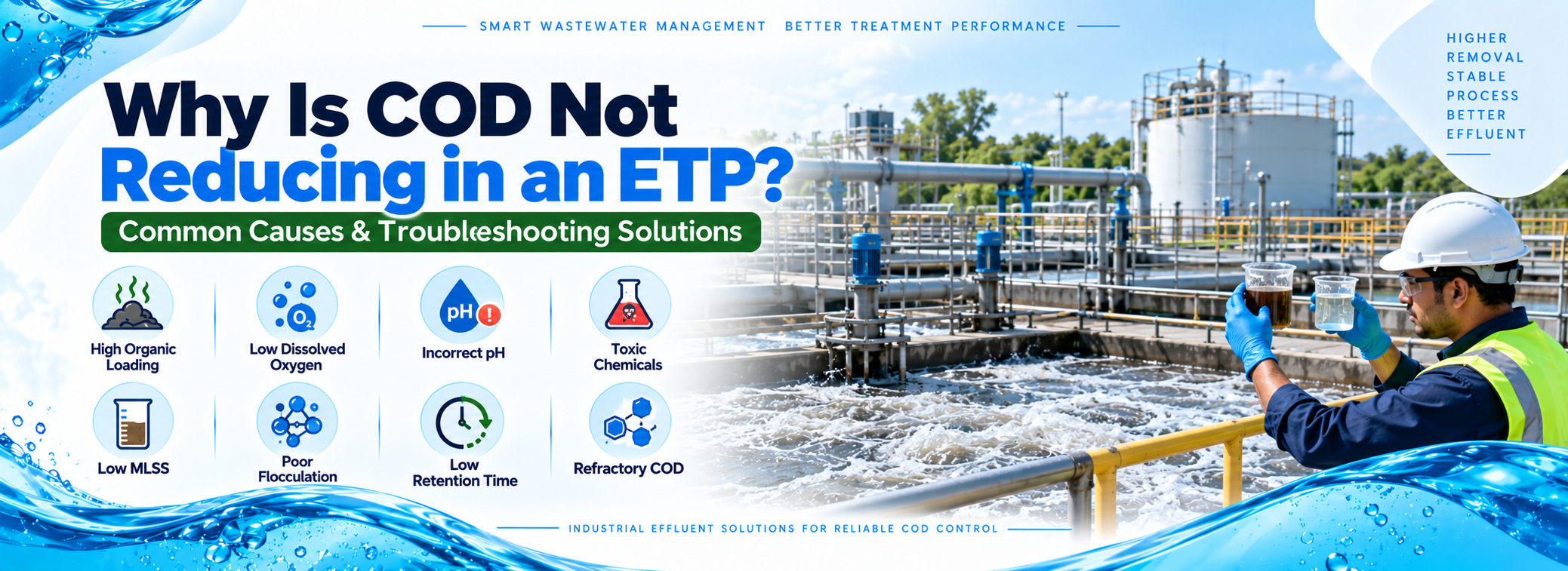
COD not reducing in ETP operations is a common wastewater treatment problem that can indicate excessive organic loading, poor biological activity, inadequate aeration, toxic industrial chemicals, ineffective pretreatment, or insufficient treatment time. When chemical oxygen demand (COD) remains high after treatment, the effluent treatment plant may struggle to meet its required discharge or reuse quality.
Chemical oxygen demand is an important parameter used to evaluate the amount of chemically oxidizable material present in wastewater. It helps operators monitor pollutant loading and assess treatment performance.
An ETP may continue running while delivering poor COD removal. Identifying the actual cause requires examining influent characteristics, treatment stages, operating parameters, and laboratory results.
Quick Answer: Why is COD not reducing in an ETP?
COD may not reduce adequately in an effluent treatment plant because of excessive influent loading, poor pH control, insufficient dissolved oxygen, unhealthy biomass, toxic wastewater, inadequate hydraulic retention time, or poorly performing chemical treatment. Some wastewater also contains refractory organic compounds that conventional biological treatment cannot remove effectively. The solution depends on identifying whether the remaining COD is biodegradable, particulate, or difficult to treat.
What Is COD in an Effluent Treatment Plant?
Chemical Oxygen Demand (COD) measures the oxygen equivalent required to chemically oxidize substances in wastewater under specified test conditions.
COD is expressed in milligrams per litre (mg/L) and is widely used to assess industrial wastewater pollution and treatment performance.
Why Is COD Reduction Important in an ETP?
Effective COD removal helps industries:
- Reduce the pollutant load in treated wastewater.
- Evaluate biological and chemical treatment performance.
- Maintain stable wastewater treatment operations.
- Meet applicable discharge or reuse requirements.
- Identify changes in industrial wastewater characteristics.
Unlike BOD, which measures biologically consumed oxygen under defined test conditions, COD includes a wider range of chemically oxidizable substances. A high COD value does not necessarily mean all pollutants are biodegradable.
EPA NERL
What Are the Main Causes of COD Not Reducing in an ETP?
- Excessive Organic Loading
When wastewater enters an ETP with a higher COD load than the system was designed to handle, treatment efficiency may decrease.
Sudden increases can occur because of production changes, cleaning operations, chemical discharges, or concentrated wastewater batches.
Common signs: Increasing inlet COD, high aeration demand, and unstable outlet COD.
Recommended solution: Monitor both wastewater flow and COD concentration. Use equalization and controlled feeding where appropriate to reduce shock loading.
- Insufficient Dissolved Oxygen in the Aeration Tank
Aerobic microorganisms require oxygen to break down biodegradable pollutants.
When dissolved oxygen (DO) becomes insufficient, biological oxidation may slow down, leaving higher residual COD.
Potential causes include blower problems, clogged diffusers, excessive organic loading, and poor aeration control.
Recommended solution: Measure DO at representative locations and operating times. Check blowers, diffusers, mixing, and actual oxygen demand. Maintain the DO range specified for the treatment process rather than relying on a universal setting.
- Incorrect pH Levels
Biological treatment depends on suitable pH conditions.
Highly acidic or alkaline wastewater can inhibit microbial activity and affect chemical treatment performance.
Recommended solution: Monitor influent and biological reactor pH. Identify the source of pH fluctuations and optimize neutralization before biological treatment.
Chemical dosing must follow approved operating procedures.
- Toxic Chemicals Inhibiting Microorganisms
Industrial effluent may contain solvents, heavy metals, disinfectants, pesticides, or other compounds that inhibit biological treatment.
A sudden toxic discharge can reduce microbial activity and cause a rapid increase in outlet COD.
Recommended solution: Investigate changes in industrial processes and chemical usage. Conduct suitable toxicity or respirometry testing and implement source control or pretreatment where required.
The US EPA’s industrial wastewater guidance recognizes that toxic materials may inhibit biological treatment and sometimes require pretreatment.
EPA NERL
+1
- Low MLSS or Unhealthy Biomass
Mixed Liquor Suspended Solids (MLSS) represents the suspended solids concentration in the biological reactor, including microorganisms.
If the active biomass is insufficient for the applied organic load, COD removal may decline.
Possible reasons include excessive sludge wasting, biomass washout, poor settling, or toxic shock.
Recommended solution: Review MLSS, MLVSS, sludge age, sludge settling, and food-to-microorganism ratio (F/M). Adjust sludge management based on the process design and operating data.
- Insufficient Hydraulic Retention Time
Hydraulic Retention Time (HRT) is the average time wastewater remains in a treatment tank.
When flow exceeds the design capacity, wastewater may pass through the system without sufficient treatment time.
Short-circuiting within tanks can also reduce effective contact time.
Recommended solution: Verify actual flow, effective tank volume, and hydraulic conditions. Review equalization capacity and investigate short-circuiting.
- Poor Coagulation and Flocculation
Some ETPs use chemical treatment to remove suspended, colloidal, or emulsified pollutants.
Incorrect coagulant dosage, unsuitable pH, poor mixing, or ineffective floc formation may leave COD-bearing particles in the treated water.
Recommended solution: Conduct jar tests to determine appropriate chemicals, pH, mixing conditions, and dosage.
Chemical treatment is not equally effective for every type of dissolved COD.
- Non-Biodegradable or Refractory COD
Certain industrial wastewaters contain compounds that are difficult for conventional microorganisms to degrade.
These may include specific dyes, complex organic chemicals, and persistent industrial compounds.
If most biodegradable material has already been removed, the remaining COD may not respond significantly to additional aeration.
Recommended solution: Measure soluble COD and evaluate biodegradability. Consider adsorption, advanced oxidation, membrane processes, or other suitable treatment technologies based on treatability testing.
The US EPA’s Industrial Wastewater Treatment Technology Database identifies biological treatment, adsorption, and advanced oxidation as distinct treatment options for different wastewater contaminants.
US EPA
- Poor Sludge Settling and Solids Carryover
Even when biological treatment removes dissolved organic matter effectively, poor clarification can increase final effluent COD.
Suspended biological solids contribute to measured total COD.
Recommended solution: Inspect sludge settling, sludge volume index (SVI), clarifier loading, return activated sludge (RAS), and sludge wasting.
Compare filtered and unfiltered COD to determine whether suspended solids are contributing to the problem.
- Incorrect COD Sampling or Laboratory Testing
Sometimes COD appears unusually high because of sampling or analytical errors.
Possible causes include unrepresentative samples, incorrect preservation, unsuitable test range, chloride interference, and poor laboratory quality control.
Recommended solution: Confirm sampling locations and timing, verify calibration, use suitable quality-control samples, and follow an approved COD testing method.
ETP COD Troubleshooting Chart
| Problem observed | Possible cause | Recommended action |
| Inlet COD suddenly increases | Production or wastewater shock load | Review source discharge and equalization |
| High COD with low DO | Insufficient aeration or excessive loading | Check oxygen supply and organic load |
| High COD with abnormal pH | Biological inhibition | Investigate and correct pH |
| COD rises after chemical discharge | Toxic inhibition | Identify source and assess toxicity |
| High COD with low active biomass | Biomass washout or excessive wasting | Review MLSS, MLVSS and SRT |
| High total COD but lower filtered COD | Suspended solids carryover | Inspect clarifier and sludge settling |
| High filtered COD after biological treatment | Refractory compounds or incomplete biodegradation | Conduct treatability assessment |
| Inconsistent COD results | Sampling or analytical problem | Verify laboratory procedures |
How to Troubleshoot COD Not Reducing in an ETP
A structured investigation can help operators identify which treatment stage is underperforming.
Step 1: Measure COD at Different Treatment Stages
Collect representative samples from the inlet, after primary treatment, after biological treatment, and at the final outlet.
This helps locate where COD removal is insufficient.
Step 2: Compare Total COD and Soluble COD
Total COD includes oxidizable substances associated with suspended solids.
Filtered COD provides an operational estimate of the soluble fraction, depending on the filtration method.
A large difference between total and filtered COD may indicate that solids separation requires attention.
Step 3: Review Biological Treatment Conditions
Check DO, pH, temperature, MLSS, MLVSS, SRT, and organic loading.
Step 4: Investigate Wastewater Composition
Review production changes, chemical discharges, BOD/COD relationships, and potential toxic substances.
Step 5: Evaluate Chemical Treatment
Perform jar testing where coagulation and flocculation are part of the ETP process.
Step 6: Review Hydraulic Performance
Verify flow rates, tank capacity, mixing, and potential short-circuiting.
Step 7: Conduct Treatability Testing
If COD remains high despite stable biological treatment, assess whether additional treatment is technically suitable.
How to Calculate COD Removal Efficiency in an ETP
COD removal efficiency is calculated as:
\[ \text{COD Removal (\%)}=\frac{COD_{\text{inlet}}-COD_{\text{outlet}}}{COD_{\text{inlet}}}\times100 \]
Example of ETP COD Removal Calculation
Suppose:
- Inlet COD = 1,200 mg/L
- Outlet COD = 300 mg/L
\[ \frac{1200-300}{1200}\times100=75\% \]
The ETP achieves 75% COD removal based on these measurements.
However, removal efficiency alone does not confirm regulatory compliance. An outlet COD of 300 mg/L may still exceed the applicable discharge limit.
For accurate process assessment, compare representative samples that account for hydraulic travel time, and examine COD mass loading as well as concentration.
How to Improve COD Removal Efficiency in an ETP
Maintain Stable Organic Loading
Use appropriate equalization to reduce sudden fluctuations in wastewater flow and pollutant concentration.
Optimize Aeration
Maintain adequate dissolved oxygen and proper mixing in biological reactors.
Maintain Healthy Biomass
Monitor sludge age, active biomass, and sludge wasting to support stable biological treatment.
Control Toxic Wastewater Discharges
Identify problematic chemicals and prevent untreated shock loads from reaching biological treatment.
Improve Primary Treatment
Optimize oil separation, coagulation, flocculation, and clarification where applicable.
Evaluate Advanced Treatment When Necessary
For difficult-to-degrade COD, consider treatability-tested options such as activated carbon adsorption, advanced oxidation, or membrane-based treatment.
Technology selection should account for wastewater composition, operating costs, residuals, and treatment objectives.
Monitor ETP Performance Regularly
Maintain operating records for COD, BOD, pH, DO, flow, MLSS, sludge settling, and chemical consumption.
Why Is COD Not Reducing Even When BOD Is Low?
A low BOD result with relatively high COD may indicate that much of the remaining oxidizable material is poorly biodegradable under the test conditions.
This can occur when biological treatment has already removed readily biodegradable substances, leaving more persistent compounds.
The BOD/COD ratio can provide an initial indication of biodegradability, but it is not a definitive treatability test.
Further analysis may be needed to identify the remaining pollutants and select a suitable treatment process.
Frequently Asked Questions About COD Reduction in ETP
- Why is COD not reducing in my ETP?
Common causes include excessive organic loading, insufficient oxygen, poor pH control, toxic wastewater, low active biomass, inadequate retention time, and refractory organic compounds.
- How can I reduce high COD in industrial wastewater?
Start by identifying whether COD is biodegradable, suspended, or refractory. Improve source control, biological treatment, solids separation, or advanced treatment according to the findings.
- Can low dissolved oxygen cause high COD?
Yes. In aerobic biological treatment, inadequate oxygen can slow the breakdown of biodegradable organic pollutants.
- Does pH affect COD removal?
Yes. Extreme pH conditions can inhibit microorganisms and reduce the effectiveness of certain chemical treatment processes.
- Can increasing aeration reduce COD?
It may help when oxygen is limiting biological treatment. Additional aeration will not necessarily remove refractory COD and may waste energy if oxygen supply is already sufficient.
- Why is COD high after biological treatment?
Possible causes include incomplete biodegradation, toxic inhibition, high organic loading, refractory compounds, or suspended solids escaping the clarifier.
- What is the difference between COD and BOD?
COD measures chemically oxidizable substances under defined test conditions, while BOD measures oxygen consumed biologically over a specified period.
- Can coagulation and flocculation reduce COD?
Yes, particularly when COD is associated with suspended, colloidal, or emulsified materials. Removal of truly dissolved compounds depends on their characteristics and the treatment chemistry.
- What is a good COD removal percentage for an ETP?
There is no universal percentage suitable for every ETP. Expected removal depends on wastewater composition, treatment technology, design capacity, and applicable discharge requirements.
- What should I check first when COD stops reducing?
Verify COD test results, influent loading, DO, pH, biomass condition, and treatment-stage performance. This helps determine whether the problem is biological, chemical, hydraulic, or analytical.
Conclusion: Improve ETP COD Removal by Identifying the Root Cause
COD not reducing in an ETP can result from excessive organic loading, inadequate aeration, unhealthy biomass, toxic compounds, ineffective chemical treatment, or insufficient treatment time.
In some cases, the remaining COD is difficult to biodegrade and requires a different treatment approach.
The most effective troubleshooting method is to examine COD removal across individual treatment stages and compare laboratory results with operating data.
Stable loading, proper aeration, effective solids separation, and regular monitoring can help improve treatment reliability.
Need Help With ETP Performance and Industrial Wastewater Treatment?
Reliable effluent treatment is essential for industrial operations, wastewater management, and environmental compliance.
Bluewatt provides a point of contact for businesses exploring effluent treatment and industrial wastewater management solutions.
Connect with Bluewatt through its official business channels to discuss your ETP requirements and treatment challenges.
- SEO, AEO and GEO publishing recommendations
Suggested internal links
Link this article to relevant published Bluewatt blogs covering ETP importance, common ETP problems, industrial wastewater treatment methods, STP versus ETP, and wastewater treatment plant maintenance.