
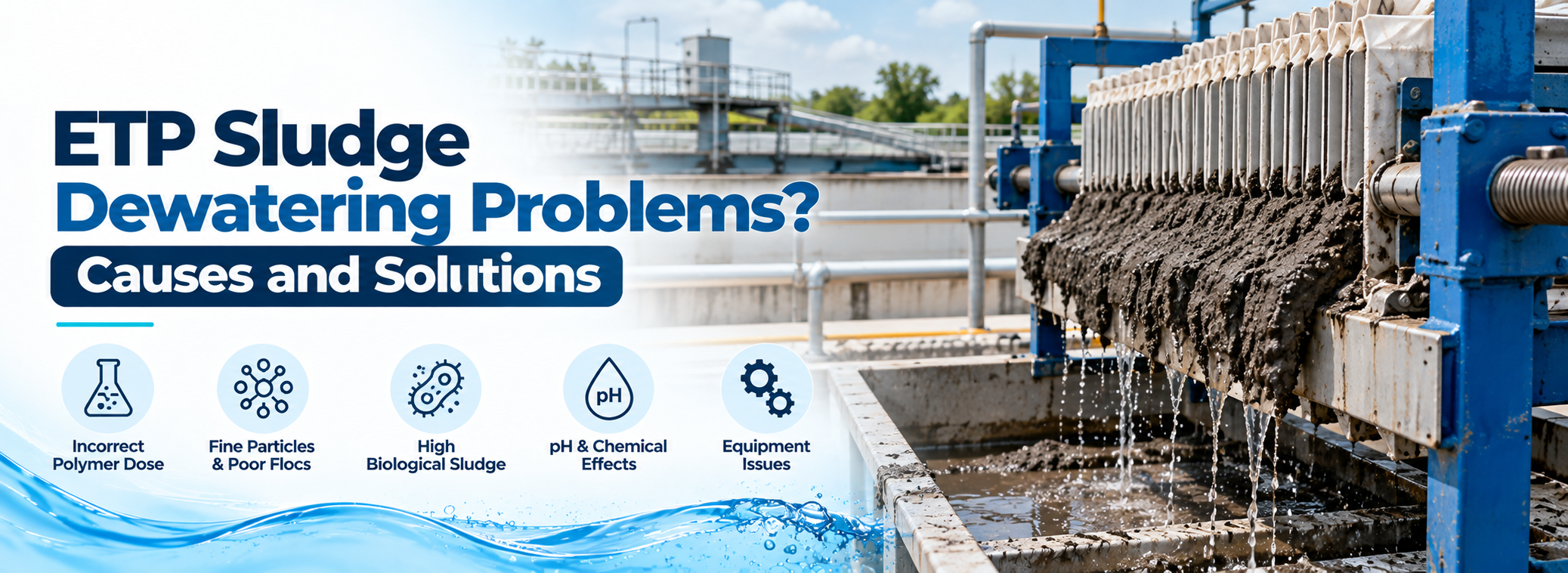
ETP sludge dewatering problems can increase sludge disposal costs, reduce treatment plant efficiency, and create difficulties in daily wastewater management. When sludge retains excessive water even after passing through a filter press, centrifuge, or other dewatering equipment, the problem may involve poor sludge conditioning, fine particles, excessive biological solids, unsuitable polymer dosing, or equipment-related issues.
Effluent Treatment Plants (ETPs) generate sludge during physical, chemical, and biological wastewater treatment. Before disposal or further treatment, this sludge is often thickened and dewatered to reduce its volume and moisture content.
However, sludge does not always release water easily. Its dewaterability depends on the type of wastewater, treatment chemicals, biological conditions, particle characteristics, and mechanical separation process.
Understanding these factors helps ETP operators identify why sludge remains wet and select suitable corrective actions.
Quick Answer: Why does ETP sludge become difficult to dewater?
ETP sludge becomes difficult to dewater when fine particles, extracellular polymeric substances (EPS), poorly formed flocs, or unsuitable chemical conditioning prevent water from separating efficiently. Incorrect polymer dosage, high biological sludge content, inadequate thickening, and filter press or centrifuge problems can also reduce dewatering performance. The best solution is to evaluate sludge characteristics, optimize conditioning through testing, and verify equipment operating conditions.
What Is Sludge Dewatering in an ETP?
Sludge dewatering is the process of separating water from the solid waste generated during wastewater treatment.
ETP sludge may contain chemical precipitates, biological solids, suspended particles, oils, metals, and other industrial contaminants.
Common sludge dewatering equipment includes filter presses, belt filter presses, screw presses, and decanter centrifuges.
The purpose of dewatering is to increase sludge solids concentration, reduce the volume of material requiring handling, and make transportation or further treatment more manageable.
Why Is ETP Sludge Difficult to Dewater?
Sludge contains different forms of water:
- Free water: Water that separates relatively easily.
- Interstitial water: Water trapped between sludge particles.
- Bound water: Water associated more strongly with particles and biological materials.
Mechanical dewatering can remove much of the free and interstitial water, but strongly bound water is more difficult to separate.
ScienceDirect
+1
What Are the Main Causes of ETP Sludge Dewatering Problems?
- Incorrect Polymer Dosage
Polymers help small sludge particles combine into larger flocs, improving solid-liquid separation.
Insufficient polymer may produce weak flocs that break apart during filtration. Excessive polymer can also cause poor dewatering, sticky sludge, or unnecessarily high chemical consumption.
Recommended solution: Conduct jar tests or appropriate dewatering trials to determine the correct polymer type, preparation method, and dosage.
- High Biological Sludge Content
Biological sludge contains microbial cells and extracellular polymeric substances (EPS), including proteins and polysaccharides.
EPS helps microorganisms form flocs but can also retain water and make sludge more difficult to dewater.
Recommended solution: Evaluate sludge composition and biological operating conditions. Select conditioning methods suitable for biological sludge rather than relying on equipment pressure alone.
PubMed
- Fine Sludge Particles and Weak Floc Formation
Very fine particles may block filtration pathways and slow water separation.
Poorly formed flocs can also break apart during pumping or mixing.
Recommended solution: Review coagulation and flocculation performance, polymer selection, and mixing intensity.
- Excessive Sludge Feed Rate
A dewatering machine has a limited hydraulic and solids-handling capacity.
When sludge enters too quickly, the equipment may not provide sufficient time or separation capacity to produce the expected cake dryness.
Recommended solution: Compare sludge feed flow and dry-solids loading with equipment design limits. Adjust feed rate where necessary.
- Inadequate Sludge Thickening
Sludge containing excessive free water can place unnecessary hydraulic load on downstream dewatering equipment.
Recommended solution: Check gravity thickeners, dissolved air flotation systems, or other installed thickening equipment before evaluating the dewatering machine.
- Incorrect pH or Wastewater Chemistry
Sludge particle charge and floc stability are affected by pH and dissolved ions.
Certain chemical conditions can weaken flocs and increase water retention.
Recommended solution: Measure sludge pH and review upstream chemical dosing. Use controlled conditioning trials before changing chemicals.
Research on biological sludge has shown that high pH and changes in ionic composition can significantly affect floc stability and dewaterability.
ScienceDirect
- Excessive Mixing or Shear Forces
Strong mechanical mixing and aggressive pumping can damage sludge flocs.
Once flocs break into smaller particles, filtration may become more difficult.
Recommended solution: Review sludge pump selection, mixing speed, polymer injection location, and transfer-line conditions.
- Filter Press or Dewatering Equipment Problems
Even well-conditioned sludge may produce a wet cake if the equipment is not functioning correctly.
Potential problems include blocked filter cloths, insufficient pressure, damaged filter plates, unsuitable cycle time, worn centrifuge components, or incorrect belt settings.
Recommended solution: Inspect equipment condition and compare operating parameters with manufacturer specifications.
US EPA sludge-handling guidance identifies feed rate, polymer conditioning, belt speed, and mechanical adjustments as important dewatering troubleshooting factors.
EPA NERL
- Changes in Industrial Wastewater Composition
Industrial ETP sludge characteristics can change when production processes, raw materials, or wastewater treatment chemicals change.
For example, a change in metal precipitation, oil loading, or biological treatment conditions may alter sludge particle size and dewaterability.
Recommended solution: Compare sludge characteristics with historical operating records and repeat conditioning tests after significant process changes.
- Sludge Storage and Ageing
Prolonged storage may change sludge chemistry, microbial activity, and floc structure.
Some sludges become more difficult to dewater after extended storage under oxygen-deficient conditions.
Recommended solution: Review sludge holding time, mixing requirements, and storage conditions.
ETP Sludge Dewatering Troubleshooting Chart
| Problem observed | Possible cause | Recommended action |
| Wet sludge cake | Poor conditioning or excessive feed rate | Optimize polymer and feed loading |
| Cloudy filtrate | Weak flocs or insufficient polymer | Check polymer type, dose and mixing |
| Sticky sludge cake | Excessive polymer or sludge characteristics | Review conditioning trials |
| Filter cloth blocks frequently | Fine particles or poor cleaning | Inspect cloths and sludge conditioning |
| Slow filtration | High filtration resistance or blocked media | Check sludge properties and equipment |
| Centrifuge produces wet cake | Incorrect operating settings or conditioning | Review feed, differential speed and polymer |
| Dewatering performance suddenly drops | Changed wastewater or sludge composition | Compare current and historical sludge data |
How to Troubleshoot Difficult Sludge Dewatering in an ETP
Step 1: Measure Sludge Solids Concentration
Check the total solids concentration of the incoming sludge and the dry solids percentage of the dewatered cake.
Step 2: Evaluate Sludge Characteristics
Identify whether the sludge is primarily chemical, biological, or a mixture.
Review particle size, pH, organic content, and relevant contaminants.
Step 3: Test Polymer Conditioning
Conduct controlled tests using suitable polymers and dosages.
Evaluate floc strength, water separation, filtrate clarity, and cake characteristics.
Step 4: Check Sludge Feed Loading
Confirm that hydraulic flow and dry-solids loading remain within the dewatering equipment’s operating range.
Step 5: Inspect Mechanical Equipment
Review filter cloth condition, pressure, cycle time, centrifuge settings, or other equipment-specific parameters.
Step 6: Compare Performance Before and After Changes
Record cake solids, filtrate quality, polymer consumption, and operating throughput.
Capillary suction time (CST) and specific resistance to filtration (SRF) tests can help assess sludge dewaterability. However, laboratory results do not always predict full-scale cake dryness accurately, so equipment trials remain important.
Springer Nature Link
How to Calculate ETP Sludge Dry Solids Percentage
Sludge cake dryness can be expressed as the percentage of dry solids in the dewatered sludge.
\[ \text{Dry Solids (\%)}=\frac{\text{Dry Solids Mass}}{\text{Wet Sludge Mass}}\times100 \]
Example
Suppose a sludge cake weighs 1,000 kg and contains 250 kg of dry solids.
\[ \frac{250}{1000}\times100=25\% \]
The sludge cake contains:
- Dry solids: 25%
- Moisture: 75%
Higher cake solids generally means less water must be transported. However, achievable dryness depends on sludge composition and dewatering technology.
How Does Cake Dryness Affect Sludge Disposal Volume?
Assume an ETP produces 250 kg of dry solids per day.
| Cake dry solids | Wet sludge cake mass |
| 15% | 1,667 kg/day |
| 20% | 1,250 kg/day |
| 25% | 1,000 kg/day |
Increasing cake dryness from 15% to 25% reduces the wet cake mass by approximately 40%, assuming the same dry-solids mass and no additional solids introduced by conditioning.
This illustrates why dewatering efficiency matters for sludge handling and transportation costs.
How to Improve ETP Sludge Dewatering Efficiency
Optimize Polymer Selection
Select a polymer compatible with the sludge’s chemical and physical characteristics.
Improve Sludge Conditioning
Ensure suitable chemical preparation, dilution, dosing, and mixing before mechanical dewatering.
Maintain Stable Sludge Feed
Avoid sudden variations in sludge concentration and excessive equipment loading.
Maintain Dewatering Equipment
Inspect filter cloths, pumps, plates, belts, bearings, and other critical components.
Monitor Cake Dryness and Filtrate Quality
Track both cake solids and solids escaping with the separated water.
Control Upstream Treatment
Stable coagulation, biological treatment, and sludge thickening can improve downstream dewatering consistency.
Follow Appropriate Sludge Disposal Practices
Industrial ETP sludge may contain hazardous substances. Test and classify sludge as required by applicable regulations before deciding on disposal or reuse.
Frequently Asked Questions About ETP Sludge Dewatering
- Why is ETP sludge difficult to dewater?
ETP sludge may be difficult to dewater because of fine particles, high water retention, poor polymer conditioning, biological EPS, unsuitable pH, or equipment problems.
- What causes high moisture content in ETP sludge cake?
Common causes include incorrect polymer dosage, insufficient thickening, excessive feed rate, and inadequate mechanical dewatering.
- Can incorrect polymer dosage affect sludge dewatering?
Yes. Both insufficient and excessive polymer dosing can reduce separation performance.
- Why does a filter press produce wet sludge?
Possible causes include poor sludge conditioning, clogged filter cloths, unsuitable filtration pressure, inadequate cycle time, or changed sludge characteristics.
- How can I improve sludge cake dryness?
Optimize conditioning, control feed loading, maintain dewatering equipment, and monitor cake solids through practical trials.
- What is the difference between sludge thickening and dewatering?
Thickening increases sludge solids concentration by removing some water. Dewatering removes additional water to produce a more concentrated sludge cake.
- Does sludge pH affect dewatering?
Yes. pH influences particle charge, floc stability, and the performance of certain conditioning chemicals.
- Can biological sludge be harder to dewater than chemical sludge?
Yes, in some cases. Biological sludge often contains water-retaining EPS. However, actual performance depends on the specific characteristics of both sludge types.
- What is a good dry solids percentage for ETP sludge cake?
There is no universal target. Achievable cake dryness depends on sludge composition, conditioning, equipment type, and disposal requirements.
- How can ETP sludge dewatering problems be prevented?
Maintain stable upstream treatment, test polymer conditioning, monitor sludge characteristics, and perform regular equipment maintenance.
Conclusion: Improve Sludge Dewatering by Correcting the Root Cause
ETP sludge dewatering problems can result from poor polymer conditioning, fine particles, biological solids, unsuitable chemical conditions, excessive sludge feed, or equipment malfunction.
The most effective approach is to evaluate sludge characteristics, optimize conditioning, and confirm that the dewatering equipment operates within its design limits.
Regular monitoring of sludge cake dryness, filtrate quality, chemical consumption, and equipment performance can help reduce wet sludge generation and improve sludge-handling efficiency.
Looking for Industrial ETP and Sludge Management Solutions?
Effective sludge management is an important part of reliable industrial wastewater treatment.
Bluewatt provides a point of contact for industries exploring effluent treatment and wastewater management solutions.
Connect with Bluewatt through its official business channels to discuss your ETP and sludge treatment requirements.
- SEO, AEO and GEO publishing recommendations
Suggested internal links: Link this blog to published Bluewatt articles about COD not reducing in ETP, common ETP problems, ETP maintenance, industrial wastewater treatment, and sludge management.
Featured image filename: etp-sludge-dewatering-problems.webp
Featured image alt text: ETP sludge dewatering problems in an industrial filter press with wet sludge cake.
Featured image concept: A realistic industrial ETP sludge dewatering area showing a filter press, wet sludge cake, and an operator checking the equipment.
Recommended technical references:
- US EPA – Operations Manual: Sludge Handling and Conditioning — troubleshooting polymer dosing and dewatering equipment.
EPA NERL
- Dewatering in Biological Wastewater Treatment: A Review — sludge floc structure and dewaterability.
PubMed
- Dewatering Assessment of Sewage Sludge: A Remaining Challenge — sludge testing methods and full-scale performance limitations.
Springer Nature Link