
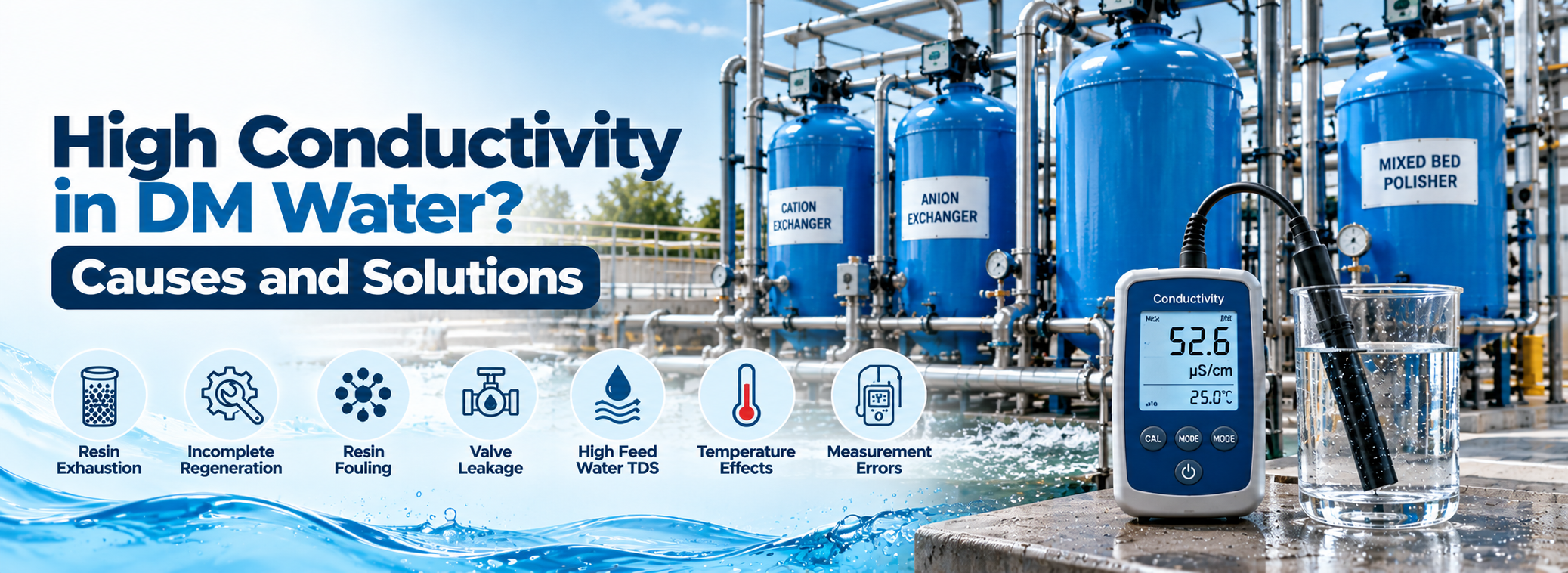
High conductivity in DM water is a common operational problem in industrial demineralization plants. It indicates that the treated water contains more electrically conductive dissolved ions than expected. Common causes include exhausted ion exchange resins, incomplete regeneration, valve leakage, resin contamination, high feed-water loading, and problems with conductivity measurement.
A demineralization (DM) plant removes dissolved ionic impurities from water, usually through cation and anion exchange resins. Some systems also use mixed-bed polishers to achieve higher water purity.
When the DM plant begins producing water with elevated conductivity, it may no longer meet the quality requirements of boilers, process equipment, laboratories, or other industrial applications.
Understanding why conductivity increases helps plant operators identify the affected treatment stage, restore water quality, and prevent recurring problems.
Quick Answer: Why is DM plant water conductivity high?
High conductivity in DM plant outlet water is commonly caused by ion exchange resin exhaustion, inadequate regeneration, internal valve leakage, channeling, resin fouling, or contamination from untreated water. Conductivity may also appear high because of temperature-compensation errors, carbon dioxide, or sampling problems. The correct diagnosis involves checking conductivity at each treatment stage, verifying resin and regeneration performance, and confirming the accuracy of the measuring instruments.
What Is Conductivity in DM Water?
Electrical conductivity measures how easily water carries an electric current. It increases when electrically charged dissolved substances, such as sodium, chloride, calcium, and sulfate ions, are present.
Conductivity is commonly measured in microsiemens per centimetre (µS/cm), typically referenced to 25°C.
A properly functioning DM plant removes most dissolved ions, resulting in low-conductivity water.
What Is the Acceptable Conductivity of DM Water?
There is no single acceptable conductivity value for every DM plant.
The required water quality depends on the application, treatment configuration, and equipment manufacturer’s specifications.
For example, high-purity mixed-bed systems may produce water approaching the theoretical conductivity of pure water, approximately 0.055 µS/cm at 25°C. Conventional two-bed DM systems may produce higher conductivity.
The important requirement is that outlet conductivity remains within the specified limit for the intended application.
What Are the Main Causes of High Conductivity in DM Water?
- Ion Exchange Resin Exhaustion
Ion exchange resins have a limited capacity to remove dissolved ions.
As water passes through the resin beds, exchange sites gradually become occupied. Eventually, ions begin passing into the treated water.
Common signs: Conductivity increases toward the end of a service cycle, or the interval between regenerations becomes shorter.
Recommended solution: Review treated-water quality trends, service volume, and resin capacity. Regenerate the affected resin according to the plant’s operating procedure.
- Improper DM Plant Regeneration
Regeneration restores the ion-removal capacity of exhausted resins using appropriate chemicals.
Incomplete regeneration may occur because of incorrect chemical concentration, insufficient chemical quantity, poor distribution, unsuitable contact time, or inadequate rinsing.
Recommended solution: Verify chemical quality, concentration, dosing quantity, flow, contact time, and rinse completion against the resin manufacturer’s instructions.
Veolia’s industrial water treatment handbook identifies improper regeneration as a major cause of demineralizer performance problems.
Veolia
- Resin Fouling or Degradation
Ion exchange resins may become contaminated by suspended solids, iron, organic matter, or other impurities.
Fouling can reduce effective exchange capacity and make regeneration less efficient.
Resins may also deteriorate because of unsuitable chemical exposure or operating conditions.
Recommended solution: Inspect pretreatment performance, analyze resin condition where necessary, and use resin-compatible cleaning or replacement procedures.
- Internal Valve Leakage and Untreated Water Bypass
A leaking valve can allow untreated or partially treated water to mix with the DM plant outlet.
Possible problems include worn valve seats, faulty seals, incorrect valve sequencing, or an improperly closed bypass.
Recommended solution: Inspect valve positions, seals, and automatic control sequences. Compare conductivity upstream and downstream of suspected leakage points.
- Channeling Inside Resin Beds
Channeling occurs when water passes through preferential pathways instead of flowing uniformly through the resin.
This reduces contact between water and the exchange media.
Potential causes include improper backwashing, poor flow distribution, damaged internals, and unsuitable operating flow rates.
Recommended solution: Check vessel distribution systems, flow conditions, resin bed condition, and backwashing procedures.
- Increased Feed-Water TDS
When feed-water quality changes, the ionic load entering the DM plant may increase.
The resin can become exhausted sooner, even if the treated-water flow remains unchanged.
Recommended solution: Monitor feed-water conductivity, hardness, alkalinity, silica, and relevant dissolved ions. Reassess regeneration frequency based on actual ionic loading.
- Mixed-Bed Resin Exhaustion or Poor Mixing
Mixed-bed polishers contain cation and anion exchange resins that provide additional ion removal.
High outlet conductivity may occur when the resin is exhausted, improperly regenerated, insufficiently mixed after regeneration, or affected by internal leakage.
Recommended solution: Review mixed-bed inlet and outlet conductivity, regeneration records, resin condition, and vessel internals.
- Carbon Dioxide Contamination
Carbon dioxide dissolves in water and forms weakly ionized carbonic acid, which can increase conductivity.
It may enter through contact with air in storage tanks or sampling containers. In some DM configurations, inadequate degassing also increases the load on downstream anion exchange resins.
Recommended solution: Check degasser operation where installed, storage-tank arrangements, and sampling practices.
ASTM conductivity guidance recognizes atmospheric gas absorption as an important source of measurement changes in high-purity water.
Electrical Conductivity and Resistivity of Water
- Inadequate Rinsing After Regeneration
After regeneration, residual acid, caustic, or displaced ions must be rinsed from the resin bed.
If the DM plant returns to service too early, the initial treated water may show high conductivity.
Recommended solution: Continue the specified rinse sequence until outlet quality meets the approved return-to-service criteria.
- Faulty Conductivity Meter or Temperature Compensation
Conductivity instruments require suitable calibration and temperature compensation.
A dirty sensor, incorrect cell constant, damaged cable, or inaccurate temperature reading can produce misleading results.
Recommended solution: Verify the online instrument with an appropriately calibrated reference meter and review its temperature-compensation settings.
DM Plant High Conductivity Troubleshooting Chart
| Observation | Possible cause | Recommended check |
| Conductivity rises near the end of a service cycle | Resin exhaustion | Check service volume and breakthrough trends |
| High conductivity immediately after regeneration | Poor regeneration or insufficient rinsing | Verify chemical dosing and rinse completion |
| Sudden conductivity spike | Valve leakage or bypass | Inspect valve operation and seals |
| Shorter service cycles | Higher feed-water ionic load or resin deterioration | Test feed water and resin condition |
| High conductivity after mixed-bed polishing | Mixed-bed exhaustion or internal problem | Inspect mixed-bed operation |
| Conductivity rises in the storage tank | Contamination or CO₂ absorption | Compare plant outlet and tank samples |
| Online and laboratory readings disagree | Sensor or sampling error | Verify instruments and sample handling |
How to Troubleshoot High Conductivity in a DM Plant
Step 1: Confirm the Conductivity Reading
Verify the online reading with a calibrated instrument.
Use suitable sampling procedures to minimize contamination from air, containers, and sampling lines.
Step 2: Identify Where Conductivity Increases
Measure water quality at appropriate points, such as the feed inlet, cation outlet, anion outlet, mixed-bed outlet, and storage tank.
Interpret intermediate-stage readings according to the plant design. For example, cation exchanger outlet conductivity is not expected to be as low as final DM water conductivity.
Step 3: Review Regeneration Records
Check regenerant concentration, chemical consumption, flow, contact time, and rinsing duration.
Step 4: Examine Resin Performance
Investigate exhaustion, fouling, channeling, resin loss, and changes in exchange capacity.
Step 5: Inspect Valves and Distribution Systems
Check for untreated-water bypass, leaking valves, damaged distributors, and incorrect control sequences.
Step 6: Compare Feed-Water Quality
Review changes in conductivity, hardness, alkalinity, silica, and other relevant feed-water parameters.
Step 7: Check Storage and Distribution
If conductivity is acceptable at the DM plant outlet but increases downstream, investigate storage-tank contamination, piping, and exposure to air.
Conductivity vs Resistivity in DM Water: What Is the Difference?
Conductivity measures the ability of water to carry electrical current, while resistivity measures its resistance to that current.
They are mathematical reciprocals when expressed in compatible units.
\[ \text{Resistivity (M}\Omega\cdot\text{cm)} =\frac{1}{\text{Conductivity (µS/cm)}} \]
Example
If DM water conductivity is 1 µS/cm:
\[ \text{Resistivity}=1\text{ M}\Omega\cdot\text{cm} \]
If conductivity is 0.1 µS/cm:
\[ \text{Resistivity}=10\text{ M}\Omega\cdot\text{cm} \]
Higher resistivity generally indicates lower ionic contamination.
These values must be compared at the same reference temperature.
Why Conductivity Alone Is Not Enough to Check DM Water Quality
Conductivity is useful for monitoring ionic impurities, but it cannot identify every contaminant.
For example, dissolved silica may be present at levels that matter for boiler applications without producing a proportionate conductivity increase.
Therefore, depending on the application, DM water quality monitoring may also require silica, sodium, pH, total organic carbon, or other specific tests.
Veolia’s demineralization guidance highlights the importance of monitoring both conductivity and silica during resin service cycles.
Veolia
How to Prevent High Conductivity in DM Water
- Monitor inlet and outlet conductivity trends.
- Regenerate resins before unacceptable breakthrough occurs.
- Verify chemical concentration and regeneration procedures.
- Maintain effective upstream filtration and pretreatment.
- Inspect automatic valves and distribution systems.
- Evaluate resin condition and replacement requirements.
- Protect treated-water storage from contamination.
- Calibrate conductivity instruments regularly.
- Monitor silica and other application-specific parameters.
- Maintain detailed regeneration and water-quality records.
Frequently Asked Questions About High Conductivity in DM Water
- Why is conductivity high in DM plant outlet water?
Common causes include exhausted resins, improper regeneration, valve leakage, resin fouling, channeling, feed-water changes, and contamination.
- What is the normal conductivity of DM water?
It depends on the plant design and application. High-purity systems may approach 0.055 µS/cm at 25°C, while other DM systems have different specified limits.
- Can exhausted resin increase DM water conductivity?
Yes. Once ion exchange capacity is depleted, dissolved ions begin passing through the resin, increasing outlet conductivity.
- Why is conductivity high after DM plant regeneration?
Possible causes include incomplete regeneration, insufficient rinsing, incorrect chemical dosing, or valve leakage.
- Can carbon dioxide increase DM water conductivity?
Yes. Dissolved CO₂ forms ionized species in water and can increase conductivity, particularly in high-purity water.
- Does high conductivity always mean the resin needs replacement?
No. Regeneration problems, contamination, bypass leakage, or measurement errors can also cause high readings.
- What is the difference between conductivity and TDS?
Conductivity measures electrical conduction caused by dissolved ions. TDS represents the concentration of dissolved substances. Conductivity-based TDS estimates depend on water composition and are less reliable for very high-purity water.
- Can a mixed-bed unit reduce DM water conductivity?
Yes. A properly operated mixed-bed polisher can remove residual ions and produce higher-purity water.
- Why does DM water conductivity increase during storage?
Possible causes include CO₂ absorption from air, contaminated tanks, piping contamination, or mixing with lower-quality water.
- How can I reduce high conductivity in DM water?
Identify the source of ionic contamination, verify regeneration, inspect resin and valves, improve pretreatment, and correct storage or measurement problems.
Conclusion: Maintain DM Water Purity Through Proper Monitoring
High conductivity in DM water can result from resin exhaustion, incomplete regeneration, channeling, valve leakage, feed-water changes, or contamination.
A sudden increase should not automatically lead to resin replacement. Operators should first verify the reading, locate the affected treatment stage, and investigate regeneration and equipment performance.
Regular conductivity monitoring, proper regeneration, resin maintenance, and accurate instrumentation help maintain reliable DM water quality for industrial applications.
Looking for Reliable DM Plant and Industrial Water Treatment Solutions?
Maintaining the required water purity is essential for industrial processes, equipment protection, and consistent operations.
Bluewatt supports industrial water treatment requirements, including demineralization and water purification applications.
Connect with Bluewatt through its official business channels to discuss your DM plant and industrial water treatment needs.